In Catholic doctrine, the stigmata are signs that appear on the body and match the wounds suffered by Christ during his crucifixion. They are said to be preceded and accompanied by physical, ethical, and moral torments that are indelibly associated to the dogma’s foundations. The type of stigmata, ranging from markings and cuts on the wrists and feet (as in the crucifixion), to wounds on the head and the back (because of Christ’s crown of thorns and flagellation), reflect their correspondence with the Passion and signify a person’s active participation in Jesus’ suffering, which raises them to a supposedly inviolable spiritual status.
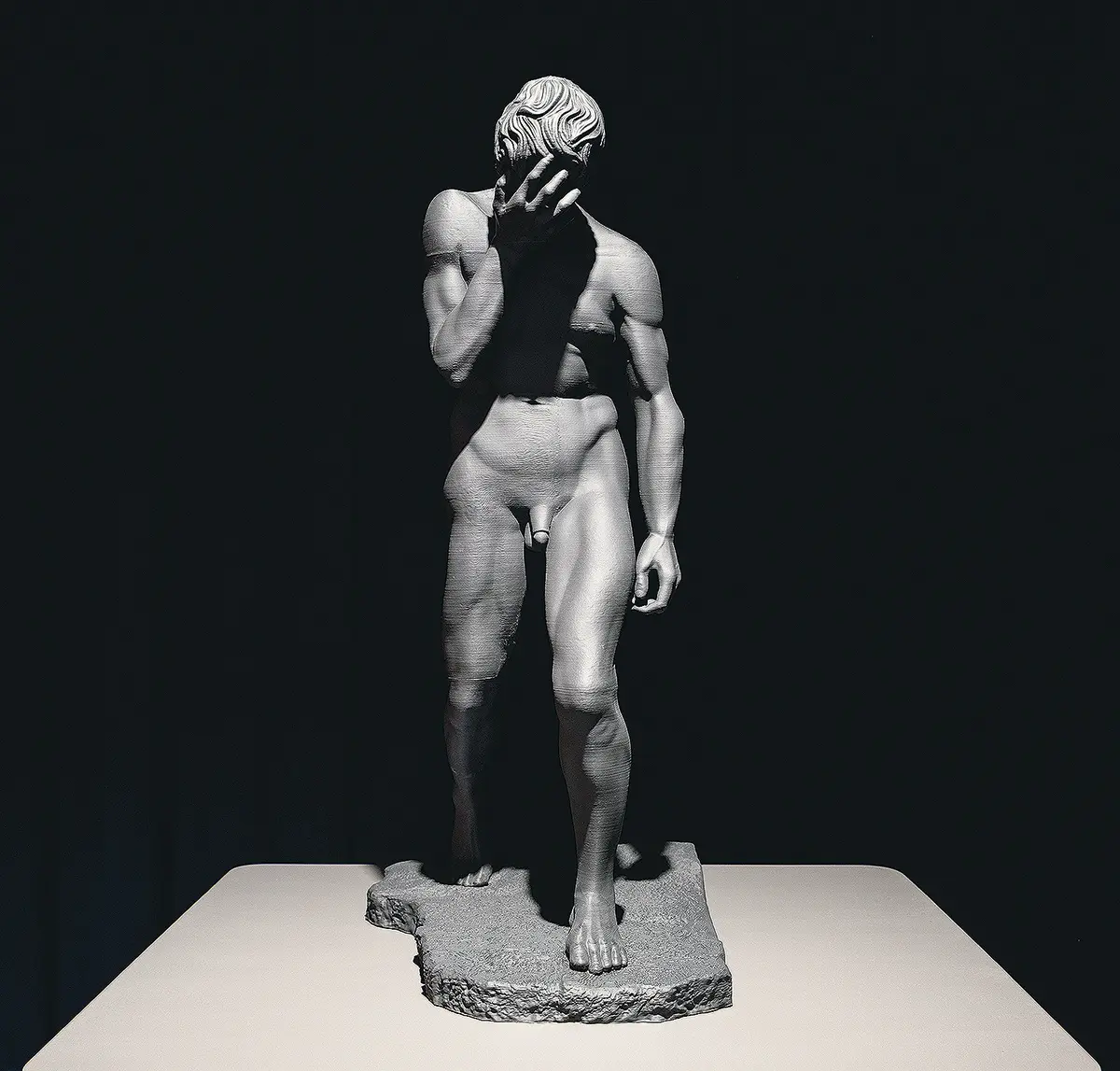
Stigmata, an anthology exhibition of works by Carlos Motta (Bogotá, 1978) focusing on his sexual identity, offers this up as a context for understanding the social realities and the political struggles of the improperly named “sexual minorities”. Anchored by the Hilos de sangre (Blood Threads, 2023), a large-format, far-reaching installation specifically commissioned for this occasion, the show is structured by Motta’s longstanding inquiry into those groups, and sets the installation up as a hinge towards Virosis, a concurrent exhibition featuring works that deal with the HIV/AIDS epidemic in Colombia, prepared by the MAMBO’s curatorial team.
Motta’s work has evolved in two complementary yet autonomous directions. One examines political and social events in Colombia and Latin America, and is part of a wide-ranging exhibition about the origins and possibilities of democracy, and the effects of the Cold War in the region; the other gives voice to representatives of social minorities, who interrogate the dominant historical narrative about sexual and gender identities. In both instances, as well as in their intersection, Motta recovers incidents, signs, and codes that dialogue with current social realities.
The exhibition under review was a signal occasion for discovering or revisiting some of Motta’s most significant works, such as Nefandus (2013), Deseos (Desires, 2015), and Cuerpo cerrado: el trabajo del diablo (Closed Body: The Devil’s Work, 2018), where he explores the legacy of repression to which non-hegemonic bodies and sexual/gender identities have been subjected. Also on exhibit—for the first time in Bogotá—were recent works that expand and deepen Motta’s inquiry, such as When I Leave This World (2022), a two-channel video installation made in collaboration with the trans artist Tiamat Legion Medusa; collaborative work has been a recurrent strategy for Motta throughout his career, as has been the use of his own body and image.
Along with those essential works, the exhibition featured a vast selection of Motta’s photographs, a body of work not often accessible and less well known by the general public, which nevertheless synthesizes and condenses his aesthetic, political, and representational interests. The photographs were displayed in an effective mural format along the double-height walls of the Alejandro Obregón gallery. Motta used photography in his earliest works in order to experiment with gender identities and performativity, but also as a medium for reflections about social issues connected to Colombia’s internal armed conflict, laying the ground for the exhibition’s broad spectrum.
All of the above notwithstanding, the show’s most important contribution may be the already mentioned Hilos de sangre (Blood Threads), where, as in other works based on historical investigation and chronology, Motta and the researcher Pablo Bedoya present a series of significant moments in the relationship between artistic production and the HIV/AIDS epidemic in Colombia. A careful design with clear allusions to blood brings forth the most relevant events in that process, from the early 1980s through the present, accompanied by stories and interviews with some of their protagonists, accessed through intimate-feeling radio booths and with a series of pencil portraits of the interviewees as a connecting thread. As an archive that extends its presence over time beyond the exhibition’s run, the project is available at www.hilosdesangre.com.
In turn, Virosis—also key to Motta’s project and clearly resonant with Hilos de sangre (Blood Threads)—was Colombia’s first group exhibition about the ways in which the HIV/AIDS epidemic impacted artistic production in the country, curated by Eugenio Viola and Juaniko Moreno, and featuring works that are undoubtedly destined to become the anchors of this urgent discussion. Although people who live with the virus have for a long time not been fated to painful, premature deaths (in fact, not even to the risk of propagating the infection), the stigma still attached to the topic in Colombia—including in the public health system, no less—remains a major obstacle.
In Stigmata, Motta challenges the dogmatic framework of Catholicism, so widespread in the region, with an analogy between Christ and his sympathizers, and those who suffer solely because of their sexual and gender identity, bringing into high relief the exclusions, attacks, and stigmatizations to which the latter are subjected. Leaning decidedly into that side of Motta’s production, Stigmata revisited an important group of works that renew the debate around diverse identities in Colombia and, crucially, about the stigmas that still attach to the HIV virus and AIDS.
EMILIANO VALDÉS