In celebration of Bob Schalkwijk’s 90th anniversary, Centro de la Imagen organized two exhibitions focusing on the creative potential in the career of a photographer who settled in Mexico in 1950 and has resided there ever since, with occasional visits to the United States or other countries as required by specific projects. María Calderón and Adriaan Schalkwijk curated and designed De adentro hacia afuera (From the Inside Out), the exhibition presented in the galleries; Gina Rodríguez Hernández created the timeline and, with the photographer, curated De afuera hacia adentro (From the Outside In), an exhibition on Centro de la imagen’s exterior perimeter fence.
This exhibition revisits Schalkwijk’s travels in different parts of the world, in different continents. Among the essential components of this body or work are the singularities of practices and environments explored: crafts, actions of the body to execute a given task, utilitarian yet aesthetic endeavors of a tradition transmitted across generations; the use of available resources in the material culture of tools and objects, and natural locations such as fields and bodies of water, or the spaces and instruments employed in different activities.
All of this can be appreciated in the works on display around Centro de la imagen, as we walk up to the institution and begin our journey into the work of photographer who captures ways of life in localities across such countries as Burma, Ecuador, Brazil, Guatemala, and The Netherlands, among many other in his inexhaustible itinerary [an eloquent work in this section, featuring the everyday life filled with the amiable chattering chats and smiles of a female work environment, even in the midst of a disagreeable labor, is Lavando tripas para embutidos (Cleaning Guts for Sausage-Making, 1970).
Inside the gallery, the exhaustive timeline created by Gina Rodríguez connects a chronological line with informative and emblematic reprographics of works and publications, also from other artists linked to Bob Schalkwijk. For the main exhibit, De adentro hacia afuera (From inside out), María Calderón and Adriaan Schalkwijk decided on a strategy of visual density, the accumulation of a great many images as a museographic tool, in order to account for Schalkwijk’s large volume of works about Mexico over almost 50 years. Other resources used by the curators were contrasting print dimensions, their placement at different heights, and the grouping of period photographs by type of frame, with others in vinyl placed higher.
The exhibition’s landscape node offers sensible itineraries that deploy a human gaze over the natural world and the bodily experience therein, in planes, textures, heights, colors, sunsets, vegetation, clouds that become, thanks to Bob Schalkwijk’s skillfulness, shapes transformed into expressive entities, as in his vista of Playa Balandra (Balandra Beach), La Paz, Baja California Sur, from 1988, which also gives concrete shape to a plot this artist appreciates deeply: traveling, matter with its shapes and colors, nature apprehended from an overhead trajectory.
The theme of Mexico City displays Schalkwijk’s great sensibility for denoting emblematic exemplars of the architecture of different historical periods: Tlatelolco, the Satellite Towers, the Monumento a la Revolución, colonial-era locations, the urban renewal projects undertaken after Mexico City was named the host of the 1968 Olympics, and photography as a chronicle of peoples and practices in all those sites.
The multifaceted character of Schalkwijk’s work is revealed by his sets devoted to construction and industry; with his virtuosic mastery of the photographic, he was able to find formal patterns connecting his commissions focusing on metal, cargo, machinery, pilasters, as in Altos hornos de México (Mexico’s High Ovens), Monclova, Coahuila, from 1975.
In the archeology node, Schalkwijk’s work expanded the interpretation of pre-Columbian architecture to the structures’ communicative potential: ornaments, fretwork, citadels, stairways, lintels, Maya domes, carved serpents [as in Templo Mayor (Grand Temple) and Coatepantli, Zona arqueológica de Tenayuca, (Coatepantli, Tenayuca Archeological Zone), Tlalnepantla, Mexico State, 1964, an intercessor site to Tenochtitlan, today’s Mexico City], documenting Mexico’s indigenous cultural diversity as it materialized in constructions.
Nighttime as an expressive risk is another topic that brings into play the skill of a photographer who sets shutter speeds, diaphragm widths, film types and other variables to dialog with one another, in order to contrast in his shots fireworks, features of buildings under certain light conditions, the greater definition of certain individuals as they wait, enveloped in the visual ambiguity of other elements in motion, as in Avenida Juárez (Juárez Avenue) , Historic Downtown, Mexico City, 1963.
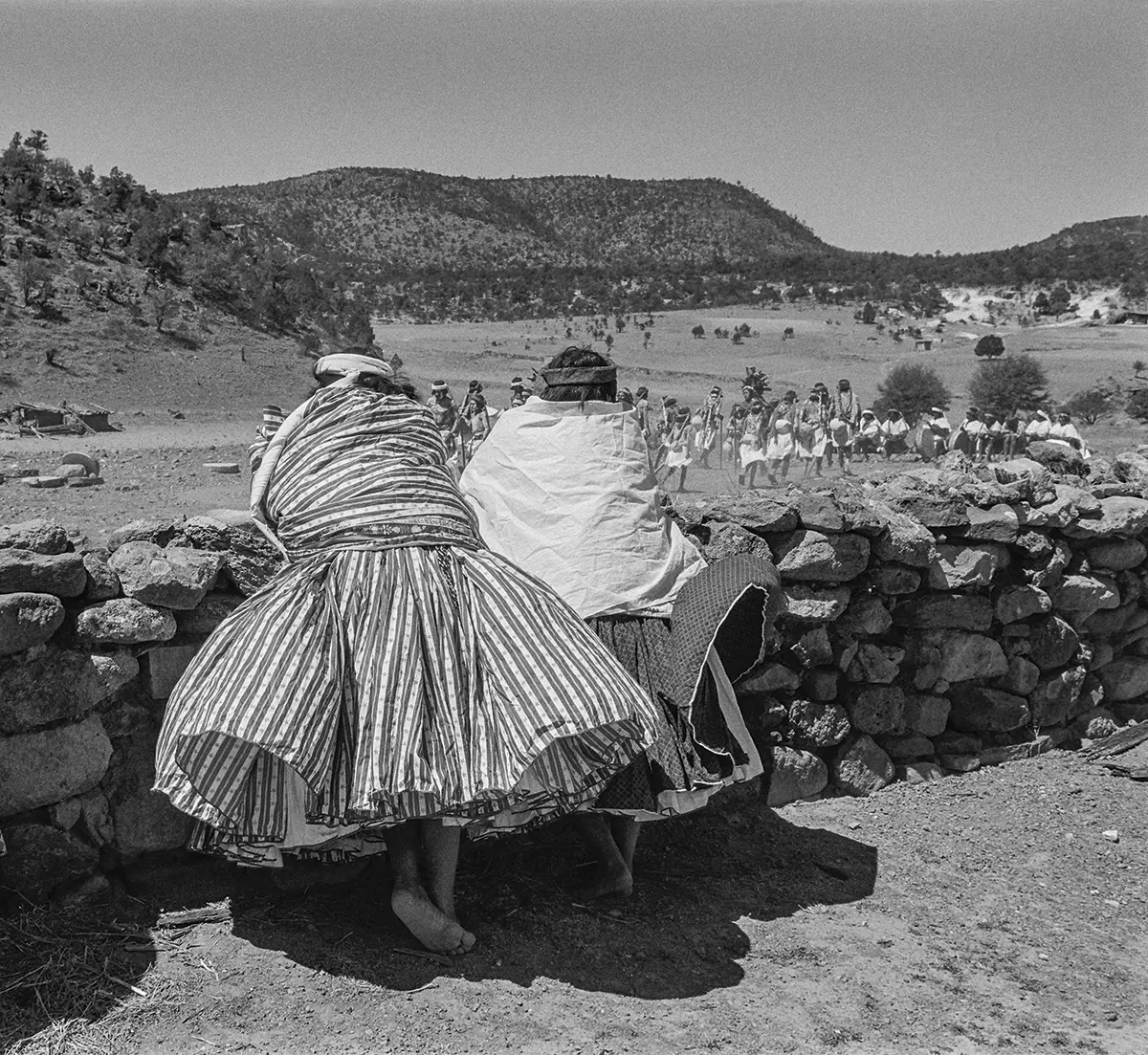
The Rituals node includes works documenting ceremonies in different regions of the country, the cyclical reproduction of local cultures. It also holds something that has been central in Bob Schalkwijk’s work in Mexico. His Semana Santa Ralámuli (Ralámuli Holy Week), Huahuacherare, 1973, is a perfect example: the region as a constant pursuit of discoveries.
The show also covers topics like commerce, with photographs from the artist’s earliest period in the country, such as Mercado de Tlacolula (Tlacolula Market), Oaxaca, from 1959; images of children that calibrate families and contexts; or portraits that denote that which they do not make apparent through the decisions people make about where to be. Bob Schalkwijk has said that he carries multiple cameras and implements with him, thus multiplying his options for shots and fostering the expansion of his by now immense archive, currently under organization in order to provide access and vitality to the materials. An archive that continues to incorporate everything that the photographer persists in producing.
EUGENIA MACÍAS