Bárbara Brändli (Switzerland, 1932–Venezuela, 2011) is a legendary figure in the construction of the ancestral imaginary of indigenous peoples in Venezuela, from a perspective that connects the most elevated aesthetic gaze with the deepest sense of anthropological investigation. In her youth, in Geneva, Brändli trained in classical ballet; later, in Paris, she had a career as a high-fashion model. Through these activities, dance and modeling, a profound attraction for the human body in motion took root inside her, which drove her to photography as a professional activity. This is why the body is present in her work as an essential musculature, in series devoted to dance, the theater, urban life, and ancestral peoples. Brändli is a cult figure among specialists because of her original approach to the details of life among the Makiritare, Sanemá and Yanomami peoples, their belief systems, rituals, and activities. She grew close to their cultures and appreciated their dignity, which she advocated for with rigor and respect. Her photographs reflect the primordial drive of creation myths, and even if she was nor especially interested in mythology, she understood it as a part a community’s life through which its view of reality could be approached. Brändli saw the significance of myths among those cultures as a process that goes beyond the creation narratives repeated generation after generation, to become expression and substance of an entire spiritual universe, manifest in cosmogonies, worldviews, and visions of life. The Sun and the Moon, celestial bodies connected to the people’s visions and cyclical experiences of time, were Brändli’s guide to connect with life on an earthlier plane. This is why she chose Los hijos de la Luna (Children of the Moon) as the title of her 1974 book of indigenista photographs, which are included in this exhibition. It expresses the way in which the artist starts with myth as an initial human elaboration, and combines it with archetypical elements that, thanks to ritual, become part of reality.
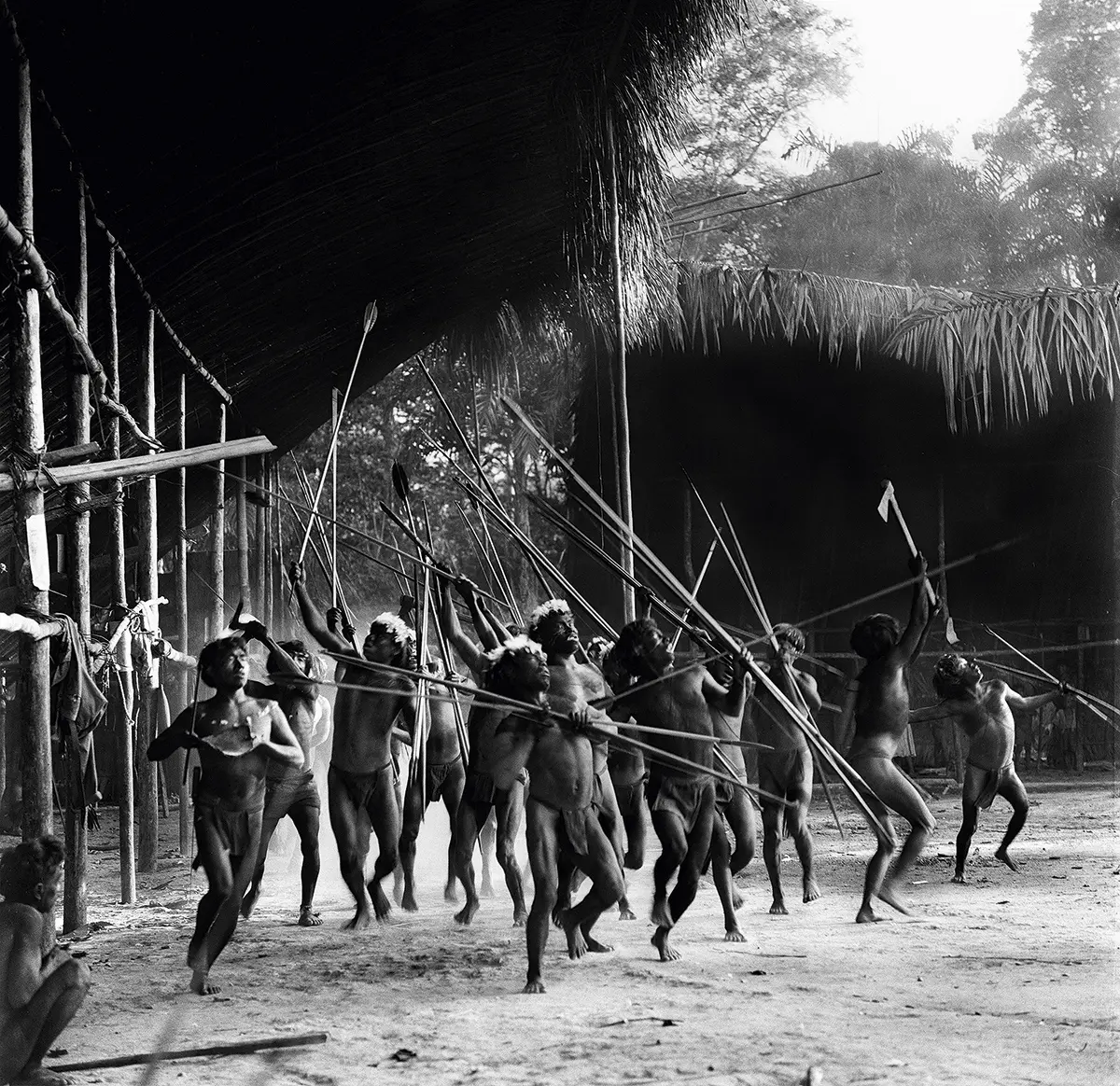
In the exhibition we encounter memorable images like Niño sanemá. Kanarakuni (Sanemá. Kanarakuni Child, Alto Caura region, state of Bolívar, Venezuela, 1964), which has become part of Venezuela’s visual imagination and exemplifies the aesthetic power of Brändli’s language with a single face on a black ground, she shot her photographs mostly at night, generating an interesting, darkened light. Other photographs, like Comunidad yanomami de Mavaca (Mavaca Yanomami Community, Alto Orinoco region, state of Amazonas, Venezuela, 1965); Baile del pijiguao en la comunidad yanomami de Mavaca (Dance of the Pijiguao in the Mavaca Yanomami Community, Alto Orinoco region, state of Amazonas, Venezuela, 1965); Jóvenes yanomamis (Yanomami Youths, Mavaca, Alto Orinoco region, state of Amazonas, Venezuela, 1965), or Niños sanemás, Alto Caura region, state of Bolívar, Venezuela, 1964), reveal the interest in dance that motivated Brändli since early on, and achieve a discourse that go from the sacramental ritual to the enjoyment of the body. These images had never been seen before. Before Brändli, we did not have this view of Venezuela’s indigenous peoples. Hers is not a mere record or reportage, but a complex aesthetic construction of a world of difference, and this constructive power is the main curatorial statement put forward by María Teresa Boulton and Johanna Pérez Daza, who produced both a re-reading of the work and an homage to Brändli and to the communities to whom she devoted part of her work. The exhibition focuses on key concepts from a perspective that encompasses several development modes. The solution is an audacious yet never gimmicky arrangement bringing together videos, contact sheets, and photographs with images from the James Webb telescope’s astronomical investigations, all of it accompanied by an electronic score composed and sung by Andrea Ludovic and the mezzosoprano Janis Denis, who provide a contemporary context for those original sources and feelings. This makes it possible to connect the indigenous creation mythology with the origin of our universe, accompanied by the creation of earthly archetypes. We are presented with a bold decision to reach beyond the photographs and the physical characteristics of their indigenous subjects, into their spirituality, their mythology, their view of the cosmos, which in some way involves a consideration of the universe and its connection with ancestral traditions, beliefs, and cultures. Thanks to the music and to the images of recent scientific inquiries into outer space, viewers are able to imagine a spiritual alliance between ancient indigenous cultures and contemporary cosmology. The idea is to bring us inside the cosmic context of both temporalities (the ancestral and the contemporary), as though seeing the cosmos for the first time through Yanomami or Sanemá eyes. The synthesis of a universe that rethinks and joins the past with the present is generated in that way, contemplating a complex ancestral legacy in order to make us open to an equally complex future.
Orígenes y originarios (Origins and Originals) is a significant contribution to the diffusion of Bárbara Brändli’s work, still not widely known. It provides a stimulus for further investigation of the various registers of her oeuvre, such as those related to dance and the theater, as well as the urban focus of two publications that situate her as a pioneer of the Latin American photo-book: Duraciones visuales (Visual Durations, 1963) and Sistema nervioso (Nervous System, 1975). Above all, this exhibition posits interesting questions about the possibility that mythical narratives and ritual images bring forth a certain knowledge of the universe and provides alternative pathways for studying the ancestral alongside the most recent discoveries.
MARÍA LUZ CÁRDENAS