The body has been a topic of sustained interest for Colombia-based Spanish artist Aurora Lario, who exhibited her most recent productions at the gallery El Museo, in Bogotá. Not just the human body as such, but the body in terms of its relationship with other living and organic beings who, like it, change over time.
The basic postulate of biology, which observes a being’s states as birth, growth, and death, can be read as a constant in Lario’s work, for example in earlier series such as Láudano (Laudanum), Gineceo (Gynoecium), and Equipaje animal (Animal Baggage). Flowers, dogs, and humans fuse into a single language by means of symbols that refer to time, to life, to consciousness, and to relations between species. This can also be seen in her recent show.
The use of color has also been a distinctive characteristic of Lario’s series, as in the case of Gineceo (Gynoecium), where red hues suggest the power of nature and tend towards an exaltation of form. There are also allusions to sensuality, to exuberance, and to fertility; ultimately, to aspects that signal an explosion of vitality.
The use of primary colors both in the outline of figures and in the background was common in those earlier series, which made the body the protagonist and rendered the location indeterminate. In Paisaje animal (Animal Landscape), however, the value of nature is for the first time both contextual and definitional.
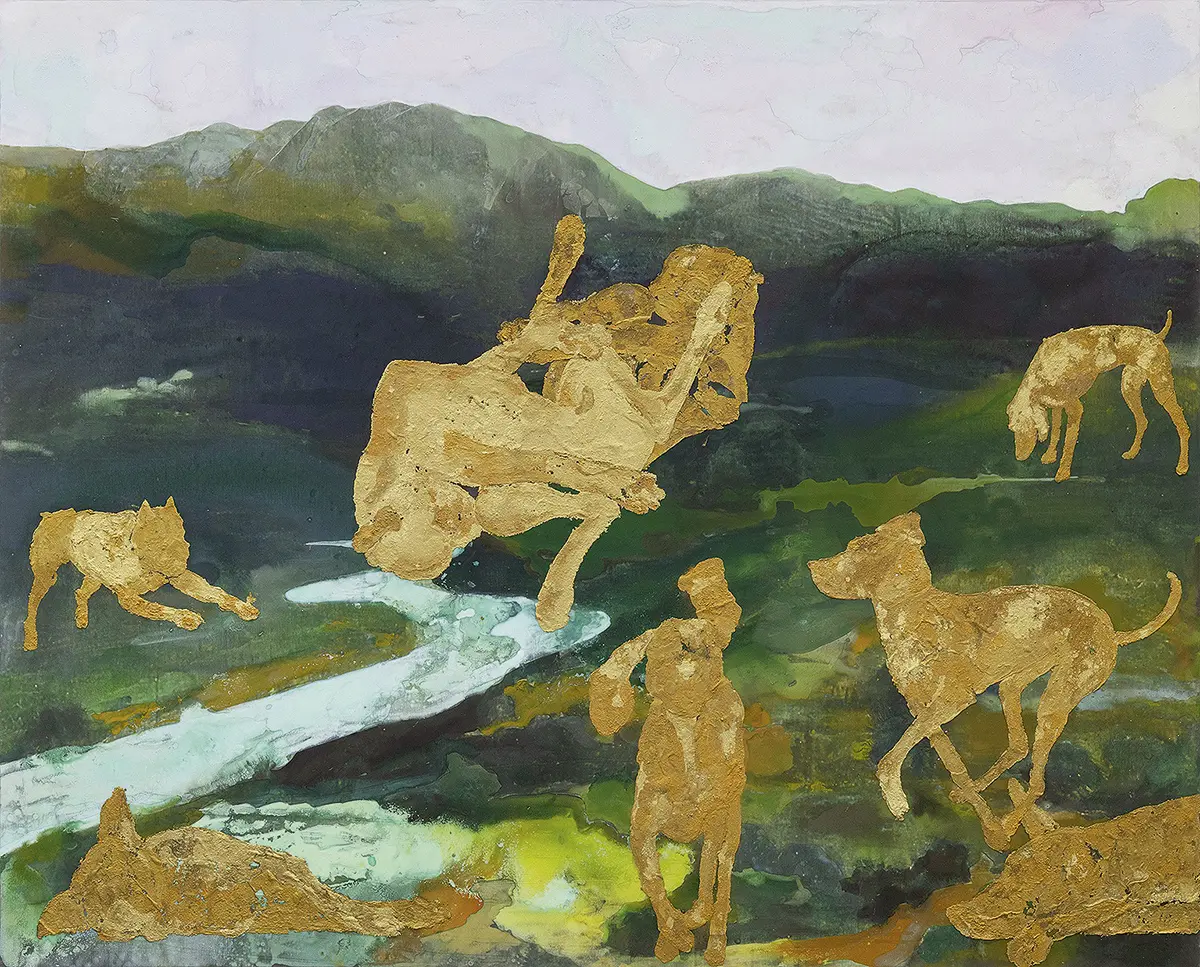
It must be noted that, as the artist has said, these spaces are of a fantastical nature, evoking Dutch Renaissance paintings from the fifteenth and sixteenth centuries, where gilded dogs can be seen jumping up and down seemingly with joy. Interestingly, the way in which Lario paints these landscapes suggests an appropriation of episodes from the European Renaissance and Baroque periods. These are landscapes that present themselves as surrounding and enveloping, but not overbearing; they become environments and contexts, but not “subjects” of contemplation. In consequence, they work well as the stage for the protagonists of Lario’s recent works: the dogs.
Dogs had already appeared in Lario’s Fauna series, from 1997, but this time around they transmit emotion and joyfulness, perhaps because of their freedom or for the recognition they enjoy as central figures rather than, as in other instances throughout the history of art, mere companions, accessories, or complements.
“In recent years, dogs have gained a large presence in our lives, in the lives of many people and families,” Lario says. “I wanted to go back to landscapes. I had not done with sufficient intensity in my work. So, I decided to reengage with the landscape and to introduce the dog.” She first paints those golden dogs using pigments, then detaches and relocates them to natural scenery, like a collage. In that way, the dogs are superimposed, some even crack during their transfer from the original surface to the final painting.
Left there intentionally, those cracks underscore the harshness of life and signal a desire not to idealize nature, the notion that perfection is not something natural but only an idea. Which does not mean that imperfection results in an absence of beauty: the opposite is true.
Perhaps the dogs’ “scars” refer to the marks and traces left by the passage of life, which make beauty possible. In any case, they increase the mysteriousness of Lario’s works.
That enigmatic quality present in most of Aurora Lario’s oeuvre, characterized by not being entirely readable at first glance. This is because the figures (including in her sculptures) not only are what they are in themselves, but also function symbolically, which, in a sense, moves them in the direction of the unconscious.
When Lario shows nature and exuberance (and, in some instances, religion), she is talking about themes rooted in the human soul and in the unconscious, and it is at that level that they have their greatest impact. That nature, those dogs, are not only representations of beings imagined by the artist (or by the viewer), but can also be understood as the apparition of the natural and animal forces that inhabit her and our unconscious.
A triple reading is possible, then: the works in themselves (technique, form, the art history they connect with); what they represent for us at the conscious level (the memory of a given dog or landscape, the allusion to a given historical period); what they set in motion in what we call the unconscious, which we all possess but can never be grasped, only accessed momentarily by means of works of art like Aurora Lario’s.
NELLY PEÑARANDA