
To speak of Artur Lescher in an exhibition like “Celestial Nouns” is to speak of Neo-Concrete art’s mid- and late- twentieth century irruption onto the Latin American artistic landscape. It is also to speak of the way in which, in post-WWII Latin America, the field of artistic production registered aesthetic positions fundamentally dominated by abstraction, in its diverse variants: geometric, lyrical, constructivist. Between them, an abstract tradition of sorts was forged as a mark of identity for the region’s project of artistic and cultural modernity in the second half of the twentieth century.
Concrete art was no exception. Intellectually, it swims the same waters as Geometric Abstraction; like the latter, it understands art as a process of the rationalization of life mediated by productivity and consumption, which in turn are conditioned by capitalist finance and capitalist firms. Seen in that light, the parallels between Concrete art and Futurism are no mere coincidence: both built their imaginaries on a mechanistic epistemological model in which human senses, human bodies, could be assimilated to machines.
Neo-Concrete art, in turn, is a reaction to the dominion exerted by Geometric Abstraction, and in that sense, it is also a reaction to Concrete art, inasmuch as it salvages a less rationalistic sphere of the historical, early-twentieth century avant-garde. This is to say, a vocation for sensibility and a closer interaction between artwork and audience, introducing, as part of a demand for greater reality, the halo of the everyday.
All of the above is on view in Celestial Nouns, an exhibition of works by Artur Lescher (Brazil, 1962), where viewers are induced to enter a space studded with works that scatter spatiotemporal structures. The installative sculpture 5120 Tango, from 2022, comprises three objects whose shapes resemble solid cones floating in the air, but also suggest some kind of elongated droplets. These objects are situated in the gallery at a distance from one another and at different heights, in some instances at floor level and in others at a certain elevation, so that viewers must look up and then down as they walk around the exhibit. The objects can be touched, and with our touch, however subtle, the elongated droplets begin to sway and play with the dimensions of the exhibition space.
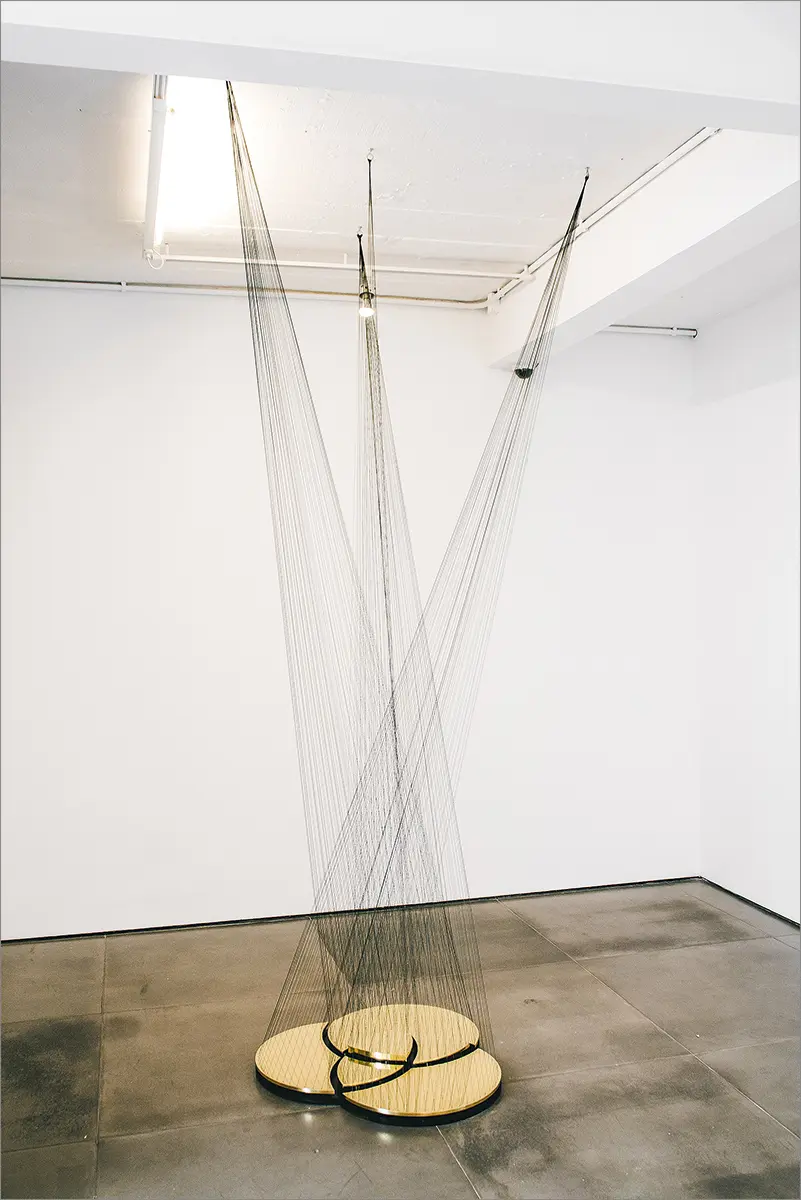
Inverso do infinito (The Inverse of the Infinite), from 2020, is the show’s other centerpiece. Like 5120 Tango, it is an installation sculpture, but presents different morphological characteristics. While the former is an expanded sculpture that unfolds in space by demarcating it with its horizontals and its verticals, Inverso do infinito (The Inverse of the Infinite) is more compact and vertical. It resembles a kind of center with three conical columns anchored in their extremes to the gallery ceiling, projecting upwards from a base of three interconnected circular pieces. Made with thread, the three columns are transparent and also play with the spatiotemporal dimensions of the gallery.
Both Inverso do infinito (The Inverse of the Infinite) and 5120 Tango are installations of objects that acquire an aerial character in their articulation. While sharing a certain taste for geometry, they keep it at a distance: their shapes do not correspond to Geometric Abstraction’s pure forms, but are instead shapes-objects with undifferentiated features; it is on that degree of formal indistinction, of imprecision, that their sensuality really resides. To play with and delight in perception, in touch, in light, rather than analysis and rationalization: therein lies one of the conditions of Neo-Concretism. It fosters sensorial interactions between artwork and viewer, enveloping the experience in a sensorial “aura of everydayness” that enhances it as a real experience.
Lescher’s Neo-Concretism, the aesthetization of his objects, suggests a relationship between art and design, manifest in the element of expansiveness, in the theatricality of his more installative works, and also in his approach to the artwork-viewer interaction noted above. That interaction, however, no longer comes from a perspective that sees it as immersed in immediate social imperatives, this is to say, one where the immediate or the historical, everyday life as such, would function as a background; rather, it unfolds in search of new sensorial experiences. That’s where design reigns in Lescher’s Neo-Concrete art: the visual delight produced and transmitted by the exquisiteness of his shapes and finishes breathes the sense of comfort of a high-design interior. In that sense, these works promote sensualistic reception as a way to break with the cerebral, mechanistic, rationalistic aspects of Concrete art, and also with Geometric Abstraction.
DENNYS MATOS