Nunu Fine Art, established in Taipei since 2014, opened its new New York location in April of 2023; the inaugural exhibition was Reverse, by the Cuban artists Ariamna Contino and Alex Hernández-Dueñas. The show featured multimedia works resulting from a cross-sectional investigation that combines ethnographic tools, sociology, and the statistics-informed production of scientific data. These explorations and intersections make reference to the ideas behind one branch of Concrete art in Argentina, the “Asociación Arte Concreto-Invención”, as published in the Manifiesto Invencionista (Inventionist Manifesto) of 1946:1 “The artistic era of representational fictions comes to an end. Man becomes more and more insensitive to illusory images. This is to say, he progresses in his integration into the world. The old phantasmagorias no longer satisfy the new man’s aesthetic desires, shaped by a reality that demands his total, unreserved presence.”
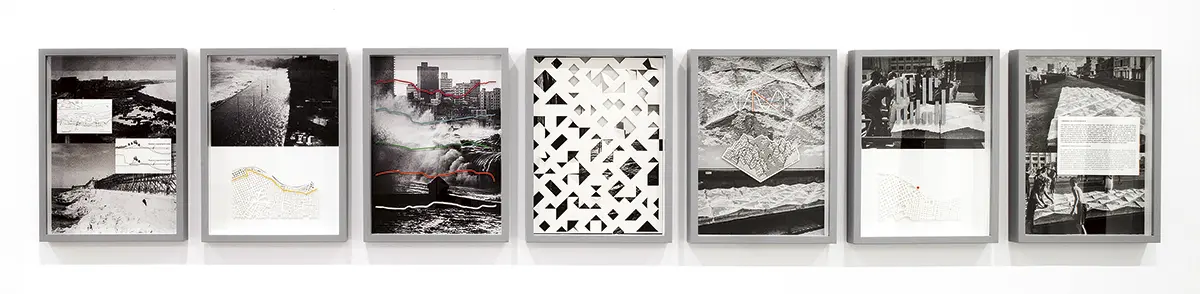
In that sense, the exhibition at Nunu Gallery can be conceptualized as “total cartography” where the landscape is read through the lens of a critical interest on the use of scientific information in order to introduce hard data into it. Hernández and Contino use those sources to generate artistic documents; these documents are a physical and symbolic record of the ways in which human beings intervene and transform environments. In particular, they are a record of the ways in which, historically, the variable of science has mediated the relationship between nature and social structure.
Both Alex Hernández and Ariamna Contino studied graphic art at the Escuela de Artes de La Habana. Contino comes from family for whom the graphic arts are a constant presence: her father was an experienced printmaker who taught several generations in the Cuban capital. Initially, both Hernández and Contino were interested in the ways in which statistics can produce an abstract graphic, which allowed them to position that image on a geopolitical map in order to reconnect the statistics with concrete social issues. Soon, however, their methodology shifted, as they became interested in producing statistical sources of their own; they now employ ethnographic or sociological tools, such as surveys, interviews, and mapping, contrast their results with other sources, and transfer them into the field of art through the production of concrete images directly related to the data obtained.
The exhibition comprises works were abstraction is linked to data about specific events in the global water cycle. In the series Specter, Hernández printed images of glaciers on 100% cotton Hahnemühle paper; the images refer to research into the ice melting caused by global warming over several years. Superimposed on these images are hand-cut glass silhouettes of shapes based on statistic data about time and ice loss. In Militancy Aesthetic, a series produced collectively by the duo, we see landscapes based on statistical data that highlight the overlap between international politics and environmental change. For example, the conflict between countries surrounding Antarctica over “so-called natural resources”, or a representation of Havana’s coastline as documented over the course of three years, the images reflecting both floods and diminishing water levels. The exhibition also includes a series of works by Contino that use multiple layers of cut paper. In contrast with the earlier images, where Hernández’s layers of glass refer to ice melting in Antarctica, Contino’s landscapes point to the use of layers of information, reminding us that statistics require reading; image and text combine to create a landscape like an extended map visualizing nature as a resource.
Like the gypsy man who lifted a blanket to reveal the block of ice that dazzled José Arcadio Buendía,2 Contino and Hernández present us with an artifice of surprising technological and scientific complexity. In Reverse, the installation from which the exhibition takes its title, a reverse osmosis filter mechanism purifies sea water into potable water that can be used to make ice, a synthesis that allows us to visualize, artificially, a cycle that takes place constantly in nature. In this case, the information captured refers to the physical, natural, and cultural aspects involved in the construction of our concept of the landscape. Visually, this work puts us in mind of Alicia Barney’s Estratificación de un basurero utópico (Stratification of an Utopian Dump,1987), where a landscape is built using collected materials. Both in Reverse and in Barney’s installation, the landscape as human construction and as social problem emerges from a series of decisions that produce an image free from phantasmagorias, an image that comes close to the concrete realities of the catastrophe we face as a species and as a civilization. The Manifiesto Invencionista (Inventionist Manifesto) called for a “scientific aesthetic” that renounced representation. Beauty and tragedy converge in this exhibition; Alex Hernández and Ariamna Contino use scientific data as their source, and then, paradoxically, use the abstract representation of this data as a basis to build concrete artworks that confront us with the imminent climate reality we have produced.
NOTES
1. Manifiesto Invencionista. Published on the occasion of the first group show at Salón Peuser, March, 1946. Arte Concreto Invención journal, August 1946, Buenos Aires, p. 8.
2. Gabriel García Márquez, One Hundred Years of Solitude. USA Pub Co Inc.
YOHANNA M. ROA