The work of Argelia Bravo has seldom been exhibited in Colombia, and I’m not exaggerating when I say that her recent show at DC, curated by Elías Doria, is the country’s first adequate recognition of her work. Faced with the challenge of presenting the work of an artist with a long career behind her without giving in to the retrospective temptation (an impossible task), the curator selected works and processes from the project Arte social por las trochas. Hecho a patá, palo y kunfú (Social Art Through the By-Paths. Done with Kicks, Canings and Kung-Fu), which features “installations, videos, objects, photographs, and dermocopies created between 2004 and 2009”.1 These are works “mostly focused on the figure and the habitat of a transgender woman named Yahaira Bravo Marcano,” a sex worker deprived of all rights and forced to ply her trade in the streets of Caracas, subject to all manner of dangers and aggressions. The Bogotá curator’s choice of content was appropriately in sync with the city’s growing interest in diversity, sexual and otherwise.
Bravo has always positioned herself against exclusion (of women, of femaleness in general, and more recently of the transgender) and has repeatedly expressed discomfort with the normative character of epistemological disciplines and modes of knowledge. She describes herself as an “informal social researcher” who is in favor of indiscipline, promiscuity—not in a literal sense, but in the sense of being diverse and not exclusively faithful to any one theory or methodology—and informality, combining activism, ethnography, forensic practices, and an agile appropriation of art history. This is encompassed by the notion of “Evidence Art”, in her own words, the “opening up, from the platform of art, of an undisciplined by-path.” Using video interviews, maps, and evidence-gathering procedures, Bravo reconstructed a map of Yahaira’s body, marked by many kinds of wounds. The traces of her scars, obtained through a dactyloscopy process that the artist calls “dermocopy” and printed on criminology sheets, along with descriptive details such as Arte evidencia 1. Inventario de un itinerario corporal (Evidence Art 1. Inventory of a Bodily Itinerary), presented viewers with an inconceivable catalog of aggressions: from bullet wounds, stabbings, and other damage caused by penetrating and cutting objects, to burns and dog bites.
Shifted in scale and mapped onto the location in the city where each violent event took place, those traces revealed the cartography of a war zone of sorts, in a city that has damned itself to a politics of death [Arte evidencia 3. Cartografía de una historia interminable (Evidence Art3. Cartography of a Never-Ending story)].
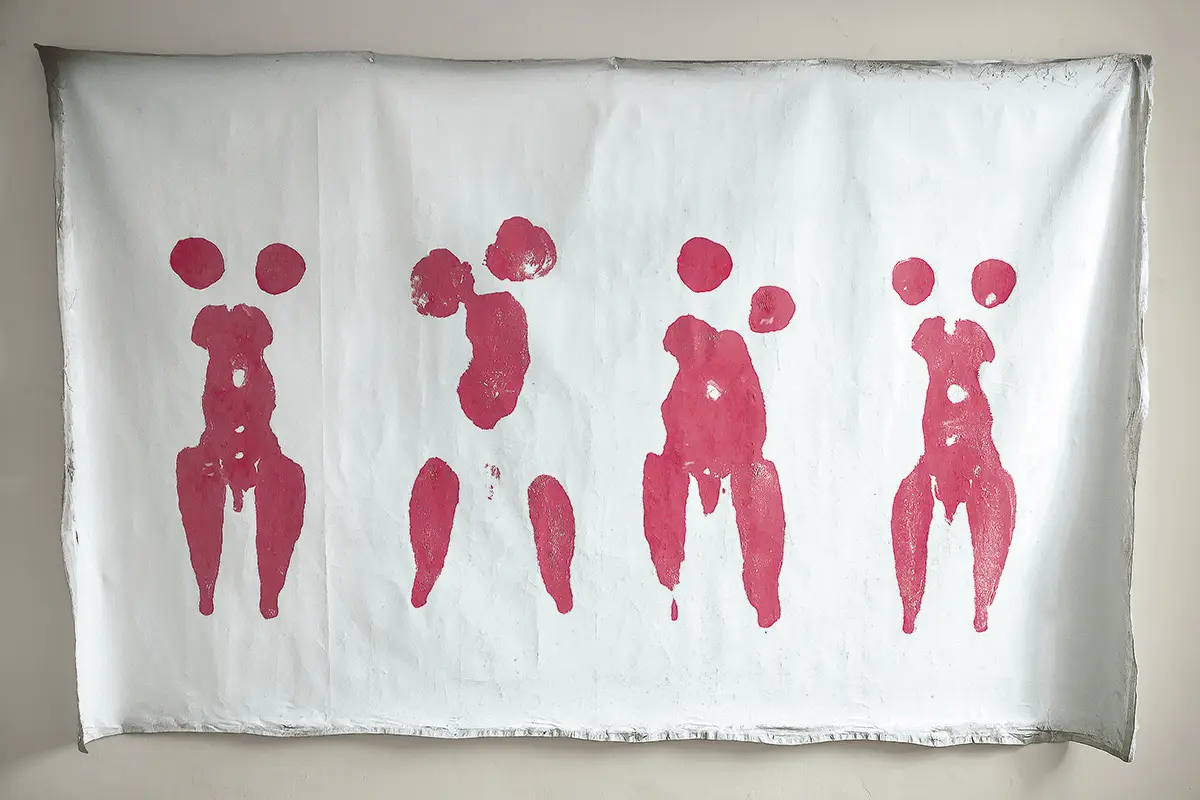
A second group of works belonged to the series Rosado Bravo (a title that can be translated as “Furious Pink”, but also “Bravo Pink”, in reference to the artist who created it; both meanings are present in the Spanish). This group included a video of the performance of that title at the 20th Havana Biennial in 2009, where, emulating Yves Klein and his Anthropometry of the Blue Period, Bravo applied a pigment of her own invention onto the bodies of two women to produce imprints on a white linen while a group of musicians played, as Klein did in 1960. Unlike the French artist’s, however, Bravo’s performance was animated and revealing. She covered the women’s bodies with a pink hue of her own creation, dubbed “Rosado Bravo, arrecho y enfurecido” (Bravo Pink, Furious and Irate), and had them press their humanity onto the white canvas; at one point, unplanned, the women surrounded and embraced the artist, leaving their imprint on the front and back of her suit. In lieu of Klein’s Monotone Symphony played by classical musicians—all men—and consisting on a single sustained note, Bravo was accompanied by four Cuban percussionists, all women, playing the batá drums characteristic of the Yoruba religion in honor of its female deities of water, Oshun and Yemayá. It was a magnificent gesture of Caribbean, Maroon appropriation, transgressive and irreverent, an assertive acknowledgment of the African roots that have survived the West, and a celebration of the body, sexuality, and diversity. This was no longer the Anthropometry of the Blue Period, but pink bodies leaving traces of their torsos, thighs, and penises on a canvas. As Klein—whom it would be erroneous to see as diametrically opposed to Bravo—said when he made his imprints: “We do not hold any right of possession over life itself. It is only as we take possession of sensibility that we can acquire life. Sensibility allows us to pursue life at the level of its material manifestations. Transported by imagination, we touch life, a life that is absolute art itself.”
Also included in the exhibition were graphic reproductions of the artist’s fingerprints, both in pink and black, and several exemplars of her Rosado Bravo, arrecho y enfurecido (Bravo Pink, Furious and Irate) pigment in bottles with labels that read: “Ideal for all types of skin. Shake well before using. Dilute in water. Apply against: discrimination, exclusion, marginalization, segregation, intolerance, transphobia, homophobia, phallocentrism, eurocentrism, androcentrism, heterosexism, xenophobia, classism, ethnocentrism, and racism.”
Argelia Bravo: En márgenes (Argelia Bravo: In Margins) resonated with the spirit of other exhibitions presented in Bogotá, intent on speaking openly about topics still shrouded in prejudice. Among those are Carlos Motta’s Stigmata, at MAMBO, which included a historical overview of HIV/AIDS in Colombia, and Iván Navarro’s Para vírgenes y niños (For Virgins and Children), at Sketch, dealing with the delicate issue of abortion. Lastly, it must be noted that Bravo’s presence in Bogotá provided an opportunity for actions at the Castillo de las Artes and for a conference with the biologist Brigitte Baptiste and Manuel Velandia, a pioneering LGTBI activist in Colombia.
NOTE
1. Félix Suazo, “Argelia Bravo.” ArtNexus 77, 2010.
SANTIAGO RUEDA FAJARDO