This year marks the fiftieth anniversary of M3X3, a pioneering work of video-dance by the choreographer and visual artist Analívia Cordeiro (São Paulo, 1954). It may sound minor, but the fact is that in the intervening five decades we have gone from a few early attempts to bring together bodily motion and computer technology, to a present day dominated by artificial intelligence and NFTs. In this race across time, Cordeiro’s work is a key precursor of the application of such techniques to artistic creation. Cordeiro was barely 19 years old when she made the iconic work mentioned above, using resources culled from computer programming and electronics. An Architecture school graduate who had also trained as a dancer since the age of seven, she began to experiment with the body in motion and its translation into binary systems and mathematics in the early 1970s.
Corpografías (Corpographs), at Centro Atlántico de Arte Moderno (CAAM) in Las Palmas de Gran Canaria, is the first in-depth, wide-ranging exhibition of Cordeiro’s work in Spain. Curated by Claudia Giannetti, a technology and media arts specialist, the show’s span extended from the artist’s beginnings in 1971 through 2022, and provided a confirmation of how current Cordeiro’s exploration of the body remains. Conceptually organized around two themes, the poetics of motion and the architectures of motion, Corpografías (Corpographs) presented the works inside the gallery, disentangling the research process behind the artist’s video art works and the formal result of each of her studies.
This exhibition is also an apt vindication of Analívia Cordeiro as a trailblazing female artist, connecting her explorations with the larger feminist field that was beginning to investigate the body in the 1970s, but also with the earliest attempts to work with the relationship between bodies and computers in places like the Centro de Cálculo de la Universidad de Madrid. A nascent interest in technology and numerical systems opened a new line of work for artists situated in different countries, from a variety of points of view. But Corpografías (Corpographs) went well beyond a merely historical interest and included more recent works by Cordeiro, some of which use the motions of the body as a basis for creating 3D-printed sculptures, as well as a number of installations arranged throughout the exhibition space that invited audiences to interact with a motion detector, to move, and to participate with their own bodies in the work of art.
The exhibition is part of a broader effort on the part of CAAM to showcase female artists (as a programming axis established by its director, Orlando Brito), as well as a set of actions intended not only to comply with a code of good practices in the visual arts, but to have gender equity as a transversal pillar across the entire program. At the same time, Corpografías (Corpographs) is an entry in the CAAM’s ongoing inquiry into dance and its presence in museum spaces, which started two years ago with Dance?, an exhibition curated by Gabriel Hernández that already featured a video work by Cordeiro.
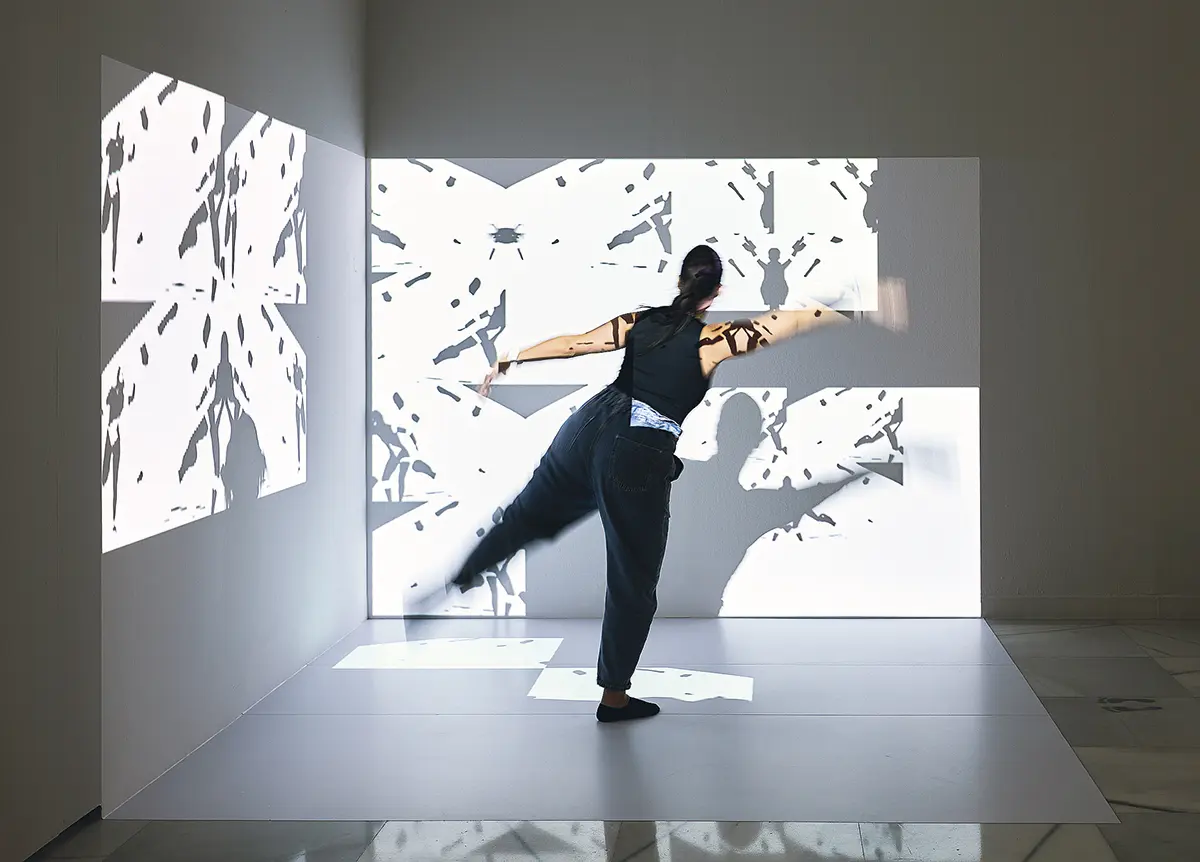
Unfolding across several exhibition spaces inside the CAAM, Corpografías (Corpographs) offered a good sampling of the artist’s work over these five decades, formalized in videos, participatory installations, sculptures, a downloadable mobile application, documentations of Cordeiro’s process (such as sketches and historical drawings), and photographs and portraits by Brazilian photographer Bob Wolfenson.
A balance between body, motion, and media art (three things that exploded in the 1970s) is not easy to achieve. Analívia Cordeiro has been able to set them in harmonious dialogue, and has done so with a conceptual bent nourished by Concretism and the importance of the linguistic turn (similarly imbued with mathematics). This exhibition brought forth the vitality of a pioneering investigation that remains wholly current, one where bodies and their relationship to the digital are subject for debate. Analívia Cordeiro expanded the concept of dance and brought it into new media in the 1970s, and continues to do so today. Ably put together, painstaking in its presentation of a lifelong dedication to artistic creativity and a fully active present, Corpografías (Corpographs) confirms it. The one regret is that this is only the first in-depth approach to Cordeiro’s oeuvre by a Spanish museum; we can only hope that many others follow its lead, since, even beyond the fascinating surprises that it holds, Corpografías (Corpographs) makes it clear that many of the questions we have today can be answered by works that already exist.
SEMÍRAMIS GONZÁLEZ