The unparalleled quality of Brazilian Constructivism can be verified by its continuous presence in history. As a confluence of politics and national aesthetics since the 1950s, its tradition reverberates into contemporary times, embodied by figures of great aesthetic strength such as Bahian artist Almandrade. He presented his recent work in the solo show titled Almandrade hoje: o enigma do traço e da forma, da letra e da palavra (Almandrade Today: The Enigma of Trace and Shape, of Letters and Words) at Galeria Raquel Arnaud in São Paulo.
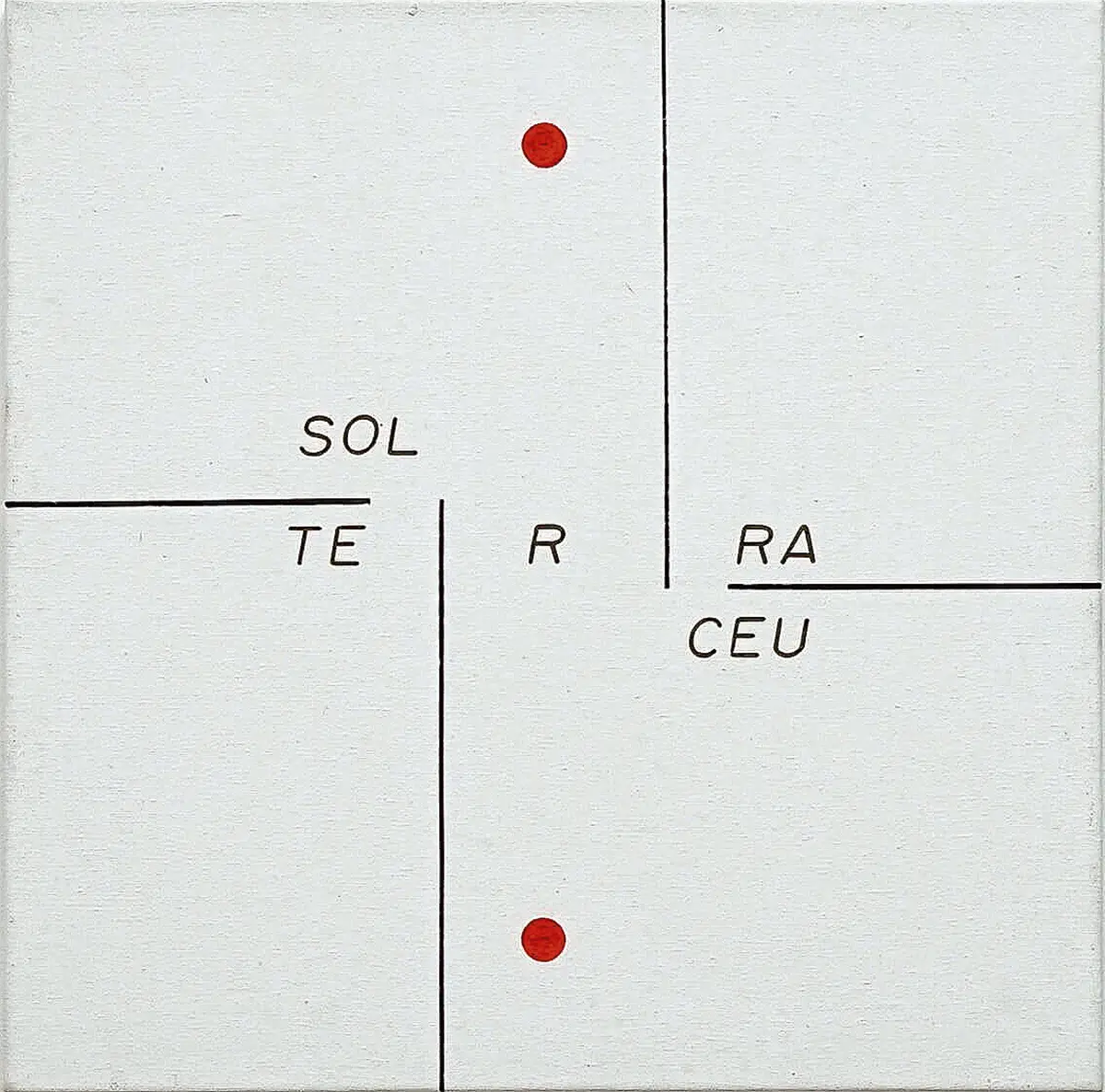
Antonio Luiz Morais de Andrade, known by the pseudonym Almandrade, is a visual artist, architect, master in urban design, poet, and professor of Art Theory in the workshops of MAM da Bahia e do Palacete das Artes (Bahia and Palace of the Arts). His extensive work encompasses pieces in various languages that remain faithful to the constructivist way, marked by geometric games and visual poems constantly arising from experimental practices on paper or canvas. Three-dimensionality has always attracted the artist, who, with his cut-and-fold practice, creates sculptures enveloped in diverse shapes and colors.
The works selected for this show trace a timeline. From 1973 to 2021, the artist has showcased his tenacious pursuit of formal clarity, eliciting a calm delight, as his works also evoke a certain lyrical grace. The compositional combination of letters to form words and the graphic arrangement of strokes in Chinese ink or acrylic create unique symbolic spaces within his artworks. Dialogical situations—inside and outside, private and public, light and shadow, closed and open(...)—arise from the architectural spaces represented in his work.
Almandrade’s work invokes Constructivism, Minimalism, Letterism, and Conceptualism, drawing from the Concrete Poetry Movement and, above all, the poem/process. His production culminates in pieces that link literary and artistic expressions ranging from visual poems—published and exhibited since 1970, where he found the possibility of expanding language through diverse mediums—to larger and more recent paintings and sculptures. In the words of poet and friend Décio Pignatari, as told by the gallery, Almandrade presents a poetic language that “differs from the language we use to communicate daily. Each poet explores language in search for an unexpected event, a singular experience.”
This artist’s influence extends beyond the avant-garde context of his natal Salvador, the capital city of the state of Bahia. He has participated in more than thirty solo and group art exhibitions, including three editions of the São Paulo International Art Biennial. His works belong to private and public collections, such as the Museu de Arte Moderna da Bahia and the Pinacoteca do Estado de São Paulo. He has published eight books and has been a member of visual poetry collectives in Brazil and abroad.
Almandrade took his first steps during the dark years of the Brazilian civil-military dictatorship (1968-1974). It was during this terrible period that his silent art took shape, offering possible analogies of political life with a good dose of humor and subjectivity. Despite the various features that stood out at the beginning of his career, one could already anticipate a coherent conceptual and artistic line driving his daily production; a continuous experimentation in search of new forms with lines, letters, and materials.
After initial figurative attempts in the early 1970s, his artistic exploration led him towards Geometric Abstraction and Conceptual Art. As a poet, he engaged with concrete poetry and the poem/process, creating a series of visual poems. Delving in more rigorous studies of Constructivism and Conceptual Art, his work evolved between geometry and concept. In the second half of the 1970s, cerebral black-and-white drawings, objects, and installation projects were compressed into a refined procedure that addressed practical and conceptual matters.
Almandrade rediscovered color in the early 1980s, and his paintings, objects, and sculptures acquired a more playful dimension without losing coherence. Despite conversing with certain modernist references, the artist has consistently created new and distinctive interpretations. With a restricted use of pictorial elements—two or three colors, two planes, two or three textures, one single stroke, etc.—he attests that simplicity does not compromise the richness of his poetics. This singularity is what predominates in his compositions, arousing the viewer’s imagination and intellect.
ALESSANDRA SIMÕES