“Re” the solo show of recent works by Vanessa Gómez Castaño (Cali, 1988) derives its name from the prefix of verbs such as review, remember, resume: tasks involved in the art of weaving, pointing to a sensory world of textures that touch the skin with our gaze and to an animal scent that powerfully enters our nostrils. A combination of experience, intensity, and memory made our skin tremble. Given the sensitive scope of this proposal, it would be reductive to say that it was an exhibition of textile art, although Gómez Castaño constructs all of her works with fibers, mostly natural. In the creative act of stretching threads, Gómez Castaño transcends professional labels: a design graduate with a focus on communication, she constantly negotiates between design as a starting point and her experimental research on the loom seen as an object and a redefinable place. Design, sans surname, implies the study of different methods that any area of knowledge can apply; it does not necessarily imply the creation of objects; it is a way of seeing, thinking, and working. Gómez Castaño has always been involved—literally and figuratively—with textiles, first as a fashion designer and, during the last few years, as an artist with the aim to enrich contemporary art with other disciplines. Even if we dislike labels, Gómez Castaño, artist and designer, asks us to review what we understand by art, crafts, and design, and to navigate the thresholds between these territories.
The range of sensory experiences displayed in the gallery spaces undermined all stereotypes without leaving aside the essence of the textile trade, as the title of the show reminds us. This implies going beyond the very notion of weaving, of threads, of fibers, and of the roots that feed it. The spaces welcome the visitor into an installation-like dimension, beginning with the scent of horsehair used in works such as Esfera grande crin blanca I (Large White Horsehair, Sphere I, 2022), Mixed Gray Horsehair, Plate I (Plato crin gris mixta I, 2022), or Medium Horsehair, Bowl Set I, (Juego cuencos mediano crin I, 2022). The first impression is therefore olfactory and on a large scale. The spherical works inhabit the middle of the room, altering the way we move in space, since we must go around them and change the way we see the rest of the room. Gómez Castaño starts from the idea of hair as something animalistic. For us human beings, it is an uncomfortable element; it smells bad and we always try to cut it, transform it, or clean it so it won’t get dirty and scruffy, thereby erasing our animal condition. It is to this primary condition that she seeks to allude. Cuerpo textil mechas I (Textile Body, Strands I, 2022), made with cotton and synthetic fibers, points to textile as our first expanded skin; the one that wrapped us at birth and warmed us after leaving the enveloping maternal womb; the one that separated us from our animal existence.
The artist revisits hair in other formats. In Plumas paloma de ciudad I (Feathers, City Pigeon I, 2022), she employs feathers of an urban bird that arouses disgust and fears of all kinds of diseases, up to the very idea of the plague. Here they hung gracefully from a cotton thread, endowing them with a ritual halo. On the other hand, the use of unconventional materials to weave her fabrics—such as corn-cob fiber, plants, flowers, beans, or feathers—enriches the craft’s grammar and opens the door to an experimentation that informs the works’ narratives.
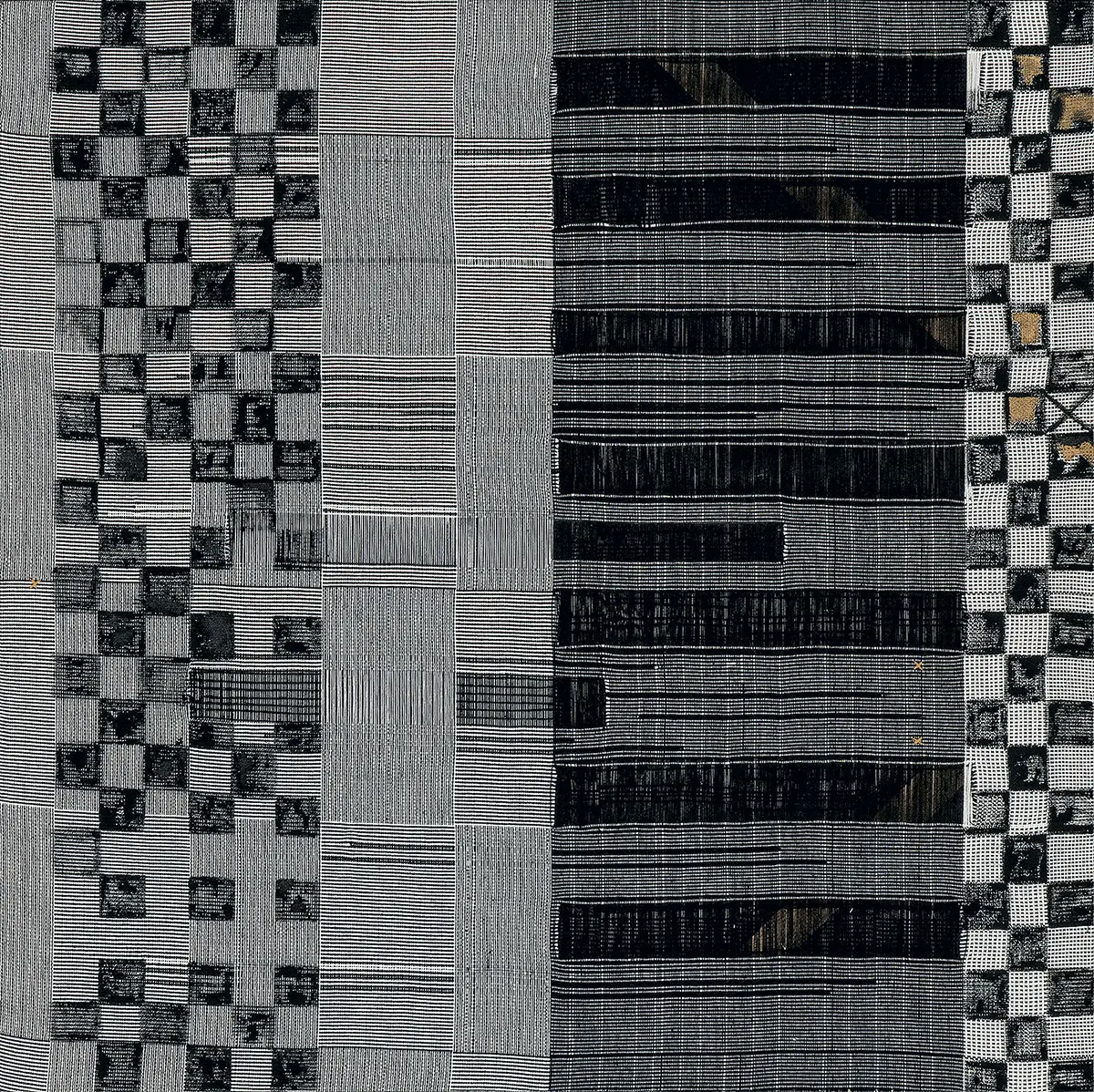
In “Re” we also found works that were not arranged as installations and that responded to the shape of the frame as the second home to the loom. For this type of works, the artist drew with threads, offering two scenarios. The first one presents the loom as a matrix in relation to the digital medium, such as in Cuadro pixel I (Canvas, Pixel I, 2022) and Cuadro sombras BYN I (Canvas, Shadows BYN I, 2022). Textile art is conceived from perspectives such as digital design in order to stimulate exchanges between disciplines: an integral part of the DNA of Gómez Castaño’s artistic practice. The other scenario consists of a group of works possessing a very fine surface, such as Gasa negra II (Black Gauze II, 2022) and Gasa cruda I (Raw Gauze I, 2022), which seem like thin layers of skin: that large, all-encompassing tissue connected to our body, which it covers entirely.
Finally, it is important to point out that the artist aims to conjure the body as a whole. We are not referring to an absolute, ontological whole, but to a body that articulates the possibilities of weaving. The moving body encompasses the textile in such a way that we can no longer speak of manual art, but rather of body art. This movement, this invisible but undeniable presence, is what leads the artist to consider the performative aspects of textile art: now in an embryonic form and later to be developed according to the vision and desire for experimentation that we were able to detect in this exhibition, where, according to Gómez Castaño, ideally the viewer’s experience should have prevailed, making all explanatory texts redundant.