Curator Karen Cordero tells us that the starting point of Teresa Serrano’s work is a wide-raging political disposition connecting her personal experience and the social and political events that—for good or otherwise—determine her place and her circumstance. It is indeed through such bridges between the private realm and the public sphere that her own perception of the world is singled out and transformed, only to be sent back into that very world in the hope of changing or shifting those determinations, even if minimally, by means of their versions and representations. Retrospectively, across a career spanning more than three decades, Serrano’s work comes to us as a large-scale apparatus for the particularization of the general, turning events into something that is at once private and invasive, a rebuke and a validation.
In a text cited by Karen Cordero, Teresa Serrano gave us keys to understand what structures and actuates her devices: “Since the age of nine, my father had me read the headlines of the Saturday and Sunday papers, fostering in me the need to know what was happening in the country, and so without realizing it, I became a political being.” Even so, Serrano does not see herself as a “real activist”, since her activism is confined to her work. She declares herself a feminist and concludes that, as an artist, she ultimately tends toward poeticism.
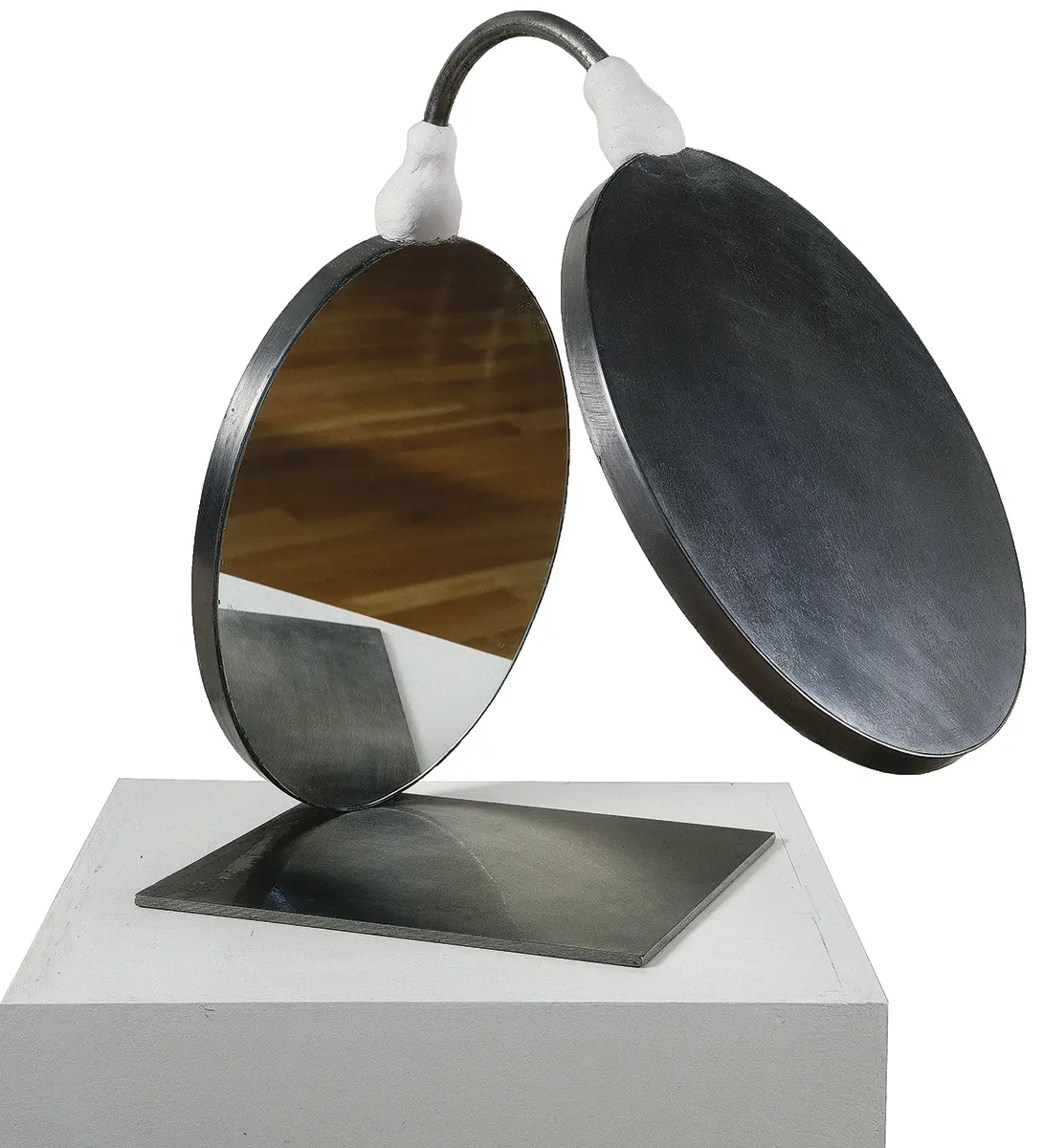
The newspaper headlines Serrano read as a child are broken apart into words that remain unsaid but, materialized in the exhibition space, be it by means of labels, neon tubes, carvings in concrete, or large metal types, unveil the reality that we are sold, invoking it and presenting it to us, in terms of essence and materialization, as a final abstraction of violence, articulated in the possibility—yet—of redemption. Supremely subtle weapons, sense machines like Cordón umbilical (Umbilical Cord, 1993). Two mirrors reflecting each other, set on an aluminum base and connected by a tube attached using a ceramic material. One speaks the other without being able to speak itself, except through the other, as a reflection on the other, unable to be one or the other, as it is only and precisely that: a reflection.
Continuing with the formal explorations that emerge from such paradoxes, we leap into Espejismo (Mirage, 2019), which says precisely what the title announces: that word can be read on the wall, written in luminous handwriting formed by bent neon tubes of the kind one sees at the entrance of a bar or a club. As metaphor, this illusion, based on a promise or a hope like the one aroused by the reflection of light on a desert’s sand, takes us to a radical objectivation: the illusion is what you see, what it tells you that you are seeing.
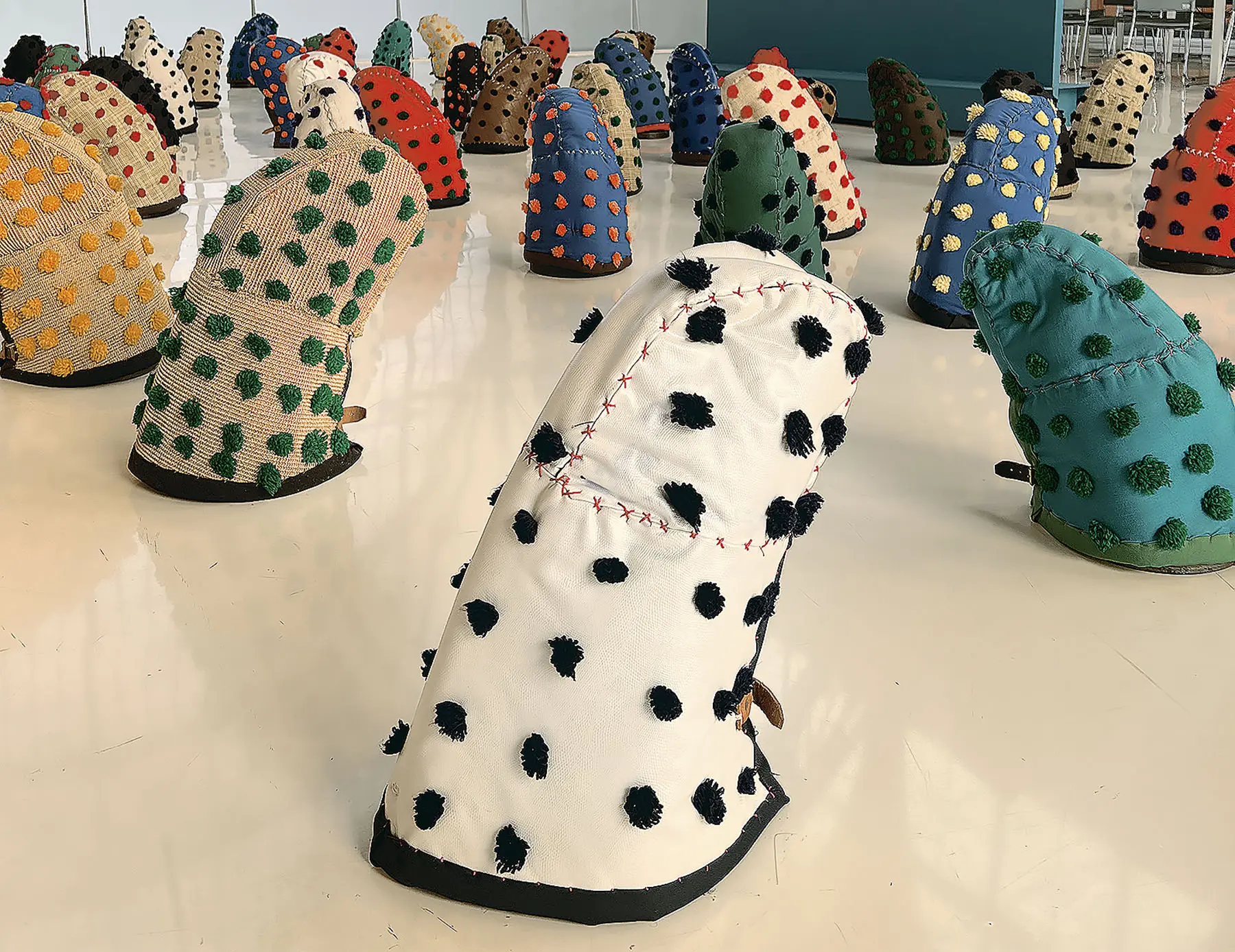
In that sense, one can see in Serrano’s trajectory a (literal) emotional mapping that stretches from her representation of Manhattan in The Island (1990)—made shortly after relocating there, having decided on a radical change in her life (and possessing the means and the supports needed to accomplish it) when her youngest child left the family home—to 52 weeks, 52 years (1997), an installation that alludes to the cycles of Maya cosmology and is composed of iron pieces wrapped in multicolor jute weavings, each made during the course of a month over a 52-month span and arranged in the gallery as a map and a stage that emulates both space and duration.
As Karen Cordero observes, the exhibition is structured around several thematic cores. The first one is the politicization of the personal, which defines the early processes of Serrano’s oeuvre. It is followed by the connected themes of hardness, softness, and sensitivity, in terms of her intentions and materials. Then comes an eco-feminist line, after which there is a narrative turn, encompassing Serrano’s forays into film and video. Lastly, Mujeres volcanes (Volcano Women, 2022), a video installation created specifically for this show. The artist describes Mujeres volcanes (Volcano Women, 2022) as “a cry of desperation and rage, a cry for help, for the unresponsiveness of the government and the society as a whole to the violence suffered by women.” Yet even as an act of protest, these ash-and smoke-spewing women become new Prometheuses, bringers of a new fire—the fire that they breathe and speak, the fire that they are, in a contemporary transposition of myths, rituals, and references.
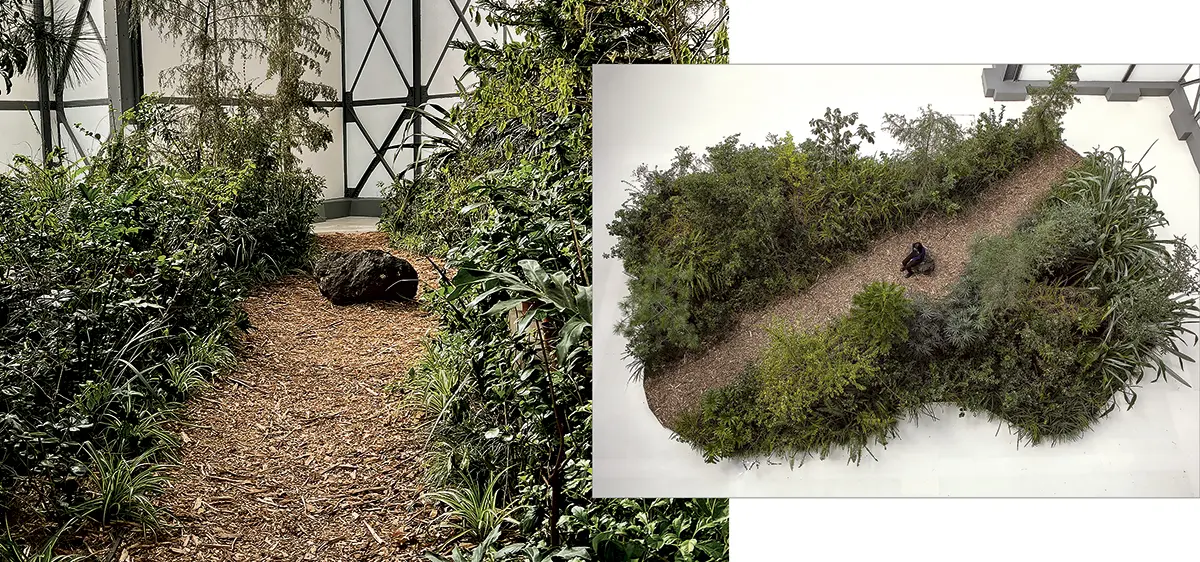
The title of the exhibition alludes to an emblematic Ingmar Bergman film but adds, as an interpretive key, precisely that connivance or complicity with regards to what lays in front of us, and the terms in which we must assume its literalness. It bends and warps them in order to bring them closer, to connect them, to appropriate them, beyond the violence of their origin. Or better yet, in spite of it, as a final gesture of consolation, of contact, even if only on the basis of the referential, of the portable, as in Isla jardín (Garden Island, 2000-2022), created and accumulated in recent years, which functions at the same time as haven and centerpiece in this retrospective: an environment that can be either circled or traversed, depending on how one wishes to understand oneself in relation to the world as such, as site and representation.
RICARDO POHLENZ
Writer, poet and art critic.