In an anthology exhibition of his work at Caracas’ Galería ABRA, Sheroanawe Hakihiiwe (Sheroana, Amazonas, 1971) offered visitors pathways into an understanding of creation and its connections with nature, the cosmos, and the social issues that emerge from growing up and working in Venezuela’s marginalized regions. Sheroanawe Hakihiiwe has been at the forefront of the international art scene since his participation as a feature artist in the 59th Venice Biennale and his exhibition at the Cartier Foundation, in Paris, and his work is now included in prestigious public and private collections around the world. Here we encountered twenty-three works (monotypes and acrylic drawings) on handmade cotton and fiber papers. The exhibition space was conceived as a totality, an eternal home, and could be understood as a journey through themes and preoccupations that persist throughout Hakihiiwe’s oeuvre: the preservation of his people’s oral memory and deep connection with their ancestral cosmology and traditions, and the spatial environment they occupy, with its unique flora, fauna, and landscape. Sheroanawe Hakihiiwe’s work is not rooted on academicism or on established artistic movements; his training is different, and so are the characteristics of his work, entirely unconnected to representational traditions.
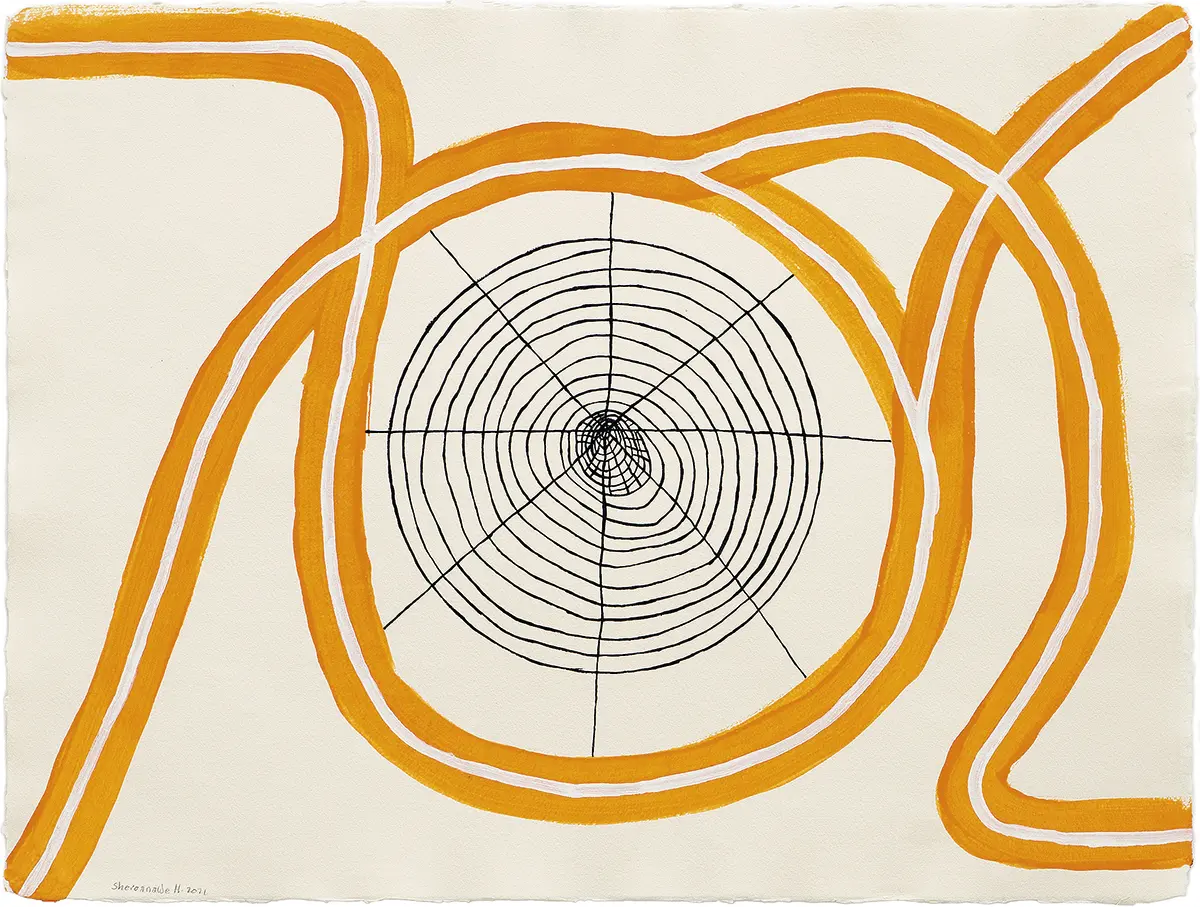
The exhibition space was organized around El poste que no se termina (The Unending Pole), a shaman’s staff of the kind used by shamans and magic men when teaching the youth. The staff is the home of the spirit, a pole that has no end because it is made from a special, highly durable and non-perishing kind of wood. On top of the log, crowning it, are white harpy eagle feathers, a symbolic element painted in a reddish hue with black dots. At the base, the staff rises from a spider web drawing, undoubtedly a reference to the relationship between fragility and permanence. This is a sacramental, mythical pole, one that brings together spirits and earthly beings; it summarizes the sense of balance, the wisdom and the respect that the Yanomami people feel towards their rainforest territories. The works on exhibit are placed around El poste que no se termina (The Unending Pole), so that viewers have the sensation of entering the sacred space of the shaman’s home. From there, the unfolding of Sheroanawe Hakihiiwe’s language becomes experiential. Among the standouts are Hema hemau (Morning Dew on a Spider Web), from 2021, an acrylic on cotton paper drawing that achieves maximum synthesis in its representation of nature: the droplets on a spider web acquire their powerful yet delicate force from what attention to detail can accomplish. It is a minimalistic, abstract, yet also realistic work of art. We could be in front of a landscape, but Hakihiiwe is not a painter of landscapes; he does not hew to genre labels, but to a reconceptualization of expressive contents. Hema hemau is accompanied by Hi i hipe amakuripe (Logs with Iridescent Traces) and Au au pore peno mayõ (White Ant Pathway), both from 2021. Notable in all these works is the extreme refinement of the compositional elements. Hi i hipe amakuripe alludes to the custom among hunters of painting dry logs in an iridescent material to help guide them in the dark. The journey of nighttime hunters seems to vibrate in this drawing, made in acrylic on cotton paper. Au au pore peno mayõ, resolved with the highest degree of distilled precision, tells the story of a different kind of journey, that of the ants as they furrow the Earth in their travels.
Another important representational space is that of vegetation. The exhibition features three palm trees that summarize its relationship with the world of plants.
Hii hi hami hoko siki reikiwe (Palm Hanging from a Ceremonial Pole), from 2021, an acrylic on cotton paper drawing, is emblematic; it brings together into a unit the ceremonial pole and the palm leaves, painted in the black-dotted reddish hue that often appears in the artist’s work. Masiko wake wake (Red Palm Tree) and Hayakawe siki (Hayakawe Palm Tree), both from 2022, express the motion of the palm leaves in a fine, dynamic line; in these works, drawing is bound by a conceptual linearity.
Each gesture, each feature, each leaf or animal, each color alludes to the Yanomami people’s ancestral memory, to Sheroanawe Hakihiiwe’s symbolic universe, to the cultural history of a rainforest that we must never allow to be lost. We are faced with a limpid, highly refined body of work, with lines, dots, and simplified shapes that engage symbolic elements and concepts. These simple patterns disclose a complex, content-rich aesthetics of powerful poeticism that alludes to Being’s primordial relationships. With it, these works penetrate the anthropologic and cultural systems around it, all the while reflecting and vindicating a historically marginalized people and a mode of existing in the world that today find themselves at risk of becoming extinct.
MARÍA LUZ CÁRDENAS