Santiago Sierra’s last exhibition was the most notable among all those held during the winter in Madrid, both for its content and for the intensity of the expectations generated in the media and in the art public. This was compounded by the fact that it was not one but two exhibitions. The show on the ground floor, entitled “2068 dientes” (2,068 Teeth) referred to the number of teeth in the series of intimidating black-and-white photographs of dentures, which were projected from floor to ceiling on black walls at the Helga de Alvear Gallery. The show on the first floor was entitled “?”, anticipating the question that visitors asked at the reception desk after being informed that access was closed to everyone who did not have a personal invitation. Those who did could only enter after signing a confidentiality agreement promising not to reveal the content of the exhibition until after its closing. The show consisted of a piece of furniture displaying the Spanish national flag completely submerged in blood, as well as a display of small-format prints reproducing the flag’s coat of arms imprinted with blood. The wall text explained that the blood had been donated by people born in all the countries that were once part of the Spanish Empire and by those born in all the autonomous communities that currently make up the Spanish Kingdom.
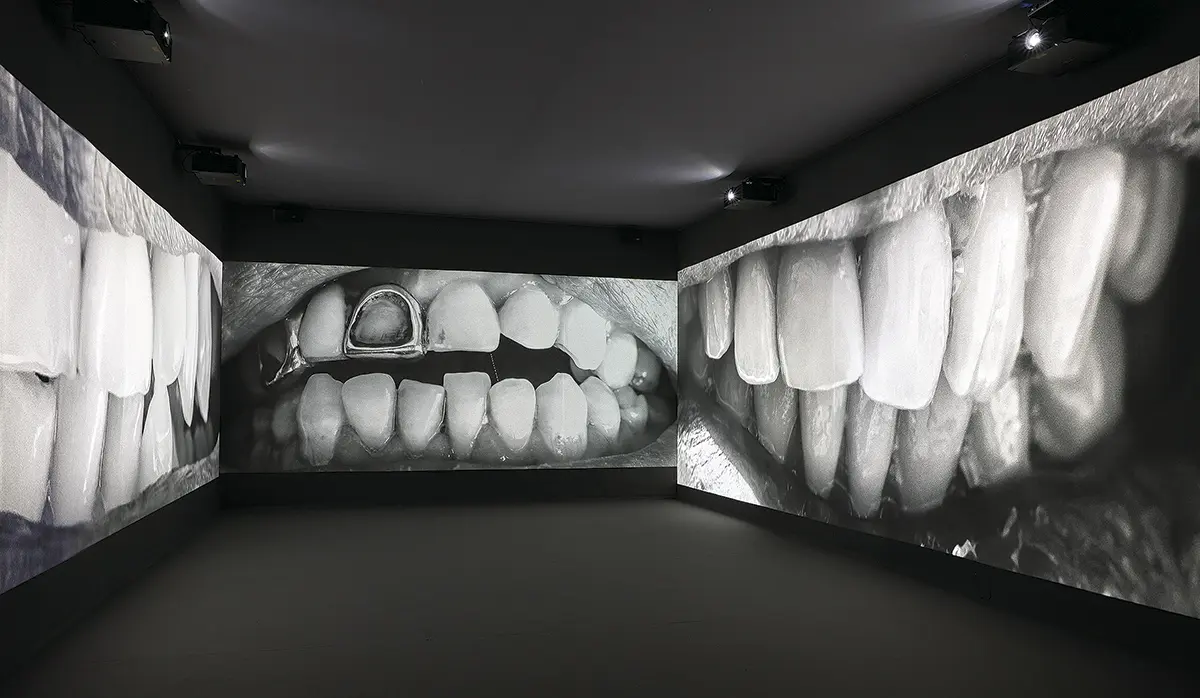
When I asked Santiago Sierra the meaning of the title “2068 dientes” (2,068 Teeth) he answered: “It’s the result of counting the photographed teeth, one by one. The figure 2,068 is not the starting point, but the outcome of the operation of portraying the migrants’ dentures.” Sierra spent a week shooting the dentures and then his assistant counted all the teeth, after which the artist gave the work its name.
Regarding the reasons why he chose Caribbean and Central American migrants who are waiting in Tijuana for the opportunity to enter the United States, he explained: “This is an issue I have been following for a long time. You know that I live in Mexico, and the most recent event has been the emergence of thousands of mega-caravans in response to the attacks migrants are exposed to along their journey. It seems that they are more vulnerable when there are few of them; in smaller groups they are exposed to all kinds of serious risks. For this reason, they travel in groups of thousands, and when they reach Tijuana, they get stuck there. They’re amassed there and they’re not well received. They find themselves appearing on local television and the press is stating that they are delinquents, gang members, prostitutes, dregs. That’s how they are received, so the local population isn’t very happy with them either, so they’re finally placed in concentration camps—I can’t call them by any other name—at the outskirts, in the desert, so they won’t bother anyone anymore. And there they are, guarded by some RoboCops that look like gringos disguised as Mexicans. Giant guys. You can’t see their faces or their eyes. They are wearing Ray-Bans, they’re armed, in uniform, impeccable. In the camps, the men may be lucky enough to be placed in a mire with some areas of cement, under tarpaulins stretched like a roof, which are the remains of the last electoral campaign. They are completely divided by racial groups and by countries. There doesn’t seem to be a good vibe between them nor with the Tijuanans. Then you have another area for families, where a very strong smell prevails. And finally, there’s the children’s area: a garbage dump covered with UNICEF posters.”
Why did you choose these people’s teeth and not their faces, for example?
“Because you know that I like to go direct to the simplest act, and the simplest act is to show the teeth. It’s so simple that it’s paleo-artistic, right? Better yet, it’s paleo-cultural, because if you show your teeth to a dog, he knows what you’re saying. And I like that, especially for this piece. You know I’ve done it before, with the gypsies in Naples, for a piece with less teeth since they were the last gypsies I met in Ponticelli. They were kicking them out, accusing them of stealing girls and things like that. I photographed the teeth of the last ones I found. I feel it’s a good strategy for portraying accosted crowds of people. Here it also seemed very appropriate to me, due to the treatment given to the victims; I really like introducing the victims by showing their teeth. It’s a warning that you are going to find a transplanted seed of hate. In other words, what you are going to see is not smiling and happy people, unless the pizzeria’s boss tells them: you have to smile or I’ll kick you out. They just don’t feel like smiling. A smile will not come out of those teeth. In fact, my first idea was to show this project throughout the southern United States, in border locations, on billboards. In Naples we did it that way, and the city acquired teeth, the windows became eyes. It all gets very surreal, doesn’t it? I wanted to do that in the US, but all the pandemic mess came up and I had to shelve the project until Helga asked me to exhibit at very short notice, and I said to myself: I’m going to do this. Also, it worked very well with the installation above. After all, we are dealing with the catastrophe of Hispanicity. Hispanic culture is what travels miles and miles to escape from hell and run towards the neighboring empire to say: accept us because we are fleeing from Hispanic culture. This fits very well with the upper floor, where it goes to the heart of the matter. Central Americans are only one part of all those who have given their blood for the construction of the idea of Hispanicity.”
The teeth projections in “2,068” incorporated an audio that is amazing, to say the least. Voices were heard, but not understood, and the pace was extraordinarily slow. “The music is called cumbia rebajada (lowered cumbia),” explains Santiago. “It’s very curious what they do, and very simple, because when you slow down the cumbia recording you get something else. They are traditional Colombian cumbias whose revolutions per minute are dropped and they become sadder and slower-paced songs. It’s more apt for dancing alone, more intimate, and more loaded.” However, Sierra did not just slow down a cumbia: he slowed it down even more and played it backwards. “Actually, the cumbia comes from the South, like the migratory flows, and when it arrives in Mexico it kind of saddens and slows down. For this show, we gave it a twist to make it even sadder, and unrecognizable by playing it backwards. The sound is quite suitable to accompany the teeth.”
This unusual soundtrack contributes, he believes, to generate a mood that in turn prepares us to view the installation upstairs. “You’re looking at these huge images of dentures that dwarf you, and listening to the cumbia rebajada. You’re alone. And then, you’re confronted with this rigmarole of having to sign a confidentiality agreement and you feel forced. These are all rhetorical maneuvers to make you feel more tense when you face the piece above. They’re inducing you to ponder all of this with the gravity it possesses.”
Was the requirement that viewers sign a confidentiality agreement an ironic comment on the exclusivism of the art world?
“I wanted to create a positive exclusivism. Something like a ‘positive elitism.’ I don’t know why all these years there’s this conviction that what we artists do has to be seen by the entire world. I disagree. I don’t want what I do to be seen by fascists, by the guys in ties. I don’t want the bankers’ press to see it, I don’t feel like it. I don’t do it for them, really. And what we did worked very well: we received an avalanche of people who wanted to see the exhibition. Here, on Fuencarral Street, there’s this little market and the woman that stands at the door is always pulling me in to tell me that there’s this and that. You will not enter a place when they want to pull you in. And yet, if you place a guard in a nightclub, there are long lines of teenagers who want to enter. It generates curiosity. Later, people understood the stuff very well, and that seemed incredible to me because everybody kept silent. If someone had told on us, we would have had loads of puny bigots at the gallery door making a racket. I trusted those participants with the care that must be given to art and our freedoms. And they delivered. Nobody screwed me. Nobody started talking ahead of time.”