During an artistic career spanning more than three decades, Sandra Vásquez de la Horra (1967, Viña del Mar, Chile) has developed a significant and unmistakable body of work, unique in her drawing style. The materials she employs, a complex and layered narrative steeped in personal origins and in her sociopolitical and cultural heritage as well as her imagination enable her to gallop at full stride.
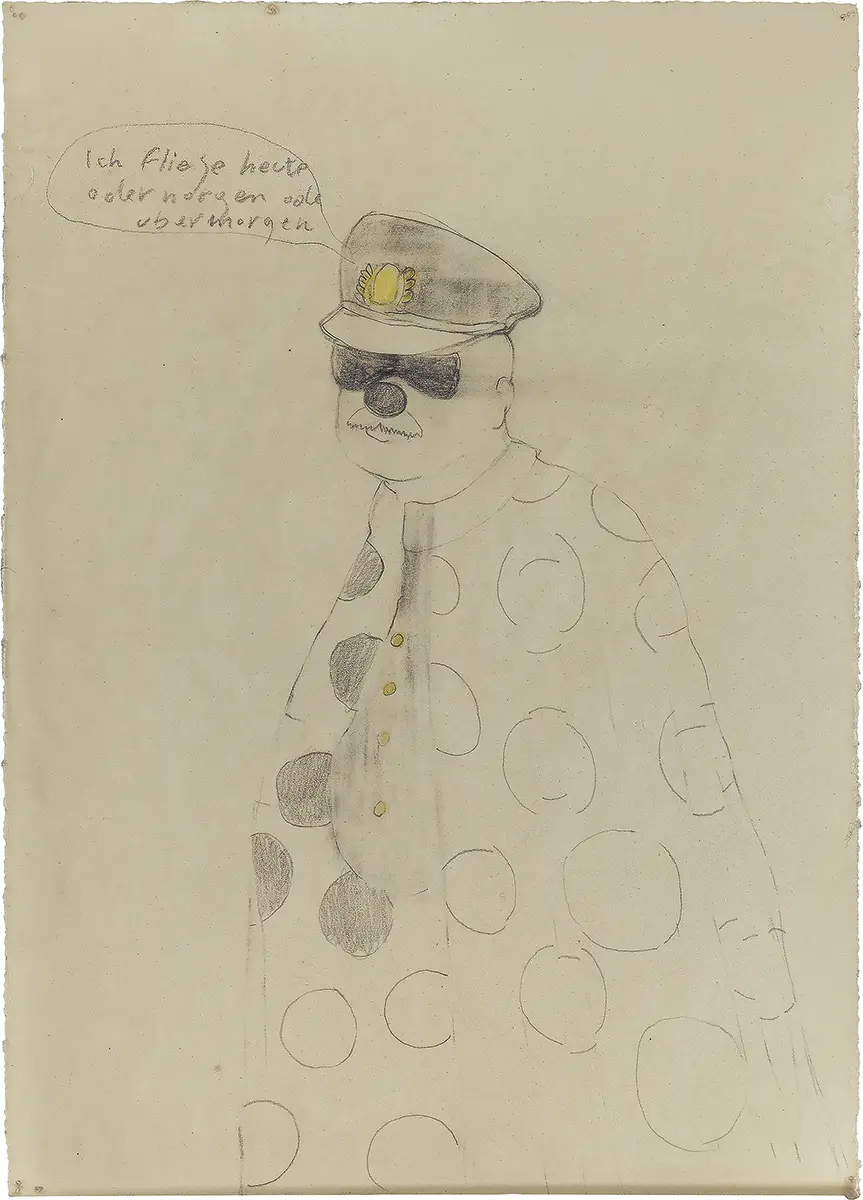
As a child, Vásquez de la Horra attended an Italian Catholic school in Valparaíso (Chile). There she received a traditional bilingual education immersed in a universe of Eurocentric literature and precepts. Always attentive to her surroundings, she did not hesitate to spend a large part of her holidays at Cárcamo in northern Chile with mestizo children descended from the Picunches, indigenous community that worshipped the spirits of the mountains, the skies, and the light, and who lived in parts of Bolivia, Peru, Chile, and Argentina. At the age of twelve, Sandra Vásquez de la Horra was admitted to the Valparaíso Academy of Fine Arts, not only to refine her artistic talents but also to satisfy her latent curiosity. In 1986, she moved to Santiago, where besides frequenting the Taller 99 (engravers workshop), she visited important collections at local museums and further broadened her horizons. In 1989, aiming for a more practical and experimental training, she returned to her hometown and began to study Communications and Graphic Design at the Design Universidad de Viña del Mar, with a focus on typography. That same year, Chile’s dictatorship came to an end. It had been a period of intense repression and censorship beginning with the military coup that ousted President Salvador Allende in 1973. In other words, the entire childhood and adolescence of Sandra Vásquez de la Horra was covered by a dark cloud of oppression, uncertainties, and fear. In works such as Ich fliege Heute oder Morgen Übermorgen (I Fly Today or Tomorrow or The Day After Tomorrow), from 2006, the artist not only underscores a past that must never be forgotten, but also presents a general deprived of his power and ironically possessing a clownish nose, without underestimating the risk of falling into evil’s banality, the notion spread by Hannah Arendt in her struggle to uphold democracy and its intrinsic values.
Vásquez de la Horra’s life and multicultural interests reached an apex in 1995. Invited by the artist Jannis Kounellis (1936-2017), she moved to Germany to study for a year at the Düsseldorf Academy of Art. One must not only remember Kounellis as one of the greatest exponents of Arte Povera —an avant-garde artistic movement emerging in Italy in the 1960s— and whose work, shaped by sociopolitical debates, crystallized mainly in installations, objects, and assemblages with unconventional elements such as iron, stone, jute fabric, and even live animals such as horses. As Sandra Vásquez de la Horra stated during an April 2023 interview in her Berlin studio: “Whoever had the good fortune to have spent time with him knew he was not only an incorruptible being but also a great artist.”1
The two artists shared some similarities; like Vásquez de la Horra, Kounellis left his homeland, Greece, at an early age to become an international artist and an active witness to the social developments of postwar Europe. His own experience prompted a strong interest in the young Chilean student’s potential, which was key to her artistic career. In 1999, Vásquez de la Horra began a second stage at the Düsseldorf Academy of Art, this time under Rosemarie Trockel (b. 1952). From 2001 to 2003, she also completed a postgraduate course at the Academy of New Media Arts in Cologne. Her first solo show, titled “SPOT ON,” was hosted in 2006 by the Museum Kunstpalast in Düsseldorf. To this day, she resides in Germany.
It should be noted that Vásquez de la Horra left Chile during a post-dictatorship period that lasted decades in several Latin American countries. Germany, where she settled in the mid-1990s, was also undergoing a reboot after the fall of the Berlin Wall, when the so-called Iron Curtain in Eastern Europe came down, ending the dreaded Cold War in a sort of domino effect. This period, both in Latin America and in Europe, was punctuated by a euphoric configuration of isolated niches by easing geographical and sociocultural borders. It is important to stress that the main debate in Germany at that time was aimed at addressing the country’s complex reunification process, with innumerable problems still stemming from the Second World War. Certain specific national issues had to be attended to in a universe not comparable to the urgent issues raised and debated worldwide today. Pressing global issues such as postcolonial revisions and reparations are now debated as the aftermath of eurocentrism in Africa and Latin America. Although it is late, we must insist on reviewing the geopolitical facts so we can acquire the necessary understanding and discernment to act more conscientiously.
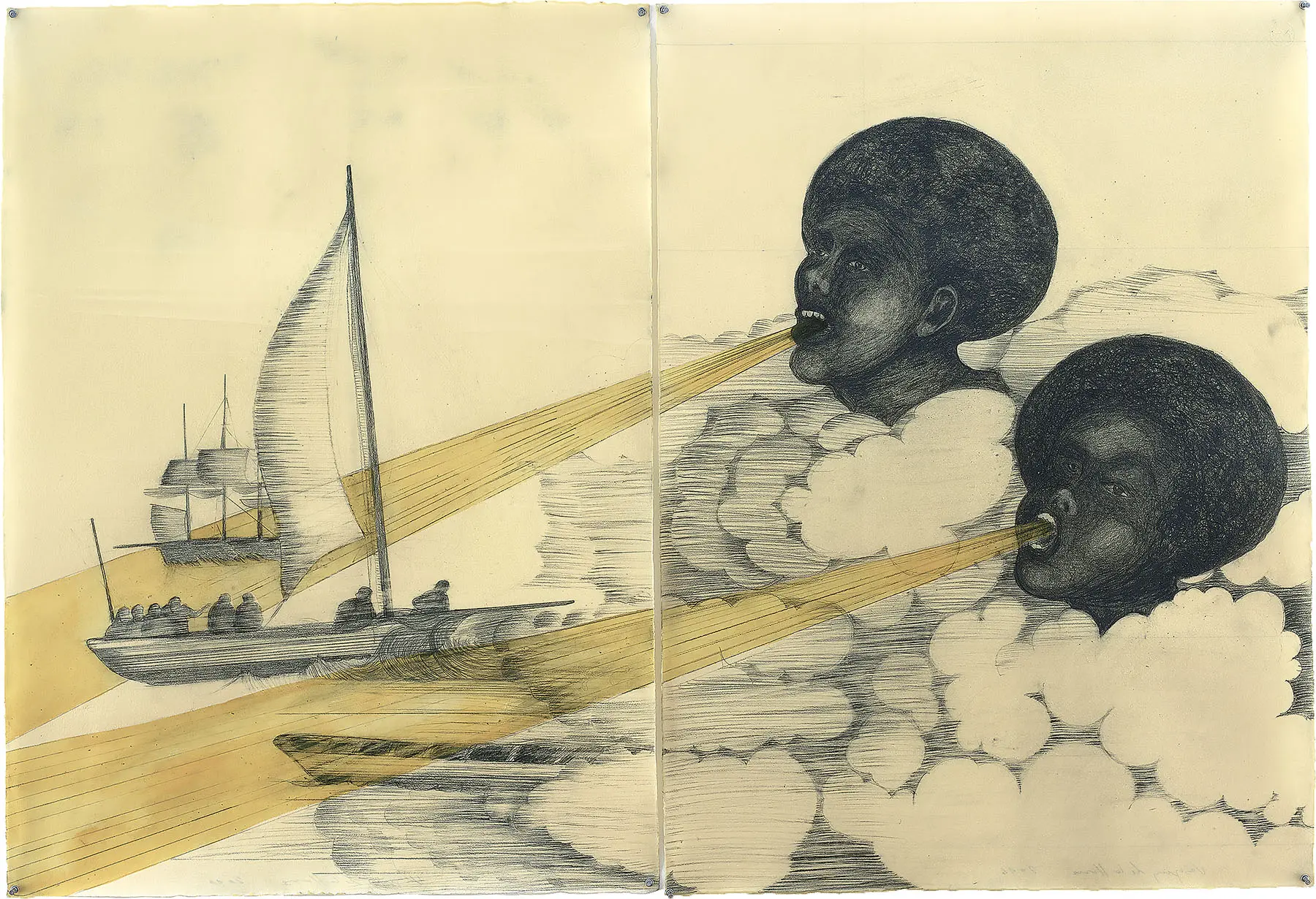
Sandra Vásquez de la Horra, an unconditional witness to this process and working both in Latin America and in Europe, transposes compelling stories into her work. Los vientos (The Winds, 2016), for instance, is a drawing that shows an extraordinary effort by inhabitants of the African continent to huff and puff in order to metaphorically scare away the approaching European vessels that want to dominate and possess their territories, populations, and identities. Works like these must replace or at least converse with non-European pieces in the collections of European museums. The current panorama cries out for revision and action: “Museums with non-European art practice colonial appropriation at the heart of Europe. There is no way to change this fact. As a society, they challenge us to decide if —in what way and for how long— we want to continue living with these institutions in the 21st century, taking into account Africans’ demands for partial restitution over the past fifty years.”2
Vásquez de la Horra has contributed to intercultural and horizontal dialogues with solo exhibitions at institutions such as the Bonnefantenmuseum in Maastricht (2010), Musée d ́Art Moderne de Saint Étienne (2011), Museo Novecento in Florence (2019), and Sächsische Akademie der Künste in Dresden (2021); as well as group shows at the Georges Pompidou centre in Paris (2010 and 2013); Marta Herford/DE (2010), Musée National d ‘Art Modèrne in Paris; Albertina Museum in Vienna and S.M.A.K. in Ghent (2015); Musée d’Art Moderne et Contemporain in Saint Étienne and Museum für moderne Kunst in Bremen (2017), among others.
Ancestral Alchemy and Mythology
Sandra Vásquez de la Horra’s autobiographical context has always shaped her artistic existence. There are recurring themes just as there are recurring beings who have a leading role in the complexity of the world she has idealized and transposed. Her subjective universe is largely represented by the female figure, while other beings dominate narratives constructed from critical, ironical, and fantastical reinterpretations of reality, apparently so as to trigger surreal scenes, but actually originating from essential elements that make up their artistic representation.
Throughout her career, this artist has remained faithful to her ideas and actions. Her life and studies in Germany led her to research and experiment in different artistic fields, from conventional techniques to new media. However, she discovers her materials and the ways to transpose her genuinely analogical creations through actions that are introspective and silent. Paper, graphite, and watercolor are faithful tools that provide her with an autonomous working method. Each drawing is covered with a special glaze after being submerged in a container with hot wax, giving it a protective finish; a kind of skin. This immersion in wax to envelop every piece of paper constitutes a sort of ritual or alchemical operation without which her work would not be complete. Based on these elements, Sandra Vásquez de la Horra develops her extensive artistic cartography with touches of intuition, concept, and chance. As the French philosophers Gilles Deleuze and Félix Guattari pointed out, we are not dealing here with a cartography or a conventional geographical map, but with relationships.3 These constitute a topography of invisible forces that turn artistic results into sensations. Based on the vivacity of her cartography, she creates a body of sensations that are neither works of art nor their isolated enjoyment, but rather an activation of forces that animate the relationship between the work and the viewer, emerging from the conditions and contexts that they are inserted in.
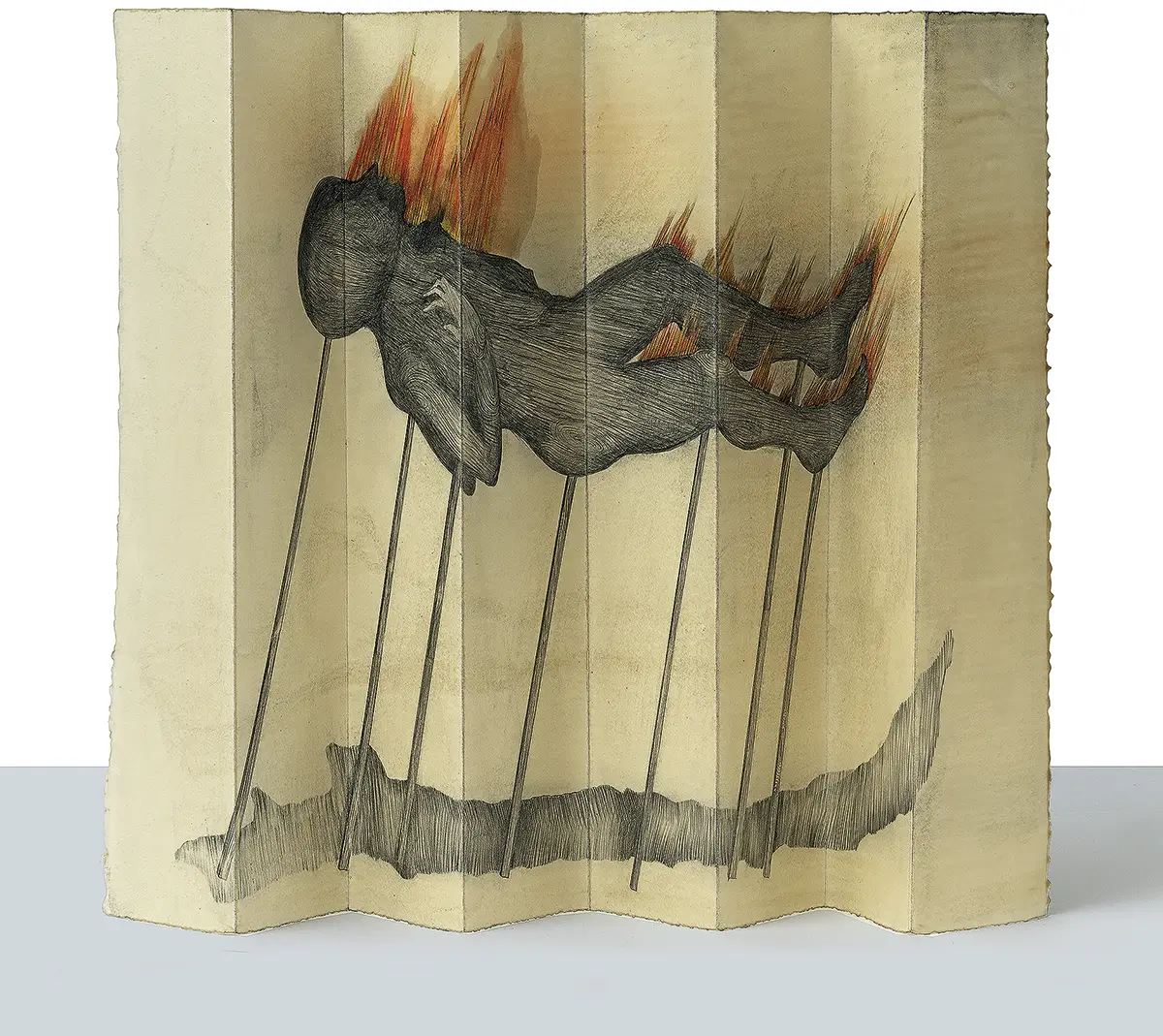
In some works, Vásquez de la Horra refers to a cartography that is both geographic and artistic. Such is the case of Without Citizenship (2021), where we see a female body in flames held up by sticks to keep its distance from the site where it used to be. What appears to be a black stain, as if alluding to an excavation site, is actually the geographical outline of Chile. These two forms exist as a negative and its positive, separated and thus unable to recompose their identity or hereditary-based “totality.” Its formal presentation also constitutes one of the practices developed by the artist: the expanded drawing. Paper has long offered her the possibilities of two-dimensional or three-dimensional effects by the use of folds, objects, spatial occupation, and installations.
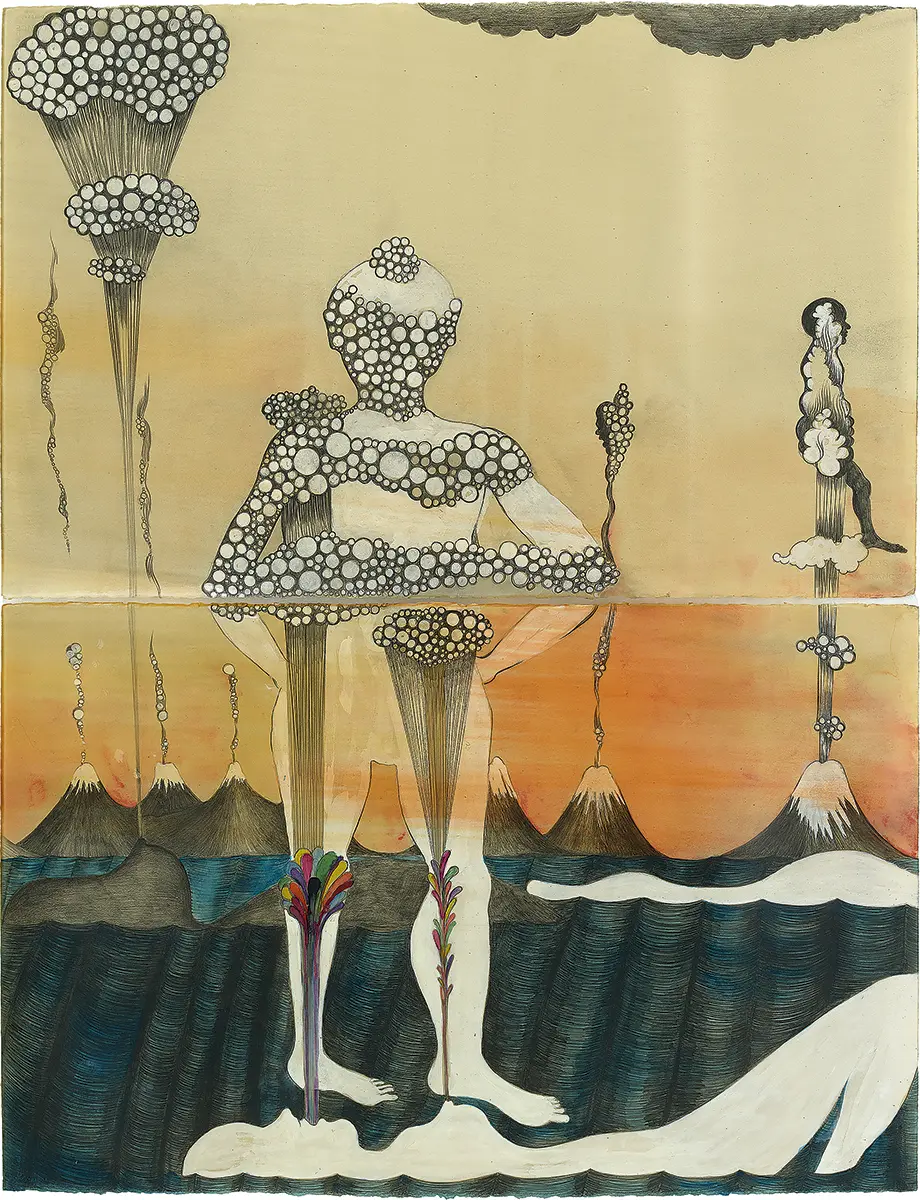
Ever since her recent participation in the main exhibition of the 59th Venice Biennale, “The Milk of Dreams” —a title taken from the homonymous book by Leonora Carrington— the immersive nature of her work, full of magic and mysticism, has materialized. The same can be said of Carrington’s work according to the biennial’s curator, Cecilia Alemani: “It is a world where everyone can change, be transformed, become something or someone else; a world set free, brimming with possibilities.”4 For the first time, Vásquez de la Horra’s drawings could be seen and experienced through the various prisms of her existence in an unusual, inviting, and enveloping format that included various works within an architectural structure evoking the feeling of a room. The works retained their individuality and independently and intimately composed both the external and internal walls of a sort of overcoat whose interior was also inhabited by objects arranged on side shelves and in a central display case. Awakening of a Volcano (2019), among other works represented there, embodies, into its narrative and visuality, this biennial’s premise: a free and mutant world that meets the demands of its time.
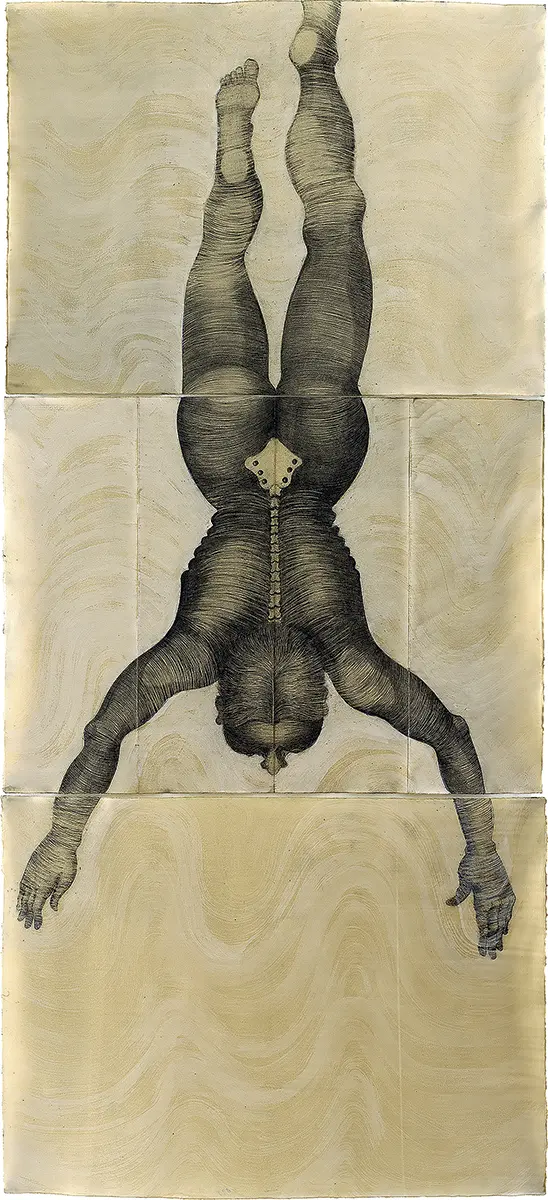
Dealing precisely with this world, the work of Vásquez de la Horra warns us in no unsubtle terms against underestimating the riches and resources that Mother Nature offers us. The essential elements for human existence —earth, fire, air, and water— recur in her works. Under the influence of humanism and colonialism, the local wisdom and innovations of indigenous peoples such as the Picunche in Chile were constantly ignored and devalued as primitive in the course of mass industrialization. Ancestral culture —its knowledge of the healing powers of Nature and the spirits that inhabit her— must be recognized and respected. All this legacy exists to be shared and experienced, as the artist does in Aguas profundas (Deep Waters, 2016), a dive into its essence and traditions stripped of any recourse to contemporary life. The mad world lived with senselessness and lack of control is left behind once courage is attained: “Courage means following the heart. There are millions of women who perform acts of enormous courage every day. No single act will reform a shrunken collectivity, but rather the continuity of those acts. As a Buddhist nun once told me: ‘Water can pierce stone.”5
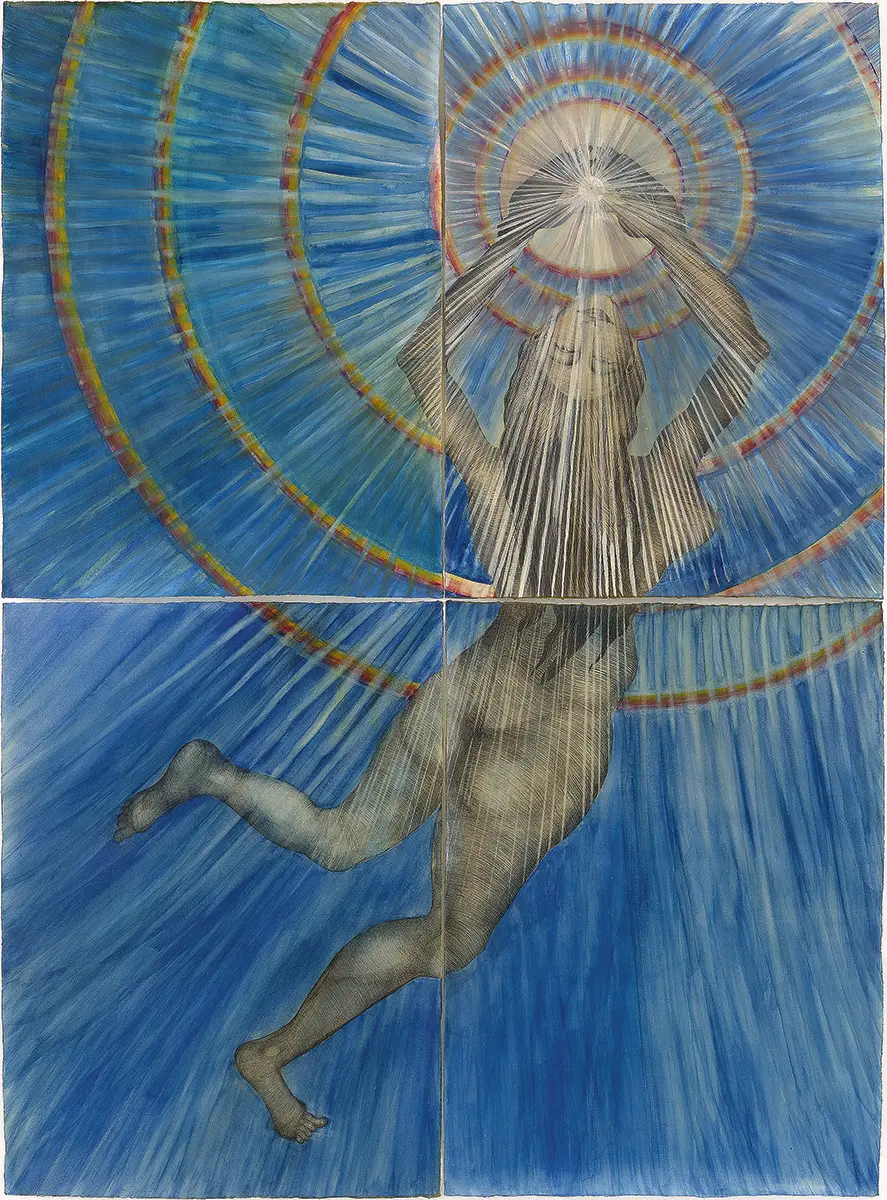
After emerging from the depths, we will restart the cycle of life, as the artist shows us in Saludo a Olorun (Greetings to Olorun, 2021), the orixá, or deity, literally known as the Possessor of the Skies and who —like Iemanjá, the goddess of the sea, or Xango, the god of thunderstorms— is among the favorite protectors of believers in Afro-American religions. Vásquez de la Horra feels the need to reach new and unknown dimensions, penetrate the mysteries, and decipher the signs, many of which are manifested in the myths and behavior of the orixás, which have been transmitted from generation to generation and from continent to continent by oral tradition: “They speak of the creation of the world and how it was repeated among the orixás. They describe an infinite number of situations involving gods and men, animals and plants, and elements of nature and society. In the traditional society of the Yoruba, a non-historical society, the past returns, and the origin of everything is explained through myth; through myth, the present is also interpreted and the future is predicted in this life and in the next.”6 Vásquez de la Horra, in turn, encourages us to contemplate this vast knowledge through her tireless pictorial gestures.
NOTES
1. Sandra Vásquez de la Horra, conversation with the author, April 10, 2023.
2. Savoy, Bénédicte. Afrikas Kampf um seine Kunst. Geschichte einer postkolonialen Niederlage (Africa’s Struggle for Its Art. History of Postcolonial Defeat), p.197. Translated by the author T.A. (München: C.H. Beck, 2021).
3. Deleuze, G. and Guattari, F. A Thousand Plateaus. Capitalism and Schizophrenia, p. 163. (London: Athlone Press, 1987).
4. Alemani, Cecilia. The Milk of Dreams. Short Guide, p. 43 (Venice: La Biennale di Venezia, 2022).
Original Quote: “It is a world where everyone can change, be transformed, become something or someone else; a world set free, brimming with possibilities.”
5. Estés, Clarissa Pinkola. Mulheres que correm com os lobos (Women Who Run with the Wolves). p. 303 (Rio de Janeiro: Rocco, 1994).
6. Prandi, Reginaldo. Mitologias dos Orixás, p. 24 (São Paulo: Companhia das Letras, 2001).
TEREZA DE ARRUDA