Conceptual art still bewilders because it includes among its disparate defining characteristics the idea that what is in the work, is more than what you see. Such is the case with Sandra Monterroso’s exhibit The Healing Paradox at Sicardi Ayers Bacino Gallery in Houston, in which what is not seen is the paradox entrenched in the works themselves. Historically, one of the most famous paradoxes is The Liar Paradox. A liar states, “I am lying.” Because he is a liar, the truth is contrary to his statement, hence he is telling the truth. However, if his statement is true, he just lied. The question is, how do Monterroso’s works resemble this quintessential paradox and how do they heal?
Fortunately, curator Alma Ruiz has done careful thinking about these works in order to unravel what she calls “the visual paradox.” Paraphrasing her text, Sandra Monterroso: The Healing Paradox: the first step in forging the paradoxical nature of some of her works is to know that they were made from discarded fabrics destined for landfills. Ruiz states, “Woven by indigenous hands who labor for low salaries to produce beautifully crafted rugs for luxury homes, the scraps tangentially point to a socioeconomic hierarchy between the haves and have-nots.” Hence, the original act of weaving fabrics by indigenous hands takes two paths: one towards the haves’ luxury homes, and another one (the scraps) towards a landfill, which Monterroso hijacks in order to use the material for her work. On the first path the have-nots get low salaries; while on the second path, by artistic fiat, the discarded materials are mended and re-elaborated to become “metaphorical healing”—presumably for the indigenous have-nots. Therein lies the paradox, for the very same artworks the viewer initially regards as beautifully crafted, intricate and enigmatic, are also the not-so-obvious “repositories of the inequalities, discrimination, and racism that still exist toward marginalized groups...” (Ruiz).
The use of neon-lights is a surprising feature in works that are mostly imbued with the aura of the artisanal. Monterroso’s work Como los triángulos: el agua celeste y la indigófera nos devuelve la luz (Like the triangles: the celestial water and the indigofera give us back the light, 2022) features a column of 20 neon triangles against dyed cotton and wool fabric. However, neon light itself is inimical to dyes, as it causes discoloration. Is there another paradox here? That a source of light that makes colors stand out, ultimately causes them to fade? The promises of modernity have been particularly unkind to indigenous populations around the globe in terms of loss of lands, destruction of habitat, pauperization, decimation, etc. Ruiz puts it slightly differently, “To say that their inclusion seems paradoxical is true; their electric-powered presence gives back the light needed in an altered state of consciousness to enter a moment of reflection on modernity or, more precisely, on the open wounds resulting from the encounters and disagreements that occurred while going through this modernity.”
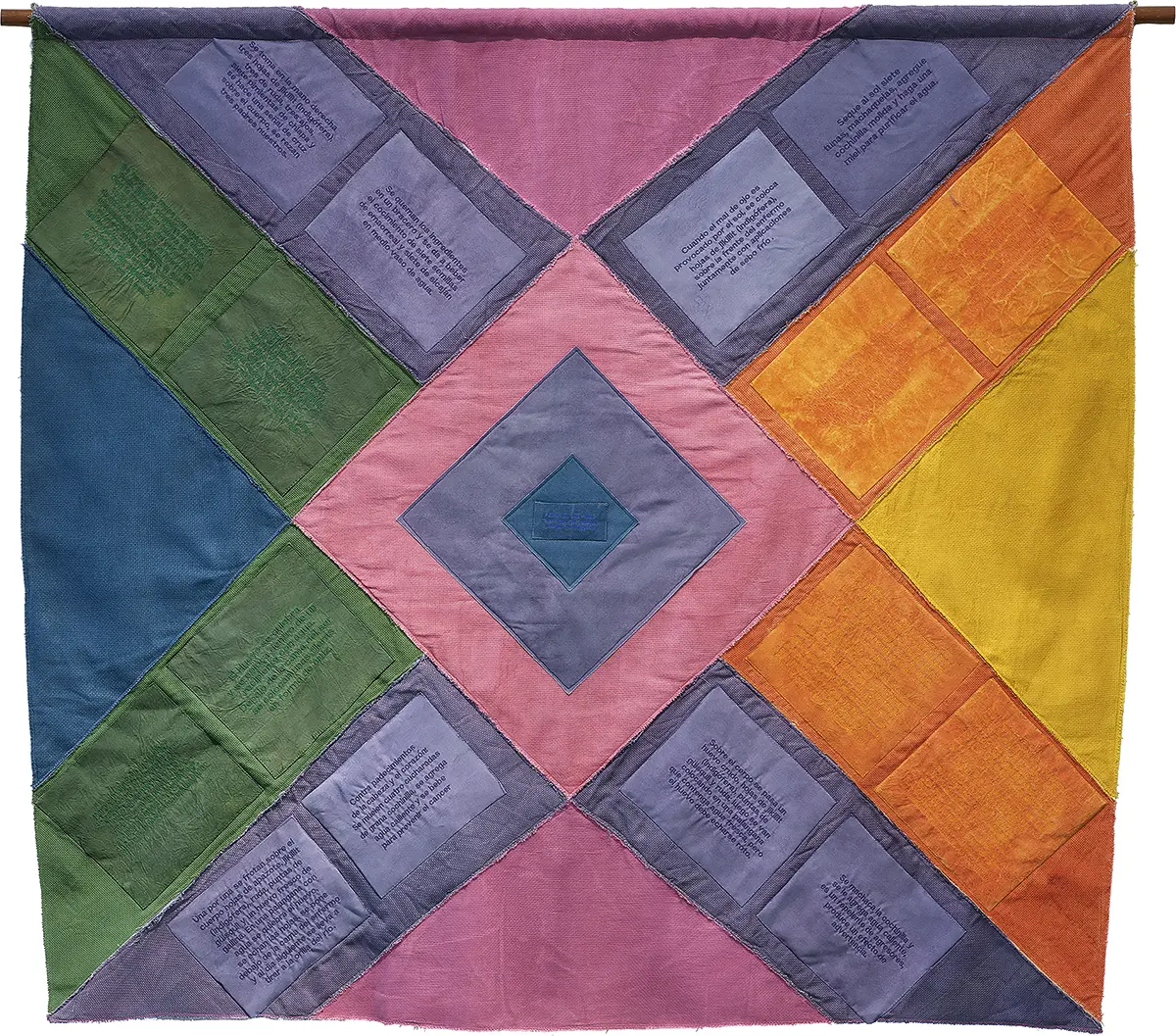
Ruiz explained that healing has been a leitmotif in Monterroso’s work. The 2022 piece Rombo para sanar heridos (Rhombus to heal wounds) is central to her current exhibit. It is made of linen and cotton dyed with cochineal, indigo, turmeric, annatto, and synthetic pigments. Each one of the natural dyes not only produces a distinct hue, but also has a curative property. A salient feature of the work is the embroidered texts that spell out recetas (ambiguous Spanish word that means both recipe and prescription) of traditional medicine. A receta quoted by Ruiz reads like instructions for conceptual art: “Prescription for the evil eye (non-physical): In a cloth bag, put a few grains of achiote (annatto) and some cross-shaped chili peppers, pass [the bag] all over the [patient’s] body, tracing the shape of a cross, and throw it into the fire.”
In a 2019 review of Monterroso’s work, ArtNexus writer Monica Kupfer noted, “Her work reflects constant research regarding her origin and her sense of identity through what she describes as “recognizing all the other women I carry within myself…I am diverse, that is, I am a descendant of the Maya Q’eqchi’, a Mayan, a woman, migrant, nomad, mother…”