The persistence of colonial narratives and imaginaries was the central theme in Peruvian artist Sandra Gamarra’s solo show, organized by Galeria Leme in São Paulo. Under the title “Em desenvolvimento” (“Developing” or “En vías de desarrollo” in the original version), Gamarra brought a critical perspective to her works around the idea of land and development. The exhibition synthesized critical elements central to the artist, involving issues of reproduction, appropriation, the art world, and the sociopolitical consequences of South America’s incomplete modernity.
The exhibition was structured around three series of works: “Gradación, En desarrolllo” (Gradation Developing), which gives the show its name, and “Cuando las papas de queman” (When Potatoes Burn). Two ways of inhabiting the Earth connect these series; in one, civilization establishes relations of possession; in the other, there is a permanent bond of interdependence. In the former view, land is given by God or obtained by reason; in the latter, land is perceived as a living being that bears all of us, as its fruit. This results in very different conceptions of land, as defined by the artist herself: “one embraces it as a subject with rights, and the other embraces it as an object through which rights are obtained.”
The exhibition took the visitors on an artistic, historical, cultural, and political journey, which is as multidisciplinary as Sandra Gamarra’s works themselves, with all of their possible interpretations. In “Gradation” the first reference that someone trained in Western art could are the Argentinean Lucio Fontana’s torn canvasses. But present above all is Elvia Paucar’s masterful loom and the centuries’ tradition of poncho weaving. Ten ponchos displayed like stretched canvasses on the wall are set in a chromatic gradation that points to the skin and the earth. Their central slits are metaphors for the sprouting of seeds, for birth, for the female body, and for Earth as the generator of all life forms.
“En vías de desarrollo” (Developing) further explores the field of painting by rereading the works of Dutchman Albert Eckhout, author of a version of the Brazilian colonial imaginary in the northeastern region invaded by the Dutch in the seventeenth century. The artist created new sketches for Eckhout’s canvases, which were then reworked as metaphors for a narrative that is open to revisions. In these sketches, characters are rendered in layers of red oxide, also known as “Indian red,” and only some feet and hands are covered by oil paint, suggesting a status of incompleteness. In another set of paintings, human feet and hands emerge from among the fruits of traditional still-lifes, alluding to the cannibalistic habits attributed to indigenous people, but also to another form of cannibalism: the consumption of “cheap labor.”
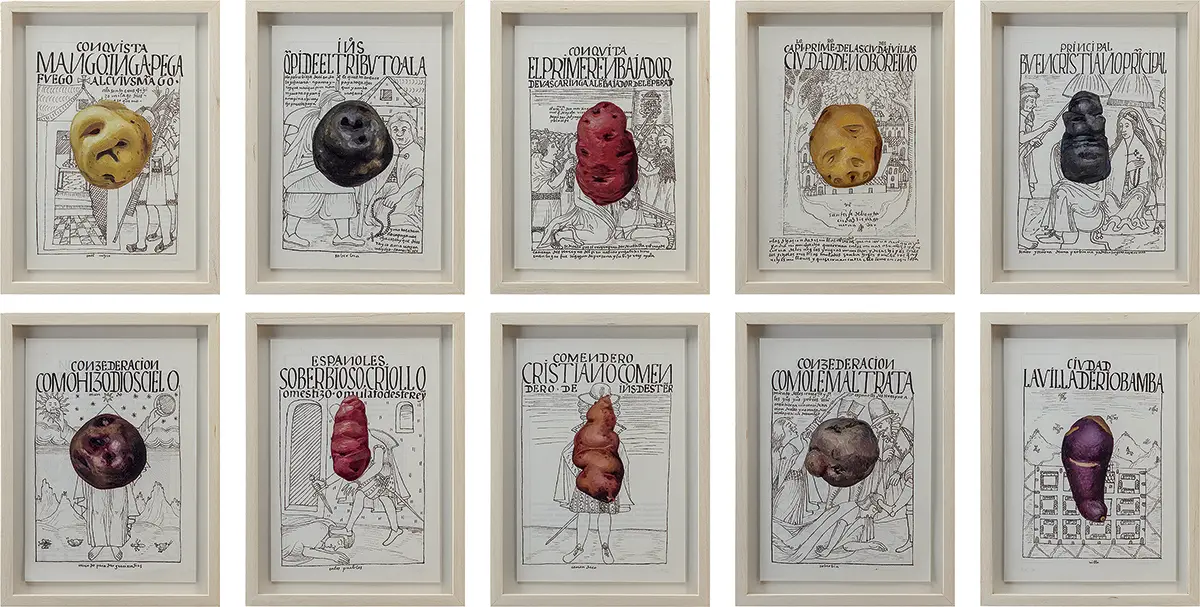
In the third series, Cuando las papas se queman (When Potatoes Burn), she questions the fallacy of a harmonious cultural and economic exchange between Spain and the Inca civilization. A version that has been denied since 1615 in a letter written by the Inca Felipe Guamán Poma de Ayala, known as Primer nueva crónica y buen gobierno (First New Chronicle and Good Government). Addressed to the King of Spain, Felipe II, the letter recounts, among other facts, the mistreatment suffered by the native people. On each reproduction of illustrated pages taken from this document, Sandra Gamarra paints a different type of potato, which is a symbol not only of history and tradition, but also of the advances of technology, since the more than four thousand existing varieties are the result of a science developed throughout time, although it is not recognized as such in the exploitation practices of colonial times and in Western paradigms.