The feminist art collective Polvo de Gallina Negra (Black Hen Dust, PGN in its Spanish initials) was launched on June 21, 1983, by Maris Bustamante, Mónica Mayer and Herminia Dosal. Since then, and over the course of ten years, Bustamante and Mayer—Dosal left the group early on—developed a systematic body of work with actions that became part of the genealogy of Mexican and Latin American feminist art. At the base of their actions was a strong critique of the patriarchal system, expressed in radically experimental strategies and languages indebted to the 1960s and 1970s Neo-Avant-Garde, whose humor, irony, and sarcasm, at times blurring the border between art and activism, informed the vast array of situations around which the group’s production was structured: action art, urban interventions, mail art and the mass media, TV performances and newspaper columns, street interventions and contests, video recordings of actions or active participation in feminist rallies. Like many art collectives in 1970s and 1980s Mexico, PGN used popular culture references to put across an incisive commentary on the social reality of women in a deeply unequal system.
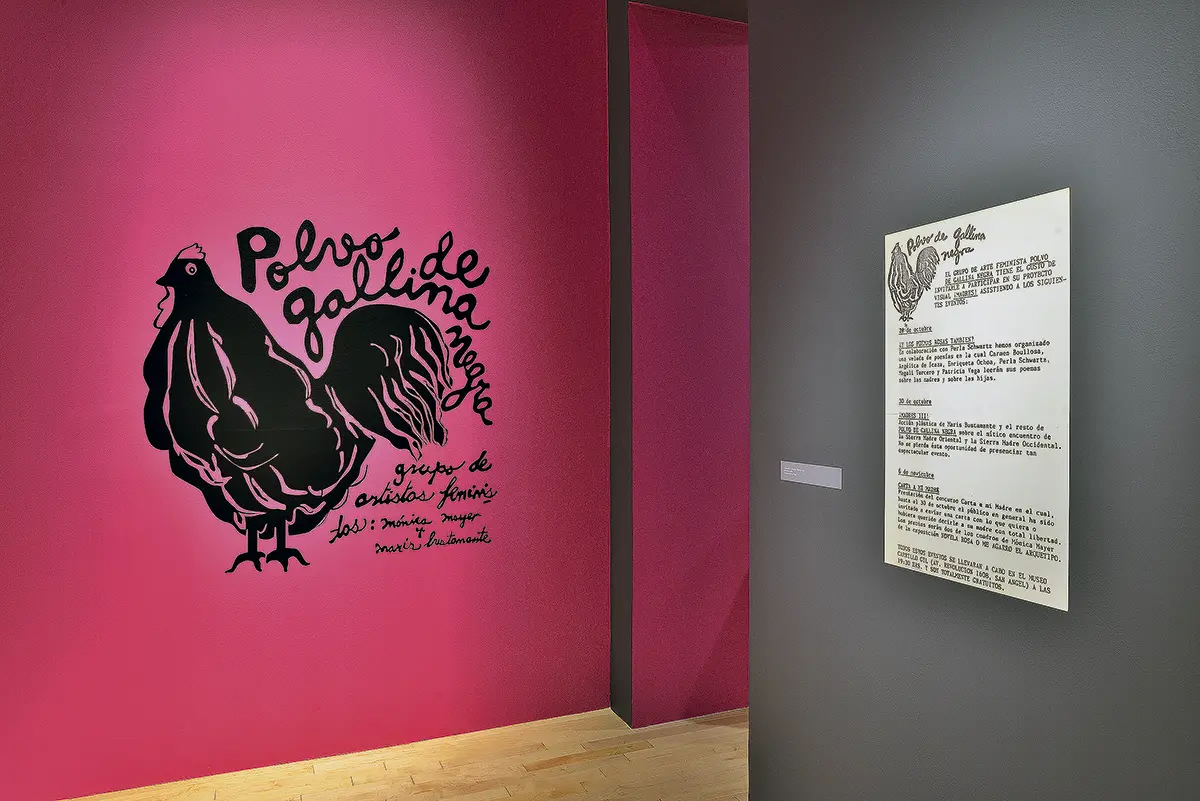
Almost forty years after the group’s launch, the exhibition “Polvo de Gallina Negra: mal de ojo y otras recetas feministas” (Polvo de Gallina Negra: The Evil Eye and Other Feminist Recipes), curated by María Laura Rosa and Julia Antivilo Peña, provided a historical tour through a decade of work, as well as through PGN members’ earlier individual backgrounds and the resonance of their actions’ in the present. It is one of the first retrospectives devoted to this group of women artists who engage the art field as a site for knowing co-conspiracy, community creation, and the circulation of shared experiences. The exhibition was on view at the Centro de Arte Contemporáneo Cerrillos (Chile) between January 15 and April 15 of 2022 and at Museo Amparo in Mexico City (Mexico) between July 2 and November 14 of the same year, and will be at Museo Cabañas in Guadalajara (Mexico) from March 11 through July 30 of 2023.
The exhibition was organized in three sections. The first section, titled Antes del polvo, 1977-1983 (Before the Dust, 1977-1983; note that in Spanish, the word polvo, dust, is common slang for sexual intercourse) encompassed earlier individual experiences and works by the PGN members. While Maris Bustamante worked with No-Grupo during the period covered in this section, Mónica Mayer began her career articulating her interests to those of a variety of feminist groups, for which her time as a student in Los Angeles, where she was in contact with the Feminist Studio Workshop, was a key influence. Nevertheless, those influences were adjusted to the Latin American context, with the adoption of a situated perspective. The two artists’ trajectories during those years involved explorations that would later become central to the work of the collective: a search for neologisms to think the practice of art; an exploration of languages that directly broke with the modern canon; and an exploration of humor and popular culture. Maris Bustamante’s works like La patente del taco (The Taco Patent) or El pene como instrumento de trabajo (The Penis as Work Tool), along with Mónica Mayer’s works like Lo normal (The Normal), El tendedero (The Clothesline) or Nuestra señora (Our Lady), are featured in this first section.
The second section, titled Polvo de Gallina Negra, 1983-1993, featured a vast selection of items and archives associated with the group’s practice. Here we observe their approach to a Latin American-inflected postmodernism, where the references to social reality and the overwhelming of aesthetic languages articulated a large number of reflections about topics like motherhood, desire, rape, or the dearth of women in the art system. Examples of this are, among others, the collective’s maiden action on October 7, 1983, titled Receta del grupo Polvo de Gallina Negra para hacerle el mal de ojo a los violadores, o el respeto al derecho del cuerpo es la paz (Polvo de Gallina Group’s Recipe for Giving Rapists the Evil Eye, or Respect For One’s Right to One’s Body Means Peace), which was presented as an artistic-political action during a feminist march against rape in Mexico City, and the project Madres (Mothers), which would have a number of outings along the entire decade. It also bears mentioning that the group used their artistic practice to propose terminology, coining words like transmaternidad (“transmotherhood”); it was used for the first time in the mail art project Egalité, liberté, maternité, which alluded to political activism as a logical consequence of struggles for the welfare of one’s children, this is to say, struggles that are inscribed in motherhood as such, like forced disappearances, resistance to obstetric violence, the recognition of reproductive and care labor, and State justice in cases of feminicide.
Lastly, the final section, titled Pospolvo. Reactivaciones (Post-Dust. Reactivations), presented activations of earlier works, along with current resonances and reverberations of the genealogy inaugurated by PGN. It covered the years 1993 through 2020, a period when protests against feminicide, the disappearance of women, and the many violences of the patriarchal system have remained as urgent as ever. This review of one of the most unique collectives in Latin American feminist art is a solid contribution to the still pending task of memory, which will undoubtedly remain a beacon for the relationship between art and activism in the region.