Throughout her career, Mexican artist Minerva Cuevas (Mexico City, 1975) has used multidisciplinary investigations to explore the structures of capitalism and their consequences for society.
This has led her to projects in which art becomes political action, as in the case of Mejor Vida Corp (Better Life Co), which Cuevas began to develop in 1998. In it, she sent by mail, free of charge, products such as student I.D.s for discounts, subway tickets, and pre-stamped mail envelopes, as well as services like the writing of recommendation letters and campaigns that protested the predatory practices of certain companies. The purpose was to critique the market and to provide social support against the system and its large corporations.
After a period of projects with similar intent, in 2016 Cuevas established the International Understanding Foundation in Cologne, Germany, a conceptual structure based on internationalism, set up to foment cultural, economic, and political freedom and to explore the impact of aesthetic practices.
For the exhibition “Game Over” at Museo Jumex, Minerva Cuevas took that same conceptual structure as her platform and encourages viewer participation, presenting a series of contemporary ruins where elements of play, ecology, and urban development are present.
The title of the exhibition speaks to the apocalyptic notion that informs these installations, devoid of any hope for a better future and marked instead by the convergence of past, present, and the desolate future that is the legacy of “progress” and the evolution of large corporations, such as those in the petrochemical industry.
The center of the exhibition, on display in gallery 1, is 200 mamuts, casi 25 camellos y 5 caballos (200 Mammoths, Almost 25 Camels, and 5 Horses), where a giant paper mammoth was created with the participation of visitors, using traditional cardboard techniques. This mammoth is a reference to those found in the area of the new Santa Lucía airport after construction began in 2020, eight 14,000-year-old specimens now on exhibit in a specially built museum.
The mammoth sculpture serves as a meeting point and a center for action in the gallery, where various workshops have been held as construction, using financial newspapers for their material, marched forward. This underscores the artist’s interest in illuminating economic and social issues. The intention of generating a participatory work of art gives greater weight to the idea of community as a form of resistance in the face of plunder and extinction.
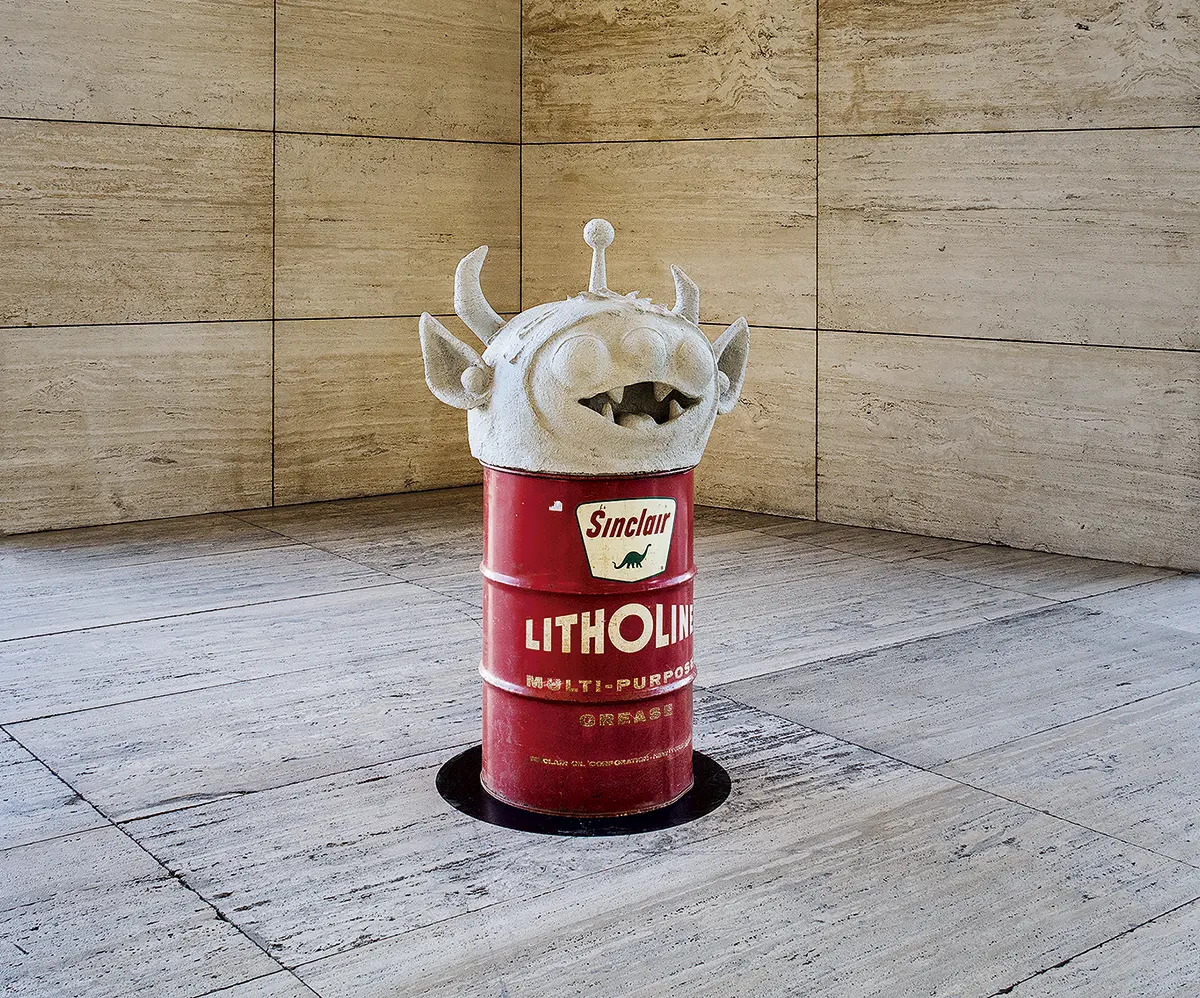
In Petro 1-8, Cuevas exhibits used barrels from such Big Oil companies like Shell, Valvoline, and BP, among others, as archaeological finds, combined with playful elements that resemble Disney or Pixar characters and bring to mind the trash containers of an entertainment resort.
With the same playfully ironic intent, Plataforma 1 (Platform 1) represents a digital landscape and makes possible the action of inhabiting a sculptural space, interpreted variously according to each visitor. The slide featured in this small play space invites visitors to enjoy and become part of the game, halfway between fiction and reality.
On a wall we encounter Hélices I-VII (Propellers 1-7), comprised of a series of propeller blades that are used as containers or pots for cactuses. The origins of this work are in Disidencia (Dissidence), a project Cuevas has developed since 2007, documenting modes of protest and autonomy in Mexico City. She noticed the items in a home in Tláhuac, where, despite the difficult living conditions, there is always a space for creativity and for life as an act of resistance.
In another gallery we encounter the video and installation No Room to Play, created in 2019 in Berlin, Germany. For this project, Cuevas researched urban development and the creation of children’s parks during the reconstruction period after WWII in Europe. Based on her research, she concludes that children’s parks are a mirror of social processes dominated by structures of power, yet can also become, by means of play and solidarity, transformative spaces.
The video presents a sequence of images of empty children’s parks, some built on sites ravaged by bombing and evoking horrific scenes of destruction. This narrative speaks of the imminence of an emergency resulting from climate change, and of how public space has been gradually abandoned in favor of other dynamics in a society that must adapt to privatization and gentrification.
“Game Over” provides a window onto a bleak future, but also an opportunity to seek new paths to achieve a more participatory society, able to confront the predations of development with a sense of community, autonomy, and imagination.
ISAURA RUIZ