A long road has been traveled between the founding—if you can call it that way—of La Panadería in the 1990s by Miguel Calderón himself, along with Yoshua Okon, Pilar Villela, and many others, and “Aesthetic Material Available,” the retrospective exhibition curated by Taiyana Pimentel and Mariana Mañón for the MARCO in Monterrey. The show then traveled in an abbreviated version to the Museo Rufino Tamayo, with very good prospects of traveling further, under that very modern premise regarding mountains, Mohammed, and who goes where.
This premise could also be what triggers the works of Miguel Calderón; not only what constitutes them, but also all of its possible activations. What gives rise to this (or another) reflection is no more than a premise, an assumption within a mapped territory; a rediscovery, a reinvention: what surprises us time and time again is not so much what makes a work of his, but rather the operations of his machinery.
His reading and re-reading of the times, of the broken and yet-to-be-broken models and conventions, result in works that are always located halfway between provocations and the devices that activate it. Miguel Calderón erupted on the 1990s art scene which, just like the free market, exceeded every rule in order to enter a globalized world that is being updated daily, like the apps we load on our small portable gateways. Well aware of these transformations, Calderón has been pointing to the social and political tensions between Mexico’s’ diverse cultural strata and to the various bridges that link them, not as exercise in criticism, but as an uncomfortable comment, a gaze that invites you to lean out to observe what otherwise might seem faded or diluted.
In this sense, Ridiculum Vitae (1999) transforms his CV into a mat ready to be used as a space or place of transit. It is not so much the object or its function, but rather the space it occupies—or the reserve stretching over it—what indicates this transit zone. Converted into an intentional action, the artist could well have forbidden us to step on it, obliging us to see it at a distance, like a rug on which the artist’s resume has been written. This would have fulfilled another intention: the do-not-touch museum game. Trampling over it gives it meaning and purpose: as evidence and omission. The literal inventory of his trajectory is the support of the piece, in terms of the potential action that activates it from the moment we ask ourselves whether to look at it while stepping over it or walking past it.
It is unfair to limit the experience offered by his work to the political or situational dimensions, given the intricate path of references and intuitions that ultimately shape it and that, like the layers of an onion, to use a common trope, reveal intentions, gestures, and nods that constitute the map of its aesthetic experience, or rather—as the name of this retrospective suggests—its matter.
Its “aesthetic availability” points to its existence, to being in existence, as in a warehouse. But in another sense, it refers to the probability of saying a lot, a little or nothing to the viewer. Thus, his intervention of a mattress store logo, whose name, DORMIMUNDO (Sleeping), invokes that other world beyond wakefulness. From mural to wall piece, it becomes MORIBUNDO (Dying) (1999), thus inferring that death—or agony, to be more exact—belongs to this world, as is represented in his logo encompassing different levels and readings: a game of meanings and intentions ranging from the mythical to the political.
In a similar vein, the series of large-format photographs he took during his visits to the Museo Nacional de Arte is especially relevant. Maintenance personnel mimic the poses of paintings from the museum’s collection for his piece Empleado del mes (Employee of the Month, 1998). In a game of transpositions and translations, of glances and power games, Calderón invokes and examines boundaries and disagreements, relevance and visibility, to revisit—between reference and its sublimation—gestures, illuminations and materialities that redeem, even if negatively, what is considered to be the ultimate intention of art.
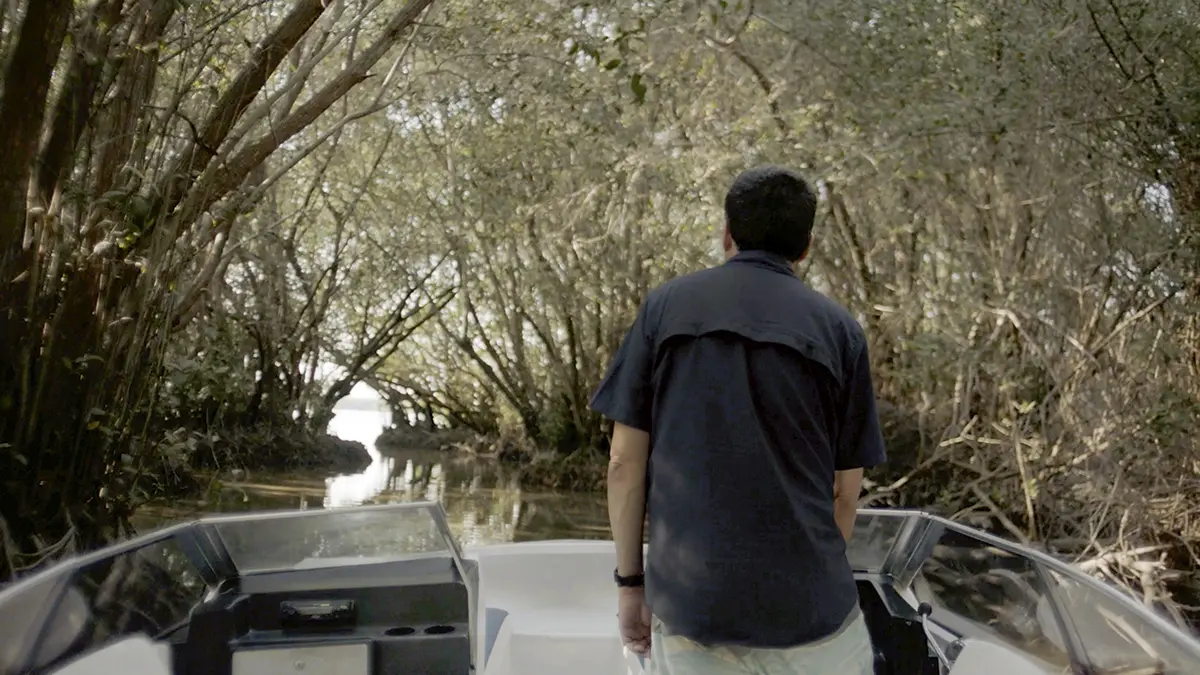
Both the photograph of the cab driver who accompanied him on a trip throughout Mexico, caught urinating on the side of the road while the taximeter continues to tick, and which reflects on transits and their contenders, and El balance de las improbabilidades (The Balance of Improbabilities) (2021), the film in progress that follows frame by frame his conversation with an adjuster through different parts of the country while facing different situations, insist on the question floating in the air: “How much does the damage cost?”