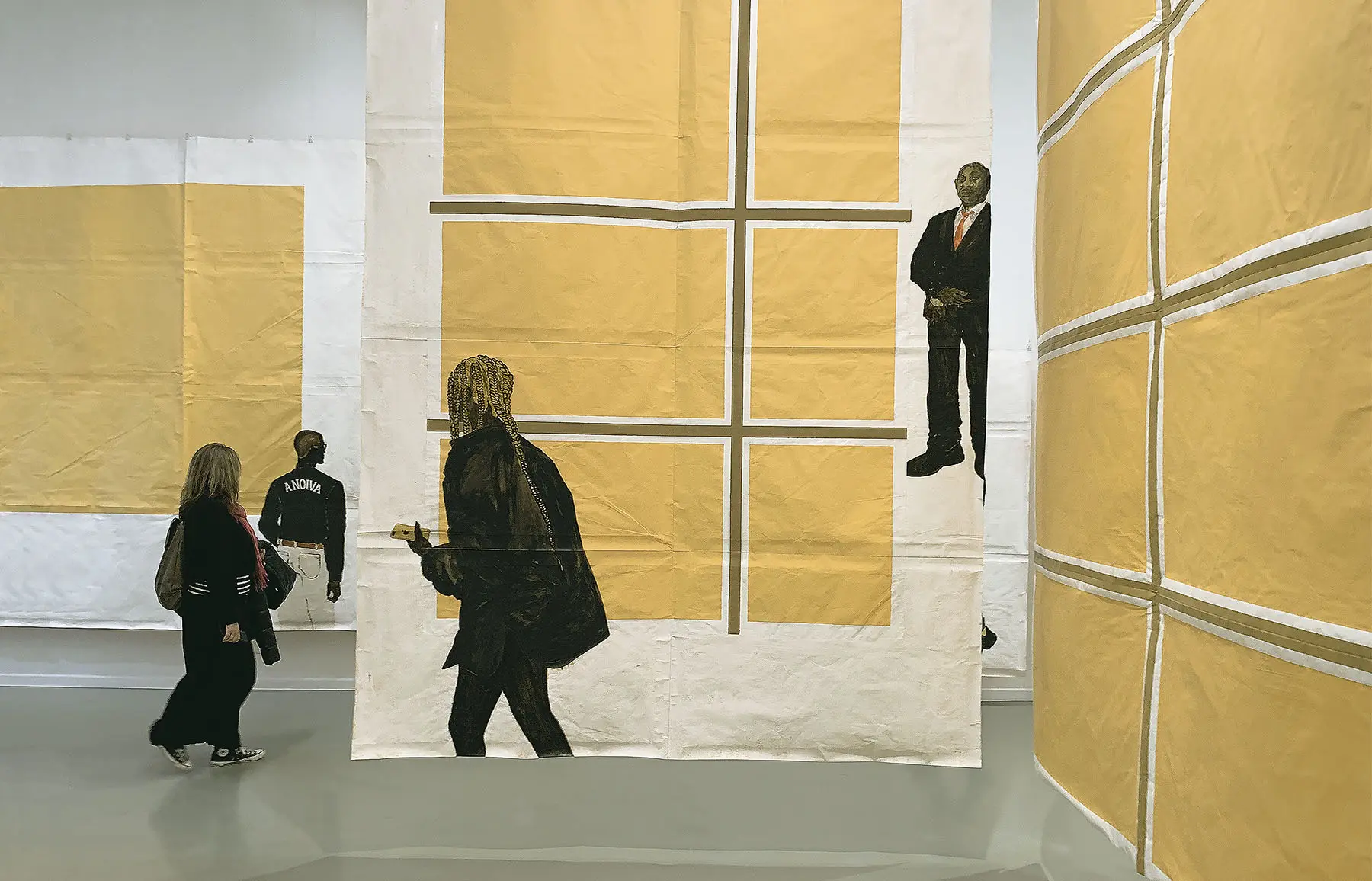
Paintings on paper hanging from the ceiling, positioned against the rooms’ walls and throughout the gallery, create new divisions within the space which visitors can walk through and explore. These paper panels are formed by rectangular sheets taped together, brown tape against brown paper. Large-scale human figures and a few objects are dotted around, all against a background predominantly painted white.
Painting over brown paper is Maxwell Alexandre’s bread-and-butter but no less worthy of attention or praise: in the country Alexandre comes from, this type of paper is called pardo, a shade of brown rather vaguely positioned between the black and the white. Employed to refer to varied mixed heritage in the most generalised manner, the shady term is found across ethnicity tick-box forms that both lay out and flatten down Brazil’s demographics. Alexandre’s earlier works state clearly that pardo is paper.
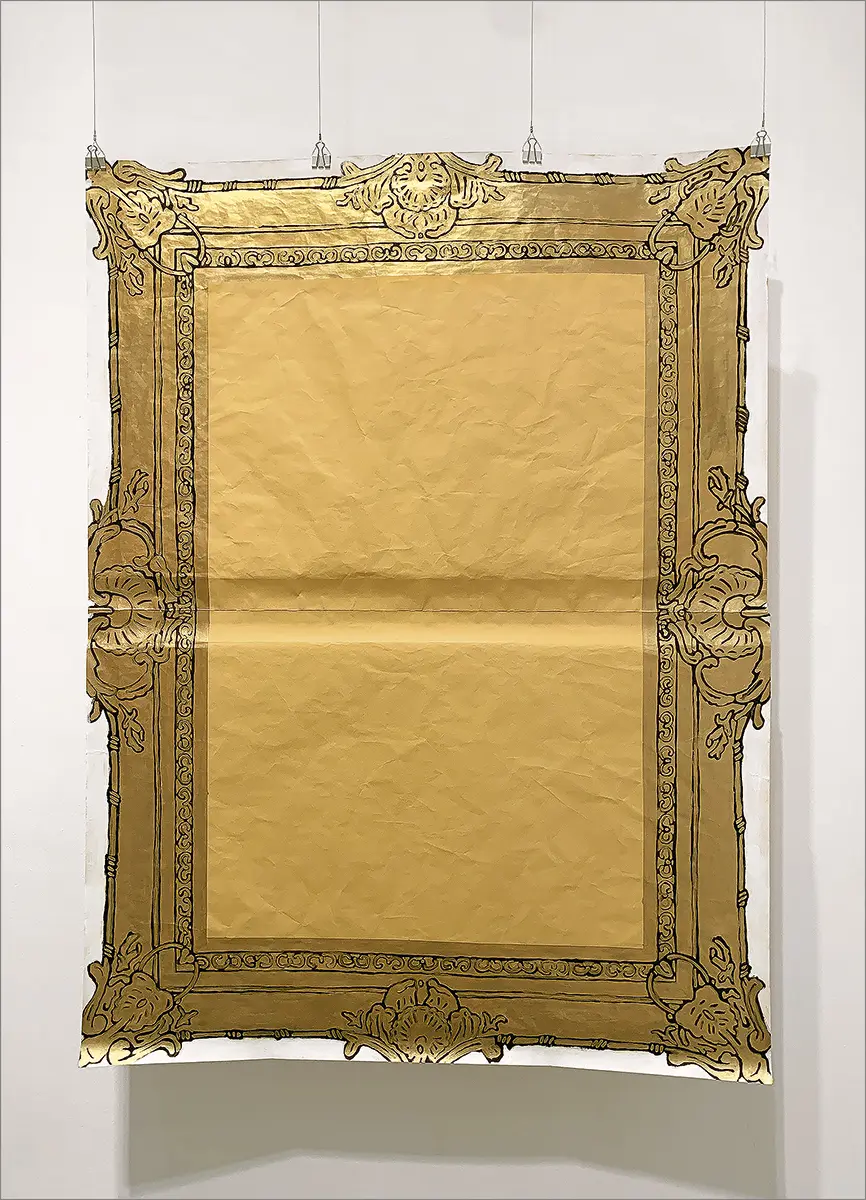
Through the past five years, Alexandre’s pardo papers have accessed high-profile art spaces across countries: Palais de Tokyo, The Shed, MAC, Tomie Ohtake, Zeitz MOCAA, you name it. Alexandre grew up in Rocinha, known as the largest favela of Rio de Janeiro, Brazil, where he lives and works. Brazilian favelas are extremely complex social spaces in which the State is scarce and parallel powers visible to the eye. For a citizen of such a community, questions about who gets to pass where, and access what, must acquire a layer of meaning far beyond my position to assume. I can’t possibly name it.
This show is titled after new powers, and an action rather specific: pasabilidad speaks not merely to the act of passing but to the ability to pass. That quality of the can. If in English the words sound distanced, let the Portuguese or Spanish clarify: can is said poder, as in power.
Shedding light on the space that Black bodies occupy in art and fashion, the exhibition resorts to two allegories: the art gallery and the catwalk. One painting features a cloak full of ornaments; a Greek sculpture denotes an obvious reminder of beauty standards; a window display comes with a security guard waiting on the other side; cool jackets, a naked body, colourful outfits, handbags, recognisable brands and logos. Some clothes say ‘welcome’, others tell an entire lifestyle.
But before this fashion blast, most of the panels visible upon entrance are plain white, with few figures in sight. Only gradually does the show get more populated. These white layers make for an easy allusion to the white cube, a so-called neutral space meant to honourably host certain types of art. Paper walls painted white and left plain remind us that none of that is neutral and, instead, constructed. Perhaps a suggestion we shall not take blank for granted.
In the gallery layout created by Alexandre’s works, more layers are acknowledged, sometimes stacked in up to three sheets, slightly spaced out between themselves. At times visible, artworks’ backs show what lies behind the painted surface, as though a reminder that narratives have other sides, layers of their own, with another colour, another density even.
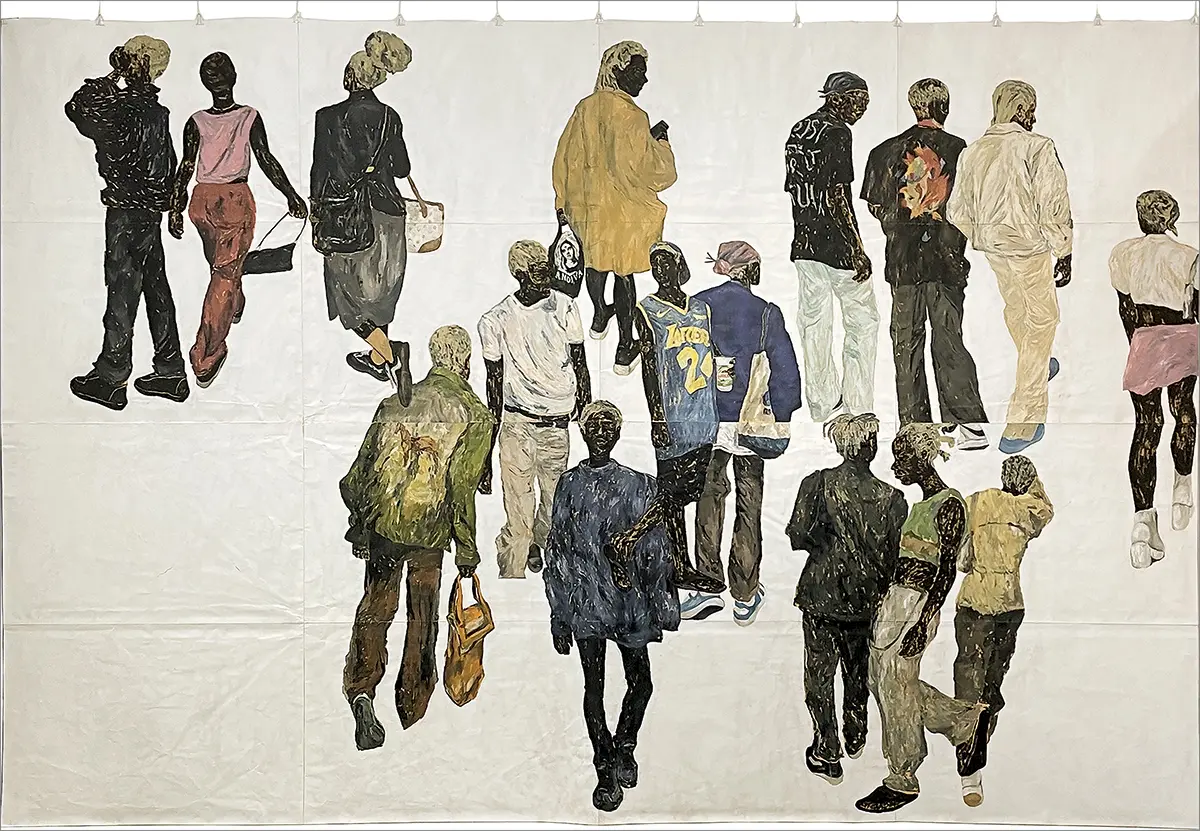
Many elements painted throughout self-refer to an art exhibition space: a far-fetched golden frame, a wide bench like those found at the centre of an art gallery, paintings, museum stanchions. Premising the power such spaces hold, questions follow about who gets to enter them and, further, who has the power to authorise so – agents often neutralised just as the white cube. It is in this questioning, about agency, that Alexandre’s response shines through.
Works seem carefully positioned so that, as the viewer moves across the space, lines and layers create a new composition every time, activated before the viewers’ eyes as they move through, in a gesture that hands agency over to the audience with great generosity: it is possible to participate. The passive space of contemplation evolves into an active experience, playing the game of layers that constantly offer something new.
Among these ever-changing compositions, ultimately, lies the presence of all human figures painted into the scenes. In them, the vibrant brushstrokes leave grooves through which light can pass. This light and energy convey life and movement to the figures, all bodies of colour.
Paintings depicted inside the paintings are always plain – brown. Against them, silhouettes contemplate, whose backs we get to contemplate in turn. Compositions come to life once again as one is willing to observe visitors in the room. Paper panels become frames that visitors inhabit as much as the bodies therein painted, their own now placed against the background. Perspective is played with, in and out of the paintings: some figures are depicted half hidden by a wall while the same happens with moving bodies in the room. It becomes possible to hide and to reveal oneself through the layers built at La Casa Encendida. Attention and action are consistently handed over to the spectator’s side, painted or in the flesh.
This game of in-and-out gives the viewer something to work with in an accessible manner, their very presence the subject matter. Those who get to pass through the rooms can, in principle, relate to it in some way. It allows one’s own body to integrate the space and encounter the painted bodies with their own, as if invited to mingle a little. Sensed on the ground, this invitation feels kind, a welcome beyond words painted across cool jackets. For a moment, the power addressed in the space feels repositioned, at the viewer’s disposal, honouring its presence and passage.
Recognising the power it holds, Alexandre’s exhibition does not belittle its visitor with the pettiness of imposing itself. Instead, it tries to elevate their presence, bring them closer, welcome them into it kindly. Walking through the space satiated my eyes and my guts with that type of satiety that is possible when one feels part of something. No doubt a privilege. Aggrandised in the space and prompting participation, those painted figures seem to help aggrandise, too, the visitor’s own presence. Perhaps a suggestion that there can be a case, or a day, in which, when they pass, we all pass.
CECÍLIA VILELA