Marlon de Azambuja refers both to art’s gestural aspect and to its raw, ascetic radicalism. In a positive sense, his work becomes an “open” process, and in an antagonistic sense, it becomes “ahistorical”. Rosalind Krauss sees structuralism as a way to turn the ahistorical (a constant of the present era) into a value rather than a contradiction. If it is possible to contest such a complex issue of “originality” with the notion of “repetition”, invoking the myth of the Argonauts, whose ship reached the end of its voyage with an entirely different body, then reality, far from historicistic, is cyclical and recurrent. 1
This explains why, while the emergence of a “nuclear art” took place in Italy during a period of radical negativism towards progress in the context of the postwar circumstance, the nihilism, the reservation, and the physical laws contained in that essential word gain new expression in the most recent exhibition of works by this Brazilian artist, based in Europe for over 15 years. Which is to say that, after an accumulation of such uncertainties as the new geopolitical tensions and the asepsis of the post-pandemic era, the selection of works on exhibit points in the direction of the “nuclear”. Almost in the same sense of the movement that rejects advances in physics and the new ultra-technologies, here in allusion to the reach and uses of the image and the symbolic, which will leave the (artistic) object itself and the exhibition space (and its aura) in a state of crisis.
Art beyond experimentalism approaches that which the theorists of Arte Povera called a “form of plenitude, or of all senses”. A form that appears not only to vision, but to touch, smell, and taste as well, and which starts from constructive processes and rather sober, organic or extremely concrete materials, existing in a sphere where the universal and the elemental become one. The use of concrete, wax or lit candles, pigments applied without the help of a brush, or works that are images emerging randomly from the process itself, contribute new facets to art as origin. At first glance, this presents us with the idea of the incommensurable, of mystery and a negation of the classifiable, properties that engage the viewer’s participation and break the pristine rules of art collecting.
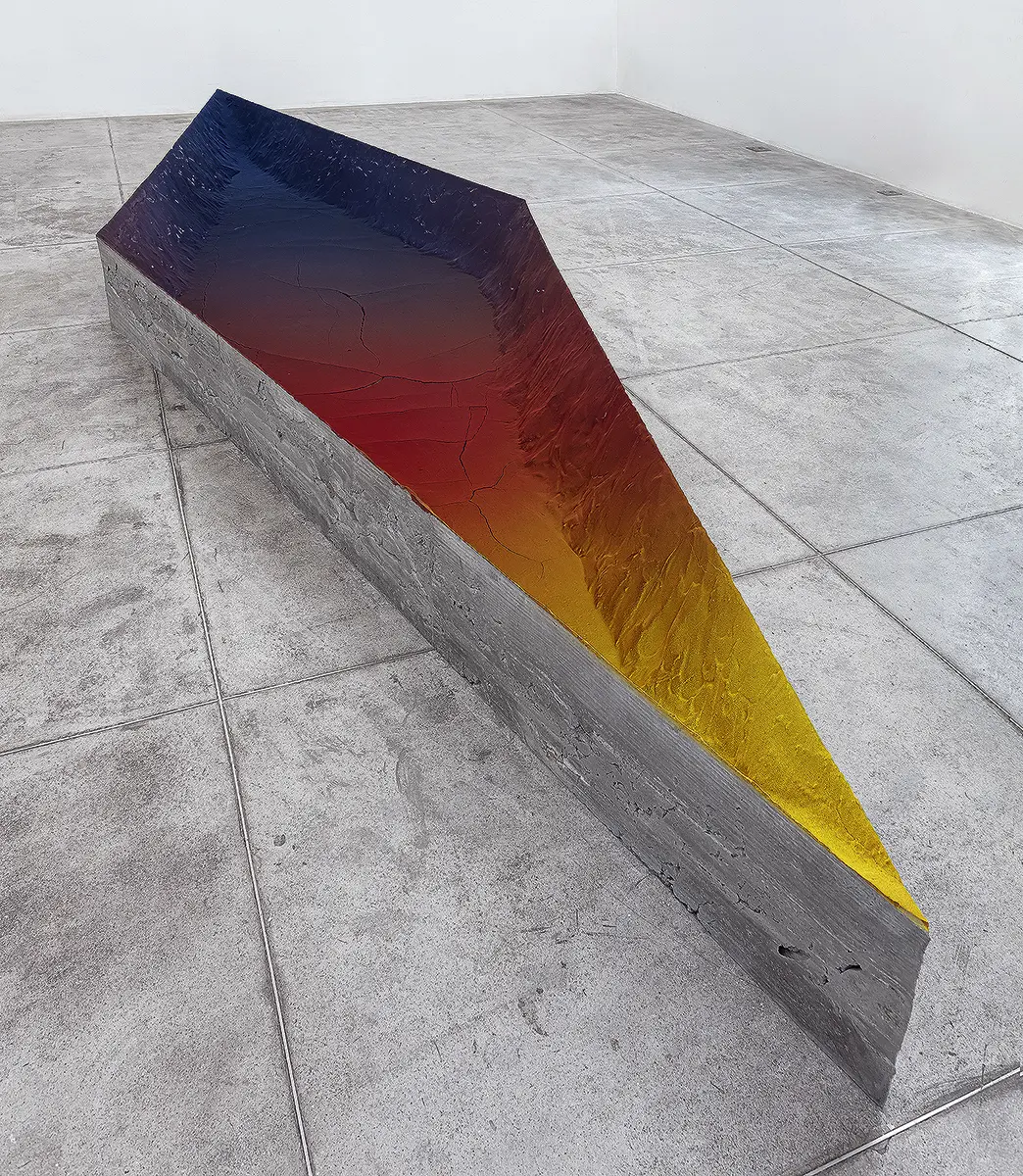
In that connection, these are some of the detours that make it possible to predict de Azambuja’s art from within a frame, where habitual categories act in dialog with their opposite pairs. Set against genre terms like sculpture are others like architecture and landscape. The main work, a diamond-shaped mass on a base, is arranged at the center of the exhibition room, occupying the niche almost from one end to the other and leaving only narrow corridors for circulation; it poses a challenge to the space’s very architecture. Meanwhile, its color is a gradient from intense blue to red and yellow, which gives it the semblance of a geological find. The surprise provoked by its literalness, moving in from every angle, puts us back in mind of the landscape, as in fact does the title, Aurora boreal (Aurora Borealis), generating yet another semiotic tension. In other words, that which is neither “architecture” nor “landscape” can be understood as sculpture. To be sure, it is sculpture pushed to its limits in terms of form, but its potentiality as discourse has expanded. Nature brings with it cyclical implications in each of the Earth’s zones (tropical, equatorial, or polar) that define our cultures. With this, Azambuja’s work highlights the counterpoint between the constructive, with its concrete elements of foreign origin, and mimesis, with the corporeal and the environmental, a pretext for discussing instances of identity that bring climate, ethical, and political matters to bear.
These confluences are also expressed in de Azambuja’s work. It consists of one kilometer of burnt candles of which all we see is the length contained within the gallery (against the back wall). The artist comes to fall back into another myth: spatiality, paying purposeful homage to Walter de Maria’s landmark The Broken Kilometer (1979), which unfurls a metal line of that length, subdivided into five groups of parallel lines. In Marlon de Azambuja’s work, which he describes as “a fire horizon, what for the American artist was seemingly fluid and unlimited becomes not only a hyperbole of metering, but a hyperbole of a drawing generated by those thousand-plus burnt candles. Those candles also provide a unique balance. As ancient devices for illumination, inseparable from the temples and the niches where art was placed, they now invoke not as much the sphere of the sacred, but rawness, another aesthetics and ethics of art.
NOTE
1. Krauss, Rosalind. The Originality of the Avant-Garde and Other Modernist Myths. The MIT Press, Cambridge Massachusetts, London: 1993, p. 3.