The exhibition Nos gustaría contestar algunas preguntas: colectivo marcelaygina 1997-2010 (We Would Like to Answer Some Questions: marcelaygina Collective 1997-2010) revisited the work of a Mexican collective formed by two female artists, Marcela Quiroga and Georgina Arizpe, featuring documentation of actions performed in the 1990s. With their bold, forward-looking proposals filled with humor, irony and social critique, marcelaygina was one of the most significant collectives in Mexico’s contemporary art scene. The exhibition, prepared by the Puerto Rican curator Michele Fiedler in collaboration with the artists and with MARCO’s director, Taiyana Pimentel, remained open from October 21, 2022, through February 5, 2023.
Reviewing the artists’ archives prompted the curator to wonder about the historical context that gave rise to their actions. Writing about events in the city of Monterrey involved an exercise of memory spanning more than three decades. At the time, the CONARTE (the Nuevo León Culture and Arts Council in its Spanish acronym) and a fledging MARCO collection were in the process of consolidation in the city, and a series of new alternative spaces, like BF15 Gallery, had begun to emerge. At the helm of BF15, Pierre Raine and Jean Christophe were contributing fresh ideas to the contemporary art scene, with different opportunities for exchange and new possibilities for local up-and-comers, in particular the members of three collectives: tercerunquinto, marcelaygina and Los Lichis.
This show brings to the public an extensive review of the work (performance, readymade and intervention) of one of the most active female artist collectives of the 1990s. During the period covered by the exhibition, from 1997 through 2010, these two artists questioned the norms imposed on women in Monterrey society, as well as social inequality and the dynamics of Mexico’s northeastern border, a territory neighboring the US state of Texas. Their collaboration began in 1997, when Arizpe and Quiroga were art students at the Universidad Autónoma de Nuevo León and took part in Monterrey’s intense art scene, with a central focus on actions, processes and multiple interventions.
Most of marcelaygina’s practice took place in the field, based on a mediation of various audiovisual languages such as TV images, or popular consumption of images and videos. Their trajectory was international; they traveled across Latin America and in Europe. In 2010, the Museo de Arte Carrillo Gil, in Mexico City, presented a retrospective of their work in an exhibition titled Check Point.
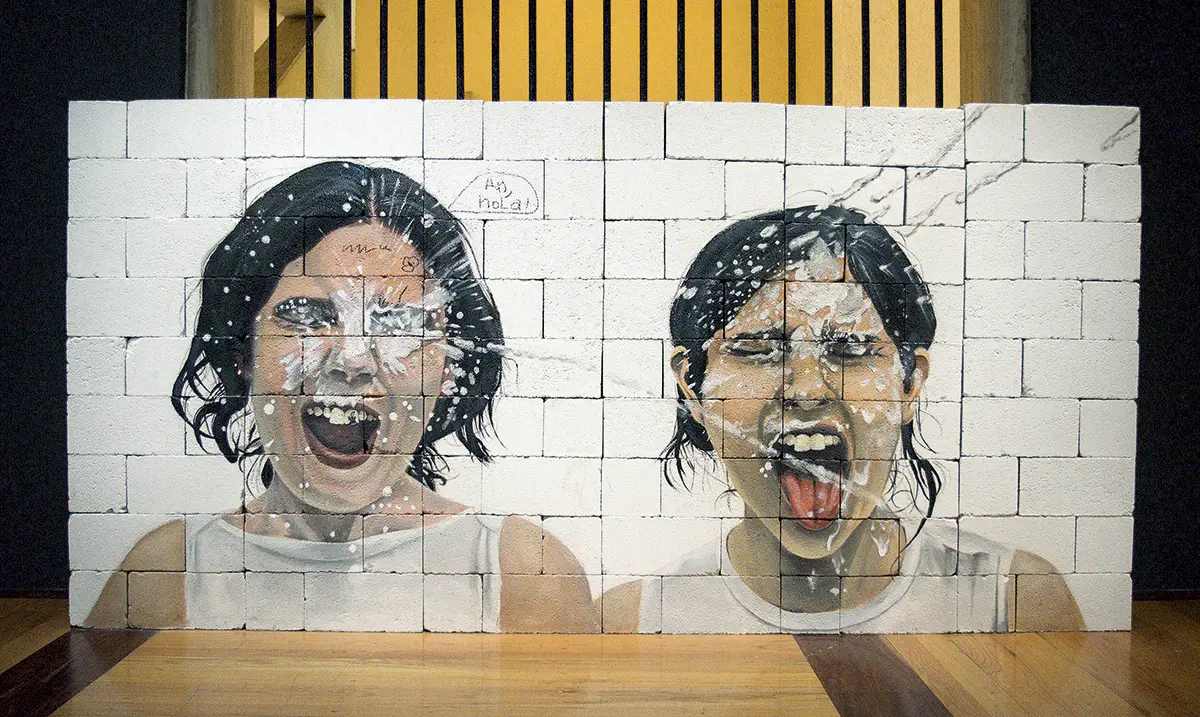
The work on exhibit in the MARCO show had institutional critique and humor at its core, first with performances documented in photographs and videos that posited questions about the roles imposed on middle-class women. Their characters, at the border between the legal and the illegal (sex workers, drug dealers, bootleggers), clearly demarcated the possibility of distancing oneself from patriarchal social norms.
This marcelaygina exhibition signaled a series of important moments in the construction of female identity, from the perspective of two young artists interested in critiquing the status quo of the arts in Monterrey in the 1990s and through the early twenty-first century. Laughter and a sense of humor are a constant in this show; the dynamism of its museography rests on a central principle: the efficient, uncomplicated integration of marcelaygina’s actions, which allow us to contemplate the photographs, video installations, sculptural items, and other forms of audiovisual communication on display.
The regional historiography of the Mexican northeast is as arid as its climate, which makes the efforts of curator Michele Fiedler, as well as the courage of MARCO Director Taiyana Pimentel and of the artists themselves, all the more significant and valuable. They worked dauntlessly to reconstruct, discuss and confront the archive in order to make a mark on the city’s memory of its recent past.