The first solo exhibition by multifaceted artist Lyz Parayzo, which ended in January at Casa Triángulo, brought into the city’s contemporary scene an environment of sharp metallic luster and luminous experiments with color, in a deliriously rehearsal of festiveness.
Parayzo, the title of the installation and a master key into the artist’s career-long autobiographical immersion, brought forth the acidic gaze of an art built on potentially explosive terrain, aware of the risks and pitfalls of the art system.
The show’s project, involving the creation of an enveloping setting inside multiple exhibition spaces, featuring large-scale mobile sculptures with spiral-cut metal sheets that swayed and moved to create a reinvented Eden, promoted a specific understanding of the legacy of the Neo-Concrete movement in Brazilian art.
Lyz Parayzo assumes specific research decisions, aware of her narrative implications, when she dialogs with the fragmented legacy of the Brazilian constructivist project and with Lygia Clark’s sensorial experiences to formulate her poetics, a poetics built for the contemporary period and engaged with fractures of gender and class as it confronts the psychic markers of socially rejected subjectivities.
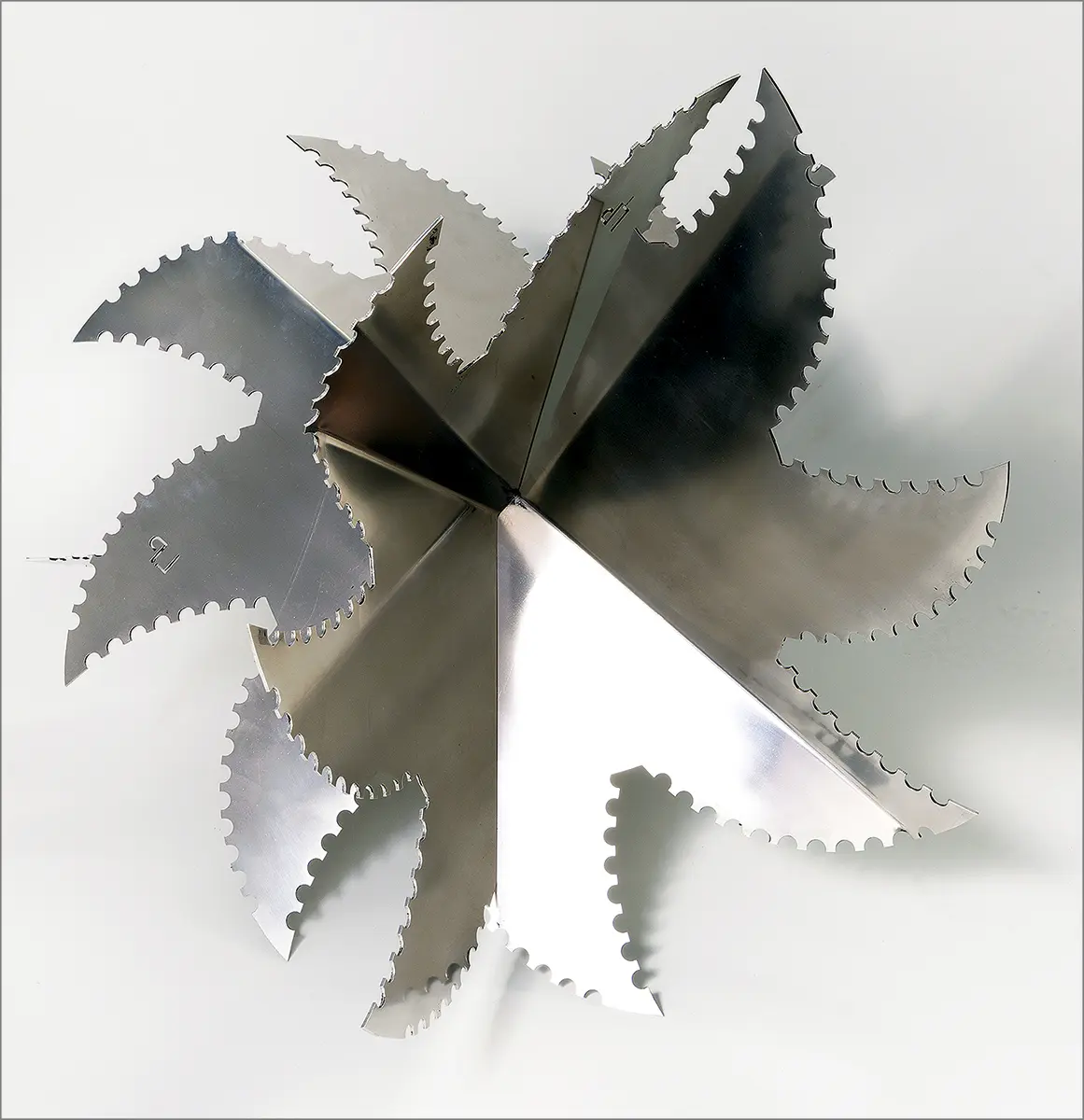
In the gallery, the recurrent coexistence of the sharp metal sheets of Parayzo’s serrated sculptures—suspended in vertical frames, in large-scale two-dimensional plates fixed to the wall, in symmetrical arrangements—welcomed visitors with a silent warning about the uncertainties, the onrush, and the pleasures in the struggles of dissident bodies.
As is known, the places reserved for dissident bodies in the contemporary scene are never those of the celebrated mainstream. Parayzo’s guerrilla art recovers the intimidated body and liberates it by constructing metallic responses, conceived as sculpture, that raise a symbolic alert about the pitfalls faced by discordant subjectivities.
Lyz Parayzo herself is a person in process whose training began in Campo Grande (a peripheral zone in Rio de Janeiro), followed with a period at the Parque Lage School of Visual Arts and the Performance Art course at the Federal University of the State of Rio de Janeiro (UNIRIO), and expanded into farther horizons with a Master’s Degree in the Visual Arts at the Beaux-Arts de Paris school in France.
The young artist’s project for that Master’s, titled Therapie Narrative: lettres à Lygia Clark (Narrative Therapy: Letters to Lygia Clark), brings together her academic research into a cross between a performance-sculpture project and a fictional conversation with the older practitioner, an important point of reference in Brazilian art.
The textual strategy of a series of letters addressed to Clark’s period in Parisian residence, between 1974 and 1976, brought to the fore Lyz Parayzo’s autobiographical project about her own gender performance, her physical audacity and her psychological incursions.
That project established a sophisticated hypothesis of interlocution with Lygia Clark, a woman who brought the body and the sensorial component of experience into a new dimension, with constructions incarnated as “non-artistic” in the most diverse materialities. This was the starting point for Parayzo’s installation in São Paulo, as an unfolding of her findings.
Another important reference in Parayzo’s art is the work of Brazilian psychoanalyst Suely Rolnik, who frequented Clark herself in Paris in the late 1970s; formulating a psychoanalytic reading of her sessions with relational objects, she conjugates many of the fronts that Lyz Parayzo explores in her own experiential project.
Here, subjectivity takes center stage, asserts its presence and points pathways for Parayzo.
The decolonization of desire, the exploration of liberated subjectivities, and the conviction that there is a space for experimenting between a way of existing in the world and that which is still to come, reveal the range of the forces that propel this young artist’s work.
The strategy for the exhibition/installation under review, Parayzo, that authorial invention of Eden, was to bring together sculpture, video, and conceptual jewelry works that reinvented the gallery space into a translucent environment, enveloping and at the same time menacing and dangerous.
Featuring stainless-steel plates and rivets, polished aluminum and steel rivets, the weight of lead, iron, and silver, the sculptures projected their own shadows across the entire space, an effect of the fluorescent lamps placed on the ceiling and carefully covered by pink film.
Inside the gallery’s exhibition rooms, the environment set up by Lyz Parayzo was bathed in shadows and bright circular halos, resulting from the motion of the suspended metal plates. To this she added a jewelry exhibit and a video projection.
The video, titled Cavalo de Tróia (Trojan Horse, 2022), was on view in the second room and divided the space with a series of frottages extracted from the serrated thread of her metal gears, as well as her guerilla jewels on display in small cases. In the same space visitors also encountered one of her visual protagonists, Bixinha Ouriço.
A stainless-steel work from 2022, the sculpture Bixinha Ouriço eschews manipulability of the kind Lygia Clark conceived for her Bichos. This new metal artwork dialogs with that reference, but the danger posed by its sharpness makes the Neo-Concrete project of audience participation unviable. Here, the menacing serrated edge activates estrangement and wariness.
Giving material expression to the flow of a corporeal consciousness that assumes the urgency of the non-binary and admits the unstable transit of a time of changes, including changes to her own existence, Lyz Parayzo calls visitors to reflection. Through her own voice, projected into the environment, visitors learned more about “the body that catalyzes a series of violences in the everyday”
This artist does not accept colonized desire or domesticated subjectivity. Her work is fueled by the decision of a transgressive artistic inquiry. In this way, she assumes the concerns of bodily knowledge and gives them expression in her three-dimensional practice: the performative aspect of her own experience is one result of the expression of her decisions.
This work, which also materializes Parayzo’s transgender militancy, is inseparable from her own life and attitude as an agent of a generation that embraces its convictions and commits to interrupt the snares and pitfalls of the era. Her own militancy is Parayzo’s proposal for such an intervention in the contemporary scene.
Performance art, by bringing forth her body in evidence, strengthened a consciousness of intransigence in the defense of dissidence and of the social place of her actions. Lyz Parayzo certainly belongs to a generation of Latin American artists who insist on confronting established cultural representations and critiquing the status of any creative process conditioned by the normalization of exclusionary patterns.