The son of Italian immigrants, Luiz Sacilotto (1924-2003) was born and raised in Santo André, a place with a history of proletarian, unionized worker struggles and leftist politics, in Brazil, which were to remain an integral part of his life. He studied at the Instituto Profissional Masculino do Brás and began to develop as an artist in the 1940s espousing the Impressionist style, which was still an important influence in Latin America, but quickly assimilating the movement to abstraction, strongly espoused by Sergio Millet. Around the 1940s, he was becoming known as a “proletarian artist”, a nickname given to him by the poet, painter, and art critic Sérgio Milliet, who had a notorious influence on the Brazilian modernist generation between 1930 and 1940.
The Brazilian constructivist movement with whom Sacilotto became closely associated, was characterized by debates that expressed the intellectual activity in the country during the 1950s and 1960s, a period especially marked by the two separate artistic currents, Concrete and Neo-Concrete artists. The Neo-Concrete manifesto in Brazilian art emerges in 1959, with the publication of the Neo-concrete Manifest by the group of the same name and must always be taken into consideration within the conjunction with the Concrete movement, which comes from the early 1950s and to the artists of the Frente group in Rio de Janeiro and of the Ruptura group in São Paulo.
Luiz Sacilotto was part of the Ruptura group, whose 1952 manifesto launched geometric art in Brazil almost half a century after the movement began in Europe. Other members of the group included in the order as listed in the manifest itself: Lothar Charroux, Waldemar Cordeiro, Gerardo de Barros, Kazimir Fejer, Leopoldo Haar, Luiz Sacilotto, and Anatol Wladyslaw, together they signed a defense of Modern art as a “medium of knowledge that can be deduced from concepts, which places it above opinion, requiring prior knowledge for its judgement.”
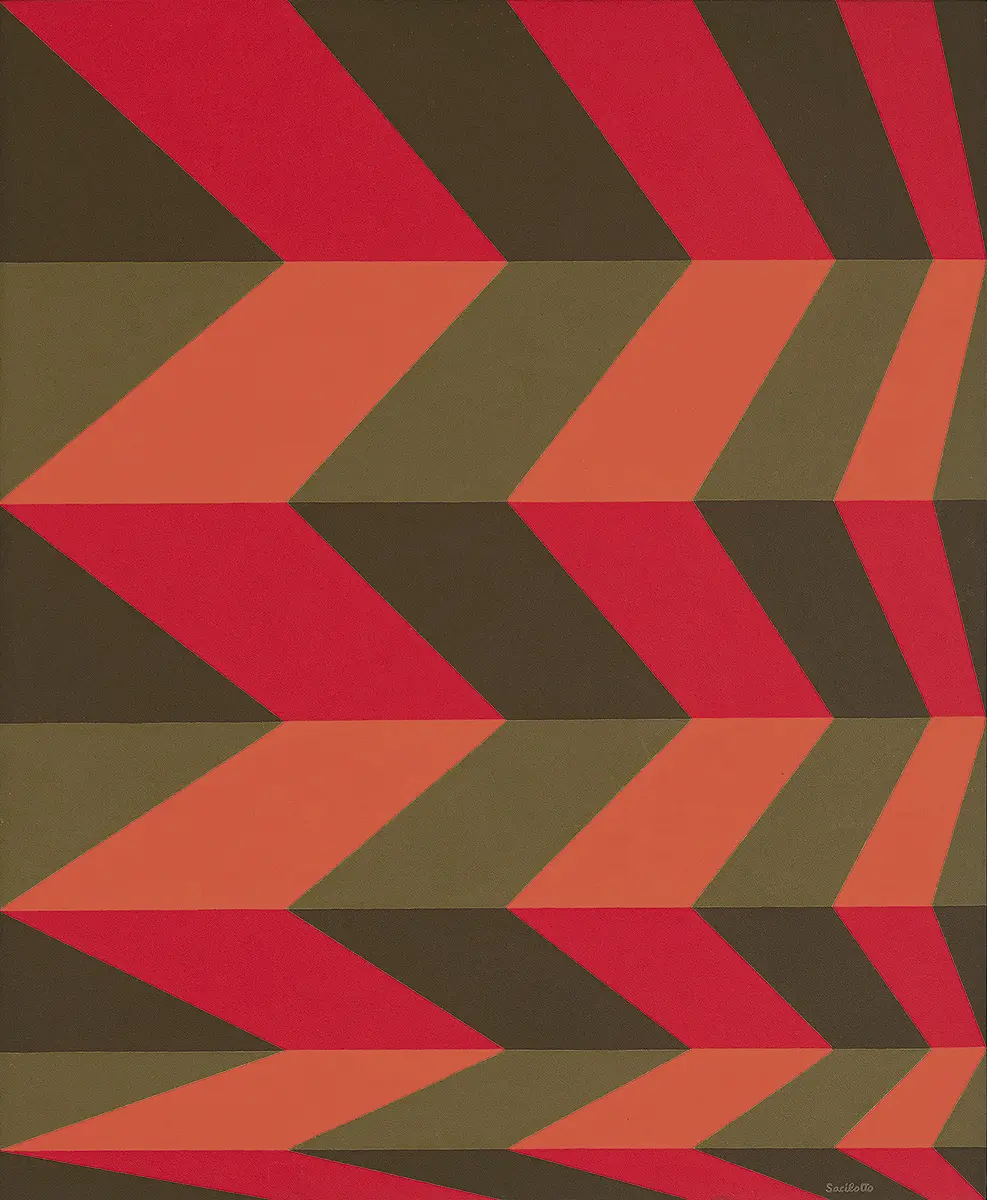
The exhibition at Leon Tovar’s gallery concentrates on the works from his last twenty years when he had solidified his style and concentrated in optical illusion. The painting titled C9993, an acrylic on canvas from 1999 has a green background with a yellow chevron pattern on top that creates the illusion of volume, whereby it looks like there are a series of creases and salient lines, which are actually totally flat, yet it is so well done that one cannot help looking at the painting from the sides to check on the volume, which of course is not there, it only looks volumetric from a frontal viewing point; another painting titled C0258 from 2002 has three red stripes on a brown background, the stripes vary from thickest to the left to thinnest to the right, giving the illusion of an undulation that translate into a protruding, relief-like effect.
His work has interesting color combinations that are very successful in creating the optical illusions: C9205, in black and purple, suggests several bumps in the canvas, while C8347 on a bright green background, a series of black triangles rush in and out of two opposing vanishing points. Ironically, considering the artist’s political affiliation with the traditional left wing, the concentration of neo-concretism on forms and colors makes any context that can be identified as political disappear from his work; and is curiously a process totally opposite to what happens in those years, during the Cold War, in Russia in which the abstraction of the Vanguard was replaced, with Stalin’s direct intervention, by a lamentable style of propagandistic realism.
Although less known than Victor Vasarely, from an earlier generation or Bridget Riley, from a later one, Sacilotto is an accomplished artist that is finally coming into focus due to the recent interest in abstraction in Latin America, particularly since the Carmen Herrera retrospective at the Whitney Museum: Carmen Herrera: Lines of Sight, Sept 2016/Jan 2017. Latin American abstraction was also extensively displayed at the Cisneros donation to MoMA when the Museum opened its new reconfiguration in 2019. One of his early abstractions, in black and white, from 1958 is in the permanent collection, but not presently on view.