
Luis González Palma’s recent work, shown at Throckmorton Fine Art in New York, also featured earlier works, so it could well be considered to be a small-scale retrospective. In fact, it turned out to be one of his best exhibitions to date, offering an enriching reassessment of his artistic production.
This talented photographer had his first solo show, “Self-Confession,” in 1989 at the Museum of Contemporary Hispanic Art (MOCHA) in Soho, New York, and it was at the opening of that show that I saw his work for the first time. It revealed a very innovative blend of photography and painterly aesthetics. The entire collection had striking sepia hues and an emphasis on the models’ eyes that was almost hypnotic; an effect the artist achieves by adding an extra layer of white pigment to the retina. The most notable element I can remember—one that is always present in his work, including the selection at Throckmorton—is how he brings the Maya and Mestizo people of Guatemala to a contemporary reality that enhances their innate grandeur and the melancholy spirit of a great culture whose social status has seriously diminished in comparison with its exuberant past. That was the first time I saw, anywhere in Latin American art, indigenous people given such a prominent place of honor and manifesting both pagan and Catholic beliefs that seem to intertwine in a natural way.
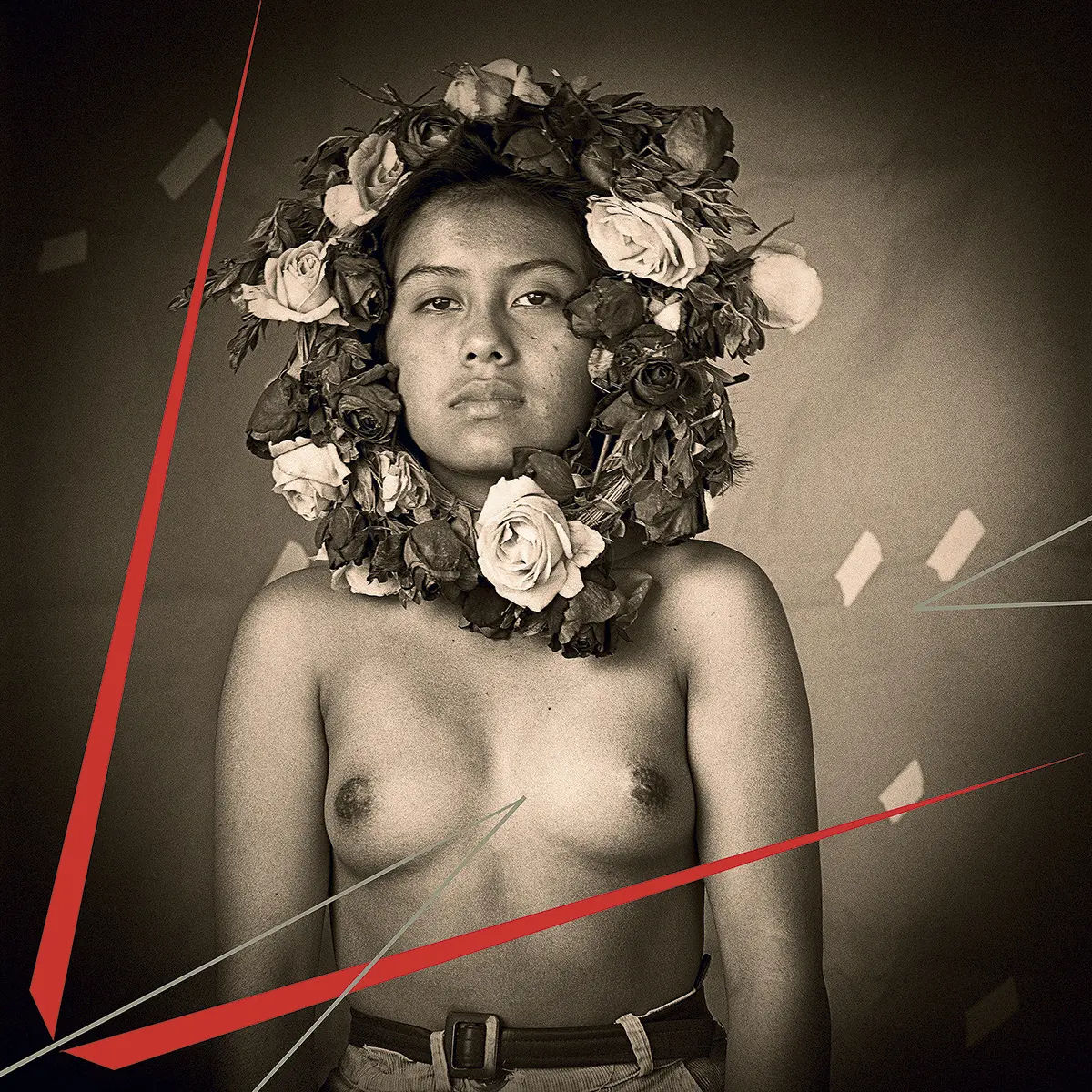
The Throckmorton show had a couple of photographs that I remember seeing in that inaugural exhibition. The Rose (1989) portrays a beautiful woman surrounded by a halo of white roses that accentuate her hieratic expression: an unusual image of feminine triumph in the work of González Palma. She looks like a Maya goddess of nature, radiating sensual beauty. It’s on the cover of an edition of Gabriel García Márquez’s novel Of Love and Other Demons (Jonathan Cape, 1995). A variation on this piece, made in 2015 and entitled Naked Rose (“Möbius Series”) alters the picture plane with geometric interventions and further distances the figure, so that we see her from the waist up. Moon (1990), the other work I saw in that first exhibition, has already become an iconic image and his most recognizable photograph. A nude woman in profile, with her hands tied behind her back and wearing a crescent moon strapped to her face, leans forwards. Mysterious hues evoke the kidnapping of victims or the remnants of an ancient sacrifice in a modern setting. This powerful image also generates an unforgettable emotional impact, reminding us of women’s vulnerability in the face of abuse in the impoverished societies of the third world. In this and other images, González Palma seems to expose disturbing and persistent realities that refuse to disappear in spite of the manifestations of modernity and the overloaded pseudo-reality of digital media.
Both González Palma and his colleague Alfredo Jaar, a Chilean artist and photographer, reveal a similar intention: to denounce human suffering. The Guatemalan artist manages to make beautiful works while portraying the fate of the less fortunate. He often uses the typical baroque halo of Guatemalan religious sculpture to frame the faces of women and children, giving them a status traditionally associated with pious images of worship. Two photographs that show these women crowned with potencias (pointed halos) are América (1990) and Virginal (2011). Both women are dressed in black and look directly at the viewer with a mystical yet astonished expression that reminds us of the Mater Dolorosa’s wounded gaze in the Hispanic Holy Week processions, or of a longsuffering contemporary woman photographed at a funeral: a widow or a mother who lost a child to the political unrest or to the drug wars that have plagued the region for the past three decades.
His images of children are particularly moving due to their weathered or anguished expressions, displaying a rare wisdom. Hero (1998) portrays a little boy with wide, forlorn eyes, who is marked with a huge star, and Hope (2000) is the enigmatic portrait of a young girl wrapped in a black cloth indicating mourning, with a lost gaze, like a silent witness, vastly alone against a sepia background of emptiness.
A very powerful photograph, which defines these women and those around them, and at the same time summarizes the precise way in which González Palma represents their undesired reality, is entitled Perdida en su pensamiento-Genoveva (Lost in Her Thoughts —Genoveva, 2011). A beautiful woman with her head covered by a shawl belonging to the peasant attire in Mexico and Central America, reminds us of the soldaderas (women soldiers) from the times of Mexicans Emiliano Zapata and Pancho Villa, when women followed their men and fought alongside them in the civil war that took place between 1910 and 1917. Although the design of the composition is a tribute to the women of Graciela Iturbide, the pensive sideways glance of Genoveva engendered an unforgettable image that sheds light on the restrained suffering of these peoples and their refusal to surrender.