
In the solo show entitled “La música como epifanía del mundo” (Music as an Epiphany of the World), Juan Sorrentino (Chaco, Argentina, 1978) comes out not only as a musician and sound artist, but also as sculptor, carpenter, and blacksmith, capable of adapting every element of each one of his works to specific aims. His numerous exhibitions around the world include those at Whitechapel Gallery (London), Bonniers Konsthall (Sweden), MAAT (Lisbon), SINNE (Finland), ARGOS (Belgium), MediaLab Prado (Madrid), Sonic Spring (New York), and the Pontificia Universidad Javeriana (Colombia). For his show at Herlitzka & Co., he conceived his compositions around four nuclei—Teleféricos (Cable Cars), Quebracho Tree, El residuo de la trama (The Residue of the Weft), Mancuspias, and Space Scanner—whose additional function is to serve as a musical ensemble tailored to the architecture of the exhibition space.
Teleféricos (Cable Cars), a sound sculpture consisting of a trio of voices heard through speakers ascending and descending along a track, alludes to cable cars, only that here passengers are replaced by the recorded voices. As they keep ascending, they lose volume and end up being cancelled out by the phenomena occurring when a sound is repeated many times. This vocal trio is a tribute to composer Alvin Lucier (I’m Sitting in a Room), whose technique is an experimental exercise in impermanent poetry.
Space Scanner is a metallic cone on a raft in a pond. Rotating on its own axis, it generates a sound that contains every frequency of the audible spectrum known as white noise. This emission scans the surrounding space, impacting surfaces in different ways, which means that it does not produce the same sound if it impacts, say, a cement column than if it bounces off a human body. This work has had several versions installed in open spaces, working randomly according to how the winds blow. One is kept in the Chaco jungle, close to an artists’ residency directed by Sorrentino.
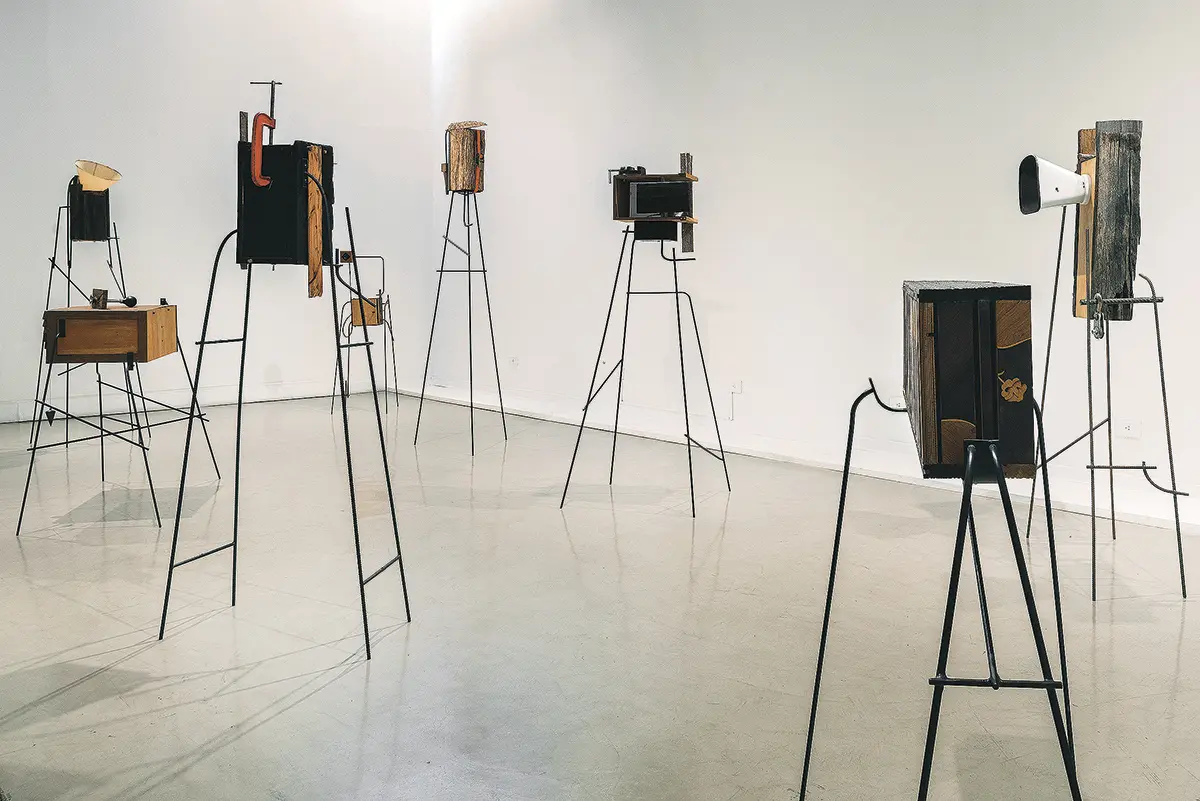
Mancuspias—whose name comes from the imaginary animals in Julio Cortázar’s story “Cefalea” (Headache) (1951)—are sculptural pieces raised on long iron legs adapted to support them. Each one refers to the memory of the materials that compose it, connecting these “music boxes” to the sound they emit. Each musical composition by these curious and indefinable sound sculptures encompasses the whole. For instance, the sound of a campfire is heard since one of the boxes is made of wood that was burned through the controlled application of fire, giving it a sleek black color. By assembling parts of a piano in an illogical fashion, frequencies very different from those of a metronome are emitted. Sorrentino’s work takes inspiration from the Argentinian singer-songwriter Atahualpa Yupanqui (1908-1992), who stated that “the guitar, before being an instrument, was a tree, and on it the birds sang. Wood knew music long before it was an instrument.”
All the pieces were activated in a concert offered during the exhibition’s opening. Manu Schaller played the theremin: an electronic musical instrument that, curiously, can be played without any physical contact; just by standing in front of it. Juan Sorrentino was moving between the works with a backpack that reproduced sounds of nature and also amplified the different works.
His projects include references and interpretations of theories related to the science of sound, the history of music, and his own life story. He was born in Resistencia, in the province of Chaco, where, as in many other places, the sound of cicadas is so constant that it is only noticed when they suddenly fall silent. This territory suffered a fierce deforestation and exploitation of its natural resources for the building of railways, since the wood of its quebrachos (hardwood trees) was used as sleepers: transversal elements to the axis of the platforms, which join, at a fixed distance, the two rails that make up the tracks. The wood can take up to fifteen years to deteriorate, but in his Quebrachos installation, the artist incorporates burned and partially destroyed pieces in a repetitive action of ascent and descent, accentuating the mechanics of a crawling motion along the wall, like a displaced body that leaves a charcoal trail. This work, which echoes the territory’s material and conceptual “mountain-city” displacements, has undergone different versions. They all bring a certain perplexity to the action to which they are subjected, while highlighting a reluctance to leave any trace, even with its remains.