“La trizadura del mar” (The Shredding of the Sea) can be understood as the representation of a landscape from the standpoint of the frictions of language: a fragmented landscape where the various pieces, each with its own identity and weight, connect to produce frictions and harmonies in space, resulting in a discontinuous, out-of-time tale about the coastal border. A coastline where social and political elements dispute the logic of the narrative, presenting territory-based difficulties for the establishment of symbolic hegemony. “La trizadura del mar” (The Shredding of the Sea) is a landscape and its mysteries, which bewilder reason.
This work, currently on exhibit at the Museo de Arte Contemporáneo, is the result of a two-year investigation along the northern coast of the Valparaíso region (Quintero, Puchuncaví and Zapallar), where the demands of the tourism industry and of vacation homeowners often hide social problems associated with the environmental crisis and with informal fishing, mainly caused by the Ventanas thermoelectric power plant and the country’s fishing laws. Adding to this are the problems derived from the development and privatization of the coastline, which permanently alter the environment.
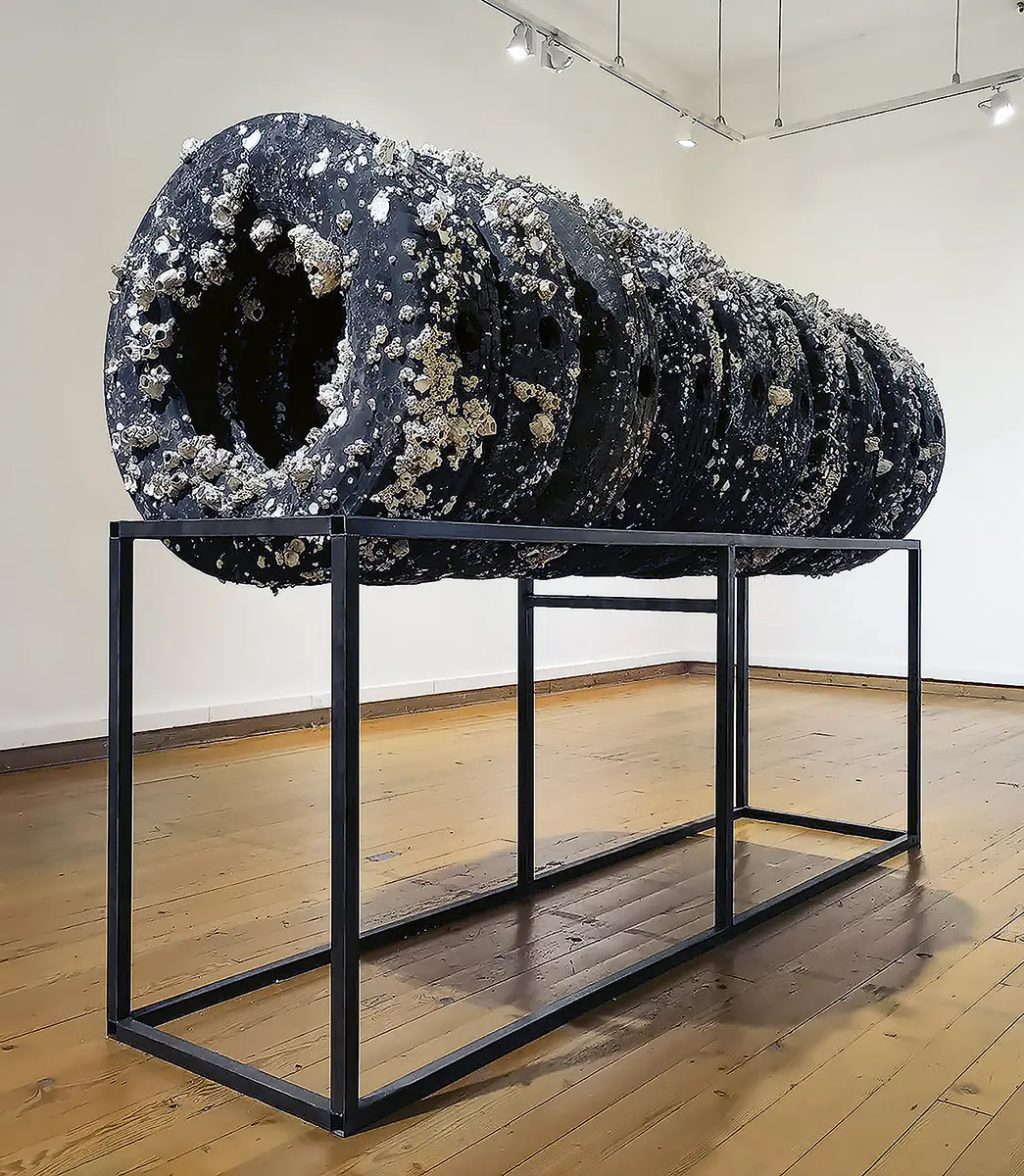
Such tangible problems intersect with the landscape as an existential space determined by the power of the horizon, and the shore as a site of friction, overlaying and unfolding multiplicity, where what is solid, what is liquid and what is ethereal all blur. A physical boundary that betrays the sea as a domain of death: the sea as a poetic abyss, a site of transfiguration and a subjective matter. A device that activates psychological processes tending towards introspection, reflection and reverie, which foster the mystique of spatial experiences and point towards a metaphysics of the landscape.
Those two frameworks and approaches are diametrically opposite, separated by a chasm that, putting them in perspective, comes close to the absurd and the nonsensical. It potentiates the drama—expressed in visual language in this instance—on the basis of interdisciplinarity, where a variety of materials, media, and supports articulate a “story without time” that alludes to the contemporary experience as a fragmented space, one in which grammatical dislocations configure a suspended dynamic body involving simultaneous realities.
Here, as in concrete poetry, the visual, spatial, and material disposition of the elements at play compose the experience, potentiating the psychological element contained in the structure.
“La trizadura del mar” (The Shredding of the Sea) is an installation structured by several production channels, both artisanal and industrial, posited as a reconstruction of the body of work where the different elements that comprise it generate dialogs in space, language tensions that launch an interrogation of representation strategies and their contents, with the production pathways converging to pose questions that disclose the uncertainty exposed in oscillations and slippages. This operation brings to the fore the attitude that contains, sustains, and projects this work of art, beyond the anecdote.
As a classified ensemble, “La trizadura del mar” (The Shredding of the Sea) unfolds into simultaneous paths operating at different scales, which alternate to form a narrative grid unmoored by the various densities and signifying levels. The signifier works through chains of unequal associations, proliferating at various levels according to parameters set by formal analogies. It is in that sense that this is a textual and intertextual space, where formal determinations of varying reach, even stylistically heterogeneous ones, act upon a field as they interweave and unravel, giving shape to an expression that forms the crust of its own meaning.
“La trizadura del mar” (The Shredding of the Sea) labors to dismantle screens and stave in the commonplace, installing suspense. It contrasts contexts in order to question language and its boundaries and the system and its margins.