Magnificently discreet. This apparent paradox punctuating the work of artist José Resende in his fifty-year career was reaffirmed once more in “Rotação e Translação” (Rotation and Translation), the recent exhibition hosted by Mul.ti.plo Espacio Arte in Rio de Janeiro. Four sculptures that have never been seen before, made with different materials and whose forms converse with the gallery space, reveal how the artist is permanently searching for authentic aesthetic experiences, either through matter or through the interaction of his forms with the world. Resende is both magnificent, because his work is inscribed in the dynamics of art history, and discreet, because he feels at ease with his unquestionable talent.
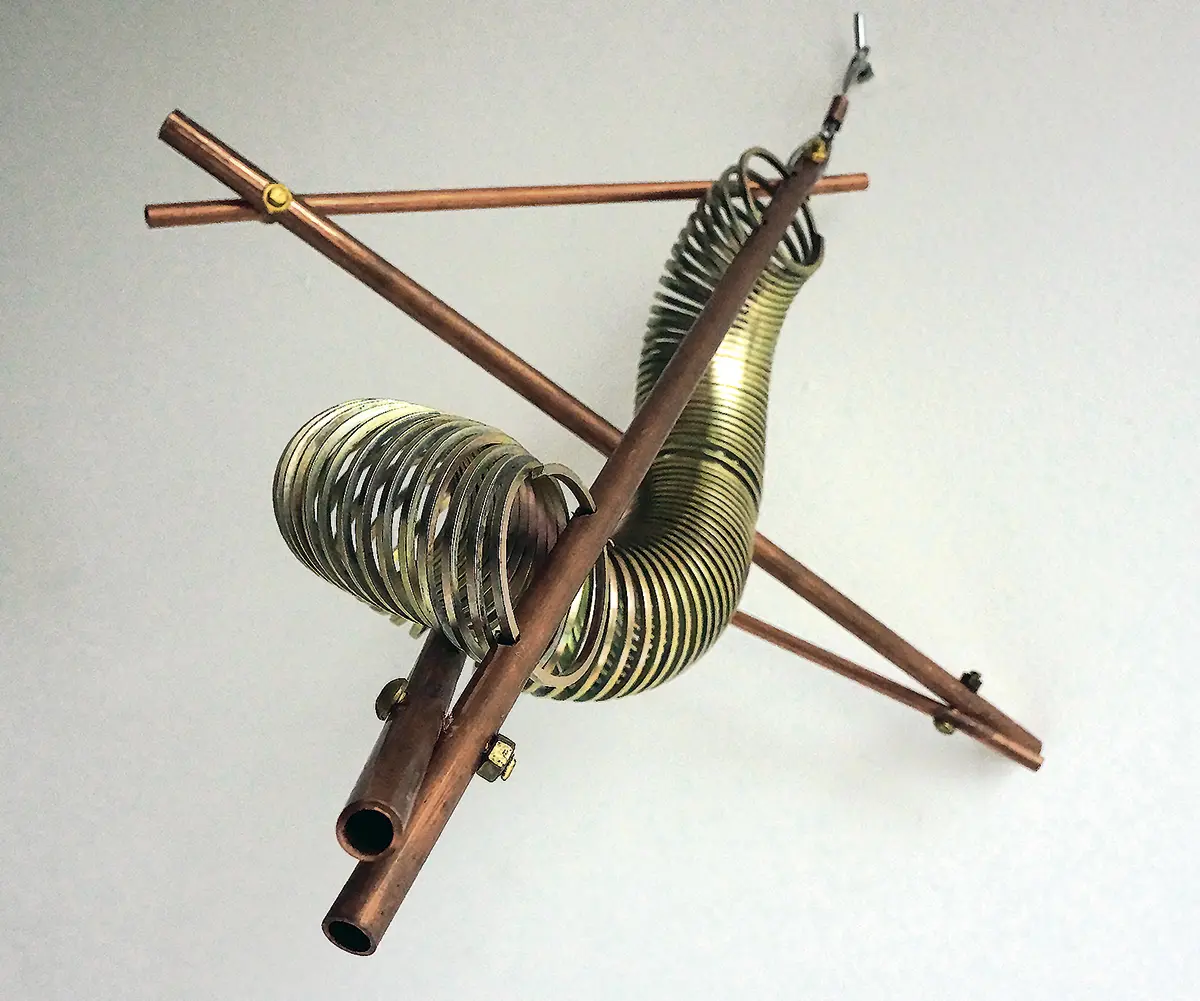
Made in materials such as brass, brass-plated clamps, copper, and steel cable, the works in this Rio exhibition were divided into two sections according to their formal characteristics. The first section contained the bigger works, which unfolded as in an exponential experiment. Five wall sculptures (each measuring about 102,3 x 31,5 x 15,8 in.) and two floor sculptures (each about 18 x 16,5 x 15,3 in.) were made from brass tubes articulated with steel cables. The second part of the exhibition, in counterpoint, displayed six smaller sculptures (approximately 18 x 16,5 x 15,3 in. each) structured on the idea of tension and movement based on hastes and molas (roads and springs). Both sections presented sculptures in spatial dialogue with the gallery space, with the spectator’s body and gaze, and with each other.
In their final structure, the sculptures portray how the artist imposes the actions of rotation and translation on braces. In the end, they give off a certain irreverence (as in many other works by the artist), recalling abstract animals, like Lygia Clark’s “Bichos”, but “Resende style”; that is, enriched by the innumerable tensions that arise from his materials and formal manipulations. Critic and longtime friend Ronaldo Brito explains in the exhibition catalogue that the title, “Rotation and Translation”, points to a phrase by the U.S. artist Carl Andre: “the minimalist sculptor, in response to people’s perplexity towards his factual pieces, insisted that they did have a base: the earth. José Resende adds: the earth, in rotation and translation.”
Aside from his solo shows in large cities of various countries, Resende has participated in national and international group shows of great relevance. His works are in major public collections, such as the Museum of Modern Art (MoMA), the Museu de Arte Moderna de São Paulo, and the Pinacoteca do Estado de São Paulo. A look at the artist’s career reveals the coherence with which he has shaped the main axis of his poetic vocabulary. He studied architecture (and built a stadium with the renowned Paulo Mendes da Rocha), which may have furnished him with his constructivist language. The initial experience of learning to draw with Wesley Duke Lee may have increased the daring that springs from his forms. Other events at the beginning of his career were fundamental, such as the founding, in 1966, of the irreverent and restless Rex Gallery & Sons, in São Paulo, in collaboration with artists Nelson Leirner, Wesley Duke Lee, Geraldo de Barros, Carlos Fajardo, and Federico Nasse; and, in 1970, the creation of the Escola Brasil Artistic Experimentation Center, which valued methods that differed from traditional education in the visual arts.