Contrary to what some myopic views may postulate in the name of science, no rigid walls exist between the real and the imaginary. The collective imaginary of the “others”, from which José Bedia’s ethnographic art imbibes, opens the door to a vital experience that pushes the border between reason and dream to its limit, unleashing a powerful energy of rich expressions enunciated in the form of painting. A shape, a line or a symbol reveal the syncretic landscape that inhabits the artist’s thoughts: it could be a star from the constellation of the six-edged turtle, to which the Seri people attribute the creation of the Earth’s surface, or, just the same, an oral tradition about Mackandal, Haiti’s independence hero. These multiverses, or multiple universes, are visited in something like the journey of the shamanic spirit, since, being complex modes of thought, they contain a logic, a style, and a narrative in which the artist experiments.
In the Viaje circular (Circular Journey) Bedia presented at MARCO, we encounter cultural landscapes where dreams, songs, and ephemeral figures are captured in material supports that transmit and fix that which is projected into distant worlds and, at the same time, here and now. Expressions of the immaterial, of the spiritual, take a certain shape, become embodied the moment the questions we formulate during the ritual exercise are answered. The artist’s anthropological gaze on forms of religiosity is, indeed, universal, yet what interests him are the particularities of the material construction of those spaces of the immaterial. What he calls an artist’s circular motion around recurrent ideas. It appears that Bedia, while observing tribal societies, asks himself: why select this specific form to transmit this abstract thought?
In The Invention of Culture, Roy Wagner writes that in the ethnographer’s encounter with the cultural expressions on the other, a new culture emerges that is neither the direct result of ideas incubated in the academic realm nor a literal representation of the other’s philosophical notions, but a mix of both. This is what we see in Crónicas americanas (American Chronicles), a group of works defined by Bedia as a hypothetical collaboration between indigenous face painting or the texture of woven baskets painted on photographs taken by the anthropologist, so that we are faced with a new object, made by multiple hands on the basis of different ways of looking at the world.
An example of the expressive potency of Bedia’s creations is La llegada del Cristo (The Arrival of the Christ), where the honesty of his treatment of original forms, selected features he deems necessary for complying with the conditions of discursive truth, is in full display; in this case, hunting with bows and arrows as part of a ritual sacrifice to explain the arrival of Christianity. Representing the Holy Trinity with the name of Christopher Columbus’ three ships, with an implication of the death of Christ, in the symbolic terms of the original peoples, says that the sacrifice, such as the act of hunting prey, is a form of exchange with the divine.
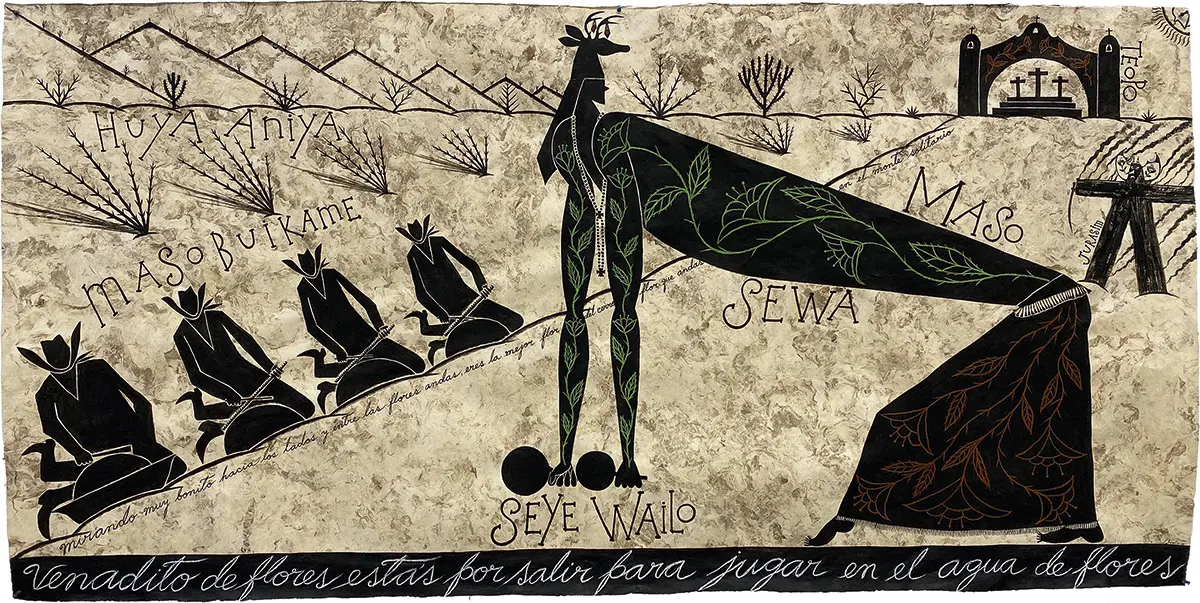
The paintings in Viaje circular sometimes feature only a few elements, but on other occasions the works depict highly complex ritual scenarios. Bedia provides ethnographic lessons; in Venadito de flores estás por ahí (Little Flower Deer Are You Out There), we see the deer dance of the Yaqui people of the Sonora desert, with the dancer, the main character in the painting, in a pose that denotes his transformation into a deer; his body shape is a faithful depiction of the dancers’ gestures imitating the animal’s motion, but both the Maso Sewa, the flower deer, and the Huya Aniya, the flowering desert, are given sound by means of the hypnotic, repetitive music of water drums and scratchers. The rattlers in the deer’s hands announce, as he walks, life’s persistence; the deer and the flowers are fertility and rain.
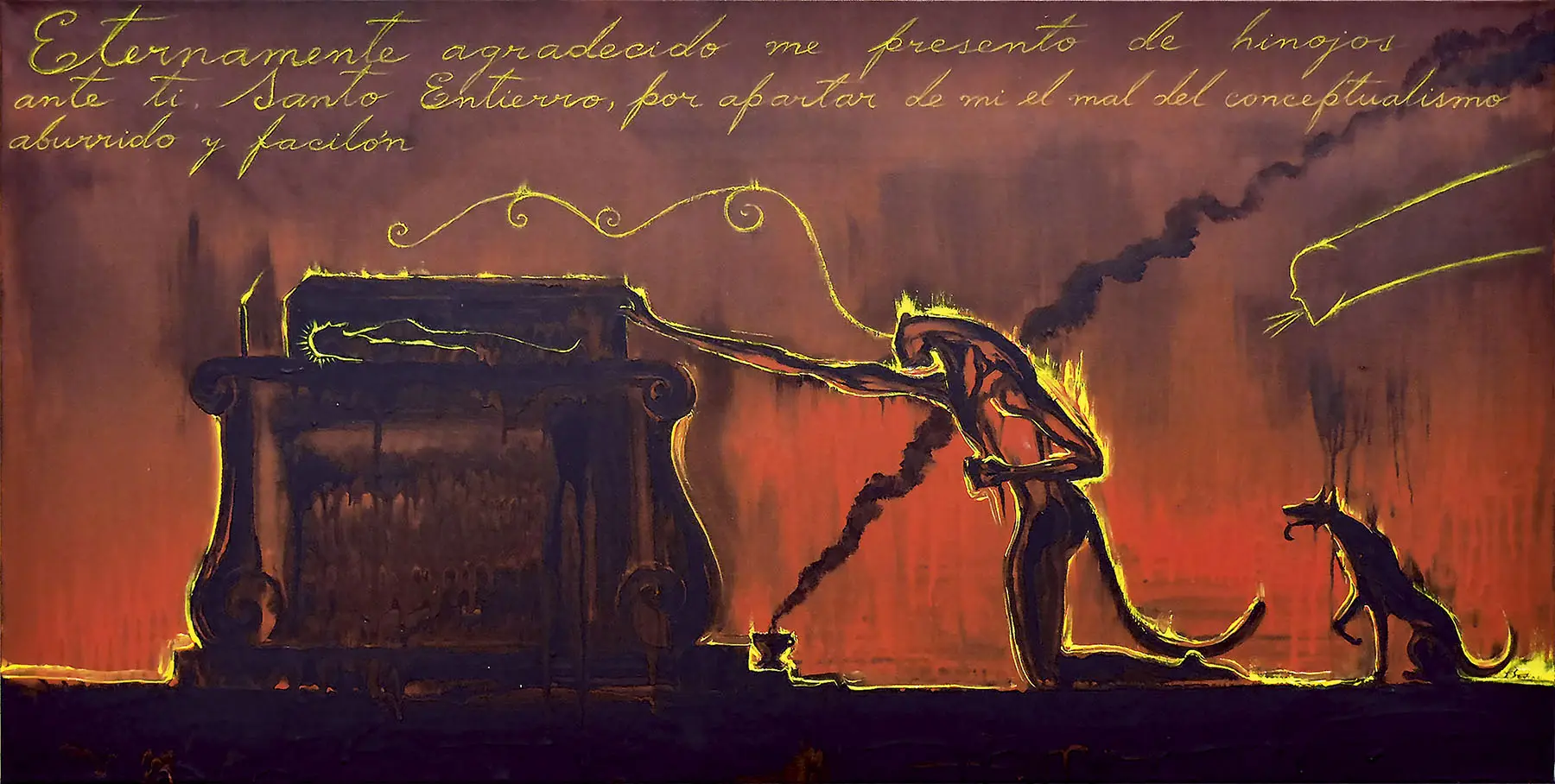
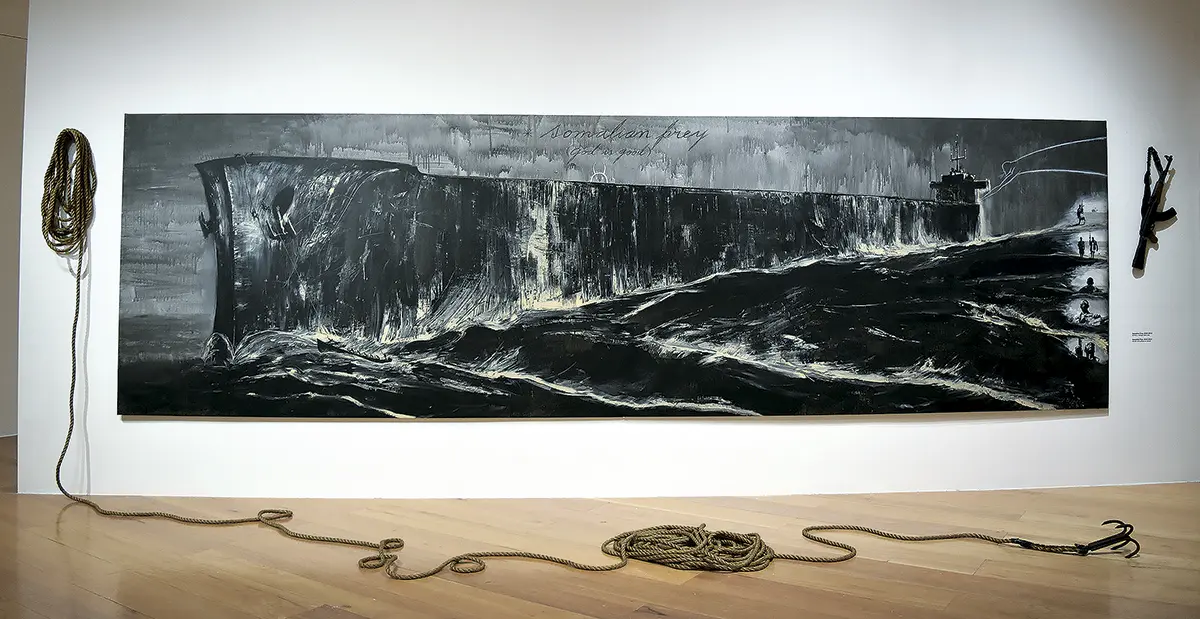
The ways in which the painter distributes imaginative competencies are sketched in contrasts of color, which can range from a forceful yellow line showing the power of a waterfall, to a red background filling a votive offering, which Bedia creates, at times in play and at times in all seriousness, in order to communicate with the saints in the same way many people do in Mexico’s folk tradition. In those two contrasts about the selection of modes of expression, the characters’ dimensions don’t follow fixed rules, either, whether they are immense like a two-meter manta ray or a jaguar eating a large corn cob, or small figures that pop up here and there, playful spirits moving between worlds, traveling in the territories of the Nahua, the Seri, the Shipibo, the Somali, Angolan or Haitian peoples: the sacred worlds in Bedia’s head, in his hands.
* Courtesy MARCO.
NATALIA GABAYET