
Jorge Lizarazo’s exhibition Tejer la luz (Weaving Light), curated by Lucrecia Piedrahíta, takes us by the hand—in a theater-like dimness broken only by the light that shines on and from the works themselves—through a life devoted to experimentation and the combination of innovative materials in textile work, with traditional fibers that honor the roots of a country’s immensely rich handcraft traditions. Jorge Lizarazo (Armenia, Colombia, 1968) is an architect by profession and a designer by choice; he decided to work on how spaces are inhabited rather than on how they are built. Inevitably, along with the functionality of design, from the moment of their conception his works involve an architectural mindset.
Lizarazo’s studio, named Hechizoo and located in Bogotá’s iconic 20 de Julio neighborhood, generously disperses the authorship of artworks created by dozens of craftspeople in what he describes as a “textile lab”, a catalyst of Colombian tradition. In the studio, to formulate his proposal Lizarazo engages in a dialog with the entire scope of possible variants of his craft, from the ancestral ones to those not yet invented, paying homage to both tradition and innovation.
With a trajectory of more than a decade already under his belt, Lizarazo presents a collection conceived around light, not as an independent element but as a phenomenon articulated in, through, and from the fibers of a large variety of works, such as rugs, lamps, and chairs. We say that Lizarazo has been working, experimenting and innovating for more than a decade; in reality, a bit of research reveals that Hechizoo’s productions move more consistently abroad, in New York, Milan or São Paulo galleries, and that the studio’s roster of clients includes showbiz luminaries and royal houses. Despite this international renown, Tejer la luz (Weaving Light) involves a personal gesture of presentation to his own country. Lizarazo’s work is rarely exhibited in Colombia, and it is especially infrequent to see it on display in spaces associated with contemporary art. This constitutes, then, a second gesture towards greater openness. Here, NC ARTE (until recently, NC-arte) debuts not only a new logo, but also a shift in its trajectory, after ten years focusing on site-specific contemporary art. With this exhibition, it presents its new vision to the world, with new plans to delve into the crossroads between art, design and architecture, something not wholly unknown in the artistic and cultural scene in other latitudes. On this occasion, it reflects on the boundaries, thresholds, and flows between disciplines. A sign of this push for dialog is the inclusion of several works in homage to three of Lizarazo’s favorite artists: Barnett Newman, Frank Stella, and Carmen Herrera.
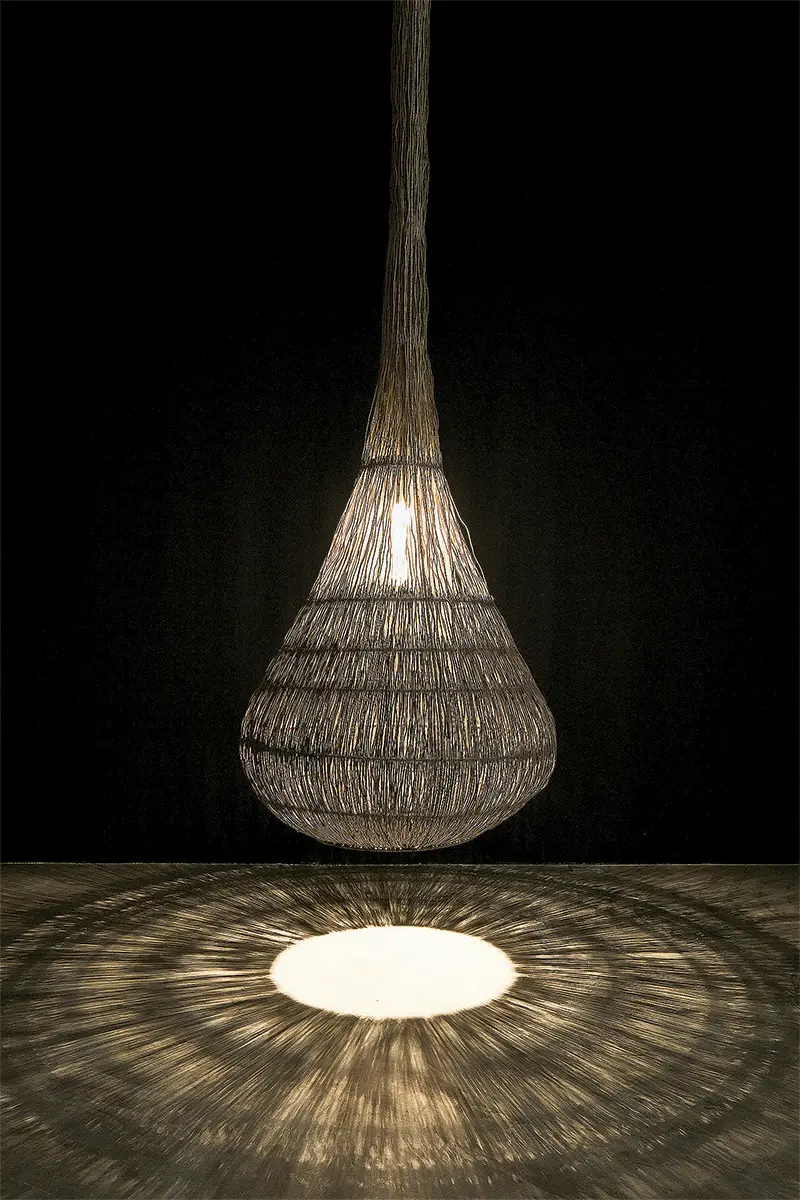
The experience of ambling around Tejer la luz (Weaving Light) is warm and sensual. We enter into a primordial home, made of textile matter and luminous warmth. Upon closer inspection, we realize that the luster and sparkle, the otherworldly textures, come from the combination of metallic threads and natural fibers, as in the large work that welcomes visitors, Tapete de chonta (Peach Palm Rug, 2022), which uses copper thread and peach palm wood. An outstanding example of Lizarazo’s way of playing with light and its impact on the perception of space is Barnett Newman (2022), a metal structure in woven copper thread and LED light. In the elongated space, it produces different ways of dwelling, depending on our position, forging an inside and an outside that function like a folding screen-lamp. There are also references to the natural world, as in the Nido (Nest) lamps, in vinyl thread and yaré, the fiber from a local liana vine, or in copper and leather thread (Nido 1, 2 and 3, 2022).
According to the curatorial essay, “Between the weavings, memory—as an aesthetic category—and light are the intimate, poetic and at the same time defiant element through which Lizarazo communicates his sensibility in the design world.” It appears that he started using copper thread by chance, and experimenting with metal fibers such as copper and tin became one of the studio’s signatures ever since. This resignification of materials, combined with the use of ancestral techniques in loom work, basketmaking, and other crafts, invites us to see these works as grand collective efforts to redefine certain practices without condemning their roots to oblivion. Understood as a microcosm, Tejer la luz (Weaving Light) could mark an iconic shift in the history of Colombian design: there is a deep knowledge of the past, of the communities that contribute to the development of the studio, but also of the innovative and experimental processes with the materials, and the unconventional uses to which the objects are put. This is to say, there is consciousness in every step taken, but also a creative, daring, free vision that seeks to go beyond predetermined domains, offering an approach to mestizaje that flows through every centimeter of fiber in this production.