Four and five years have passed since Zulia-born artist Jonathan Lara’s two interesting solo exhibitions in Caracas, one at the Chacao Cultural Center (2017), the other one at SPAZIO ZERO Galería (2018). Lara exhibited his work again at the latter location between September and October, 2022, which makes it possible to note the significant reformulations and renewals in the conception and execution of the works that justify the show’s title: Jonathan Lara. Inconcreto. Del residuo a la exforma (Joathan Lara. Inconcrete. From the Residue to the Exform).
The first observation to make is how Lara’s embrace and integration of previously explored technical resources—painting, graphic art, collage—as a function of the conceptual core of his investigation and his recent work.
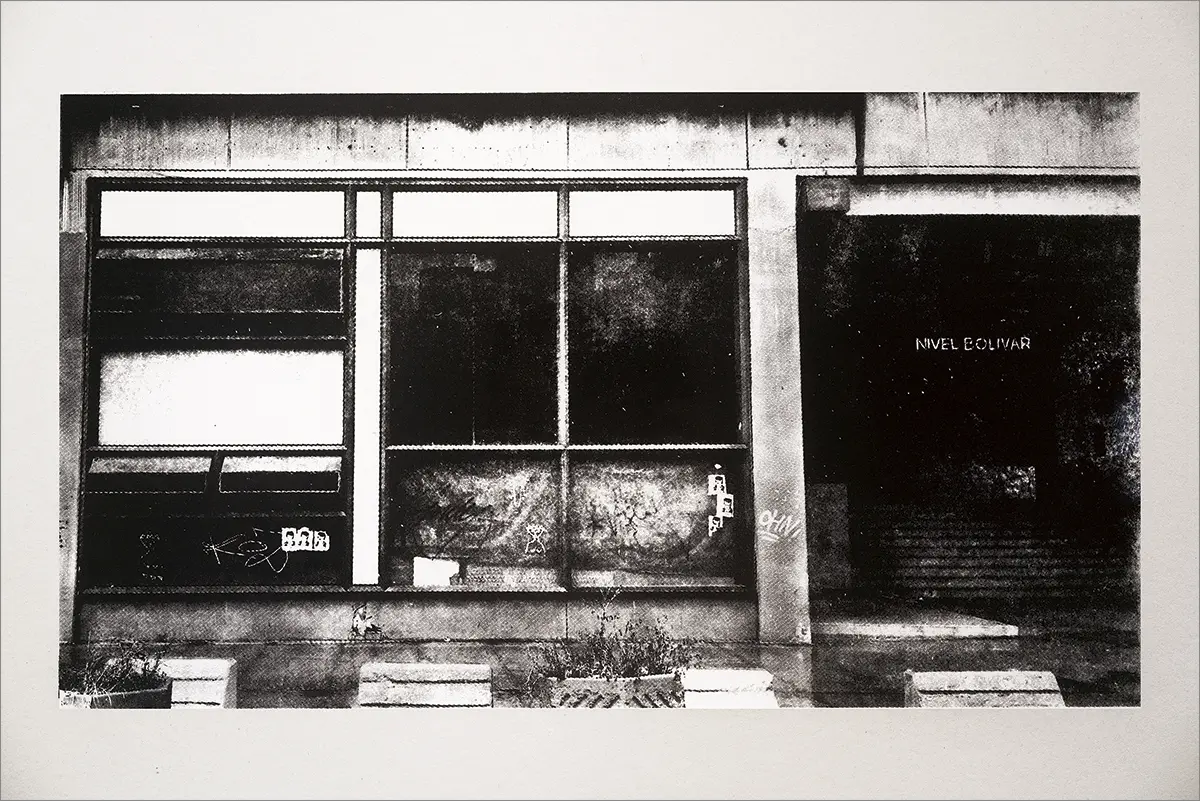
The relationship between painting and graphic art remains a close one, as does the utilization of “residual” plots to compose diverse “geometries” in painting-graphics, as in his video collages. To this he adds the use of photography, transferred as silk-screens onto canvas or paper. Media and supports vary not only according to the artist’ procedures, but also according to his compositional and communicational needs. This is why several of his stamps have been “adapted” spatially as installations. At the same time, there is a prevalence of high-contrast images and a propensity for the use of the color black—darkness—in consonance with the subject that dominates this exhibition: the decay and dereliction of the grand architectural complex known as Parque Central.
One of the most ambitious and emblematic projects of Caracas’ modernity, conceived by the architects Henrique Siso Maury and Daniel Fernández-Shaw, the construction of Parque Central began in 1970 and was completed in 1983. It was projected for multiple uses: housing, recreation, cultural activities, commerce, and as headquarters for a number of public institution. The complex comprises two skyscrapers—the tallest in South America—and six residential buildings, one of the which houses Caracas’ Museo de Arte Contemporáneo, established by Sofía Imber in 1973, with spaces specially adapted for its function.
Lara’s work is founded on fragmented vistas—residual, inconcrete, like formal remembrances—of Parque Central, after living through the pandemic on Floor 27 of the Tacagua building. The height and the photographic recording of details and textures are part of the graphic element applied in the different impressions. From there, an initial installation, previously submitted to the 16th Mendoza Prize with the title of Inconcreto desarmado (Disarmed Inconcrete; it could also be translated as Disassembled Inconcrete) and reformulated for its display in the gallery. Its flexible condition had another presence in this exhibition space, in synchrony with videos, paintings, and photographs transferred onto silkscreens that complemented our reading of the show. “Starting with a keen observation of the decaying building’s tectonics,” notes Manuel Vázquez Ortega, the curator, “Lara postulates the reconstruction of a habitat that doesn’t belong to him yet is inherently his, recreating its forms by means of lines and textures until he has produced a set of images conceived on the basis of the experimentalism of his graphic language. An ‘inconcreteness’ that, opposed as it is to the determinants of a past modernization, approaches the unstable expectations of a somber present, when the obstacles to building a project extend like the generalized feeling of an impossible society.” Such opacity, as a matter of fact, reflects “the obscure incidence of the quotidian,” as the artist puts it.
Lara’s vistas from on high allowed not only for registering the current state of decay of this architecture, but also, one could say, for a reformulation of the very concept of its abstraction. Vuelo de reconocimiento (Reconnaissance Flight, 2022), for example, is the result of several video and sound recordings, a kind of “motion and sound collage”. On the one hand, its formal solution leads towards abstract-geometric formulations; on the other, it results from a dynamic superposition and juxtaposition of images that account for forms and connections as much as for structural damages, the “filtrations, oxidations and vandalisms” that “have transformed this historical site into a superstructure of collapse,” in the artist’s words.
The installation Principios constructivos (Constructive Principles, 2022) includes eleven vertical pieces, made in cement (i.e., concrete) variously mixed with pigments, acrylic, sawdust, wood, and iron, as a metaphor of the residue. A residue that in another time was matter made form, now an ex-form: the ruin of something concrete rendered inconcrete. Vásquez Ortega continues: “Starting with the ruin, with the residue, Lara establishes the boundaries of the place, reconstructing a new habitat on the basis of segments and spatial allusions that illuminate, seen as a whole, an inescapable historical disaster.” To this the artist adds his silk-screened photographs as testimony of various abandoned sites: Ventana—antiguo Banco Industrial de Venezuela (Window—Old Industrial Bank of Venezuela, 2022), and in Ciencia y tecnología (Science and Technology, 2022), a detail of the Children’s Museum, which closed during the pandemic but was refurbished and reopened during the Carnival season of 2023. Equally of note are other works that allude to urban textures and grids, expressed in diverse materials and compositions that provide an abstract thought with points of insertion into the contemporary, given its connotations and its critical sense, beyond purely formal considerations.