
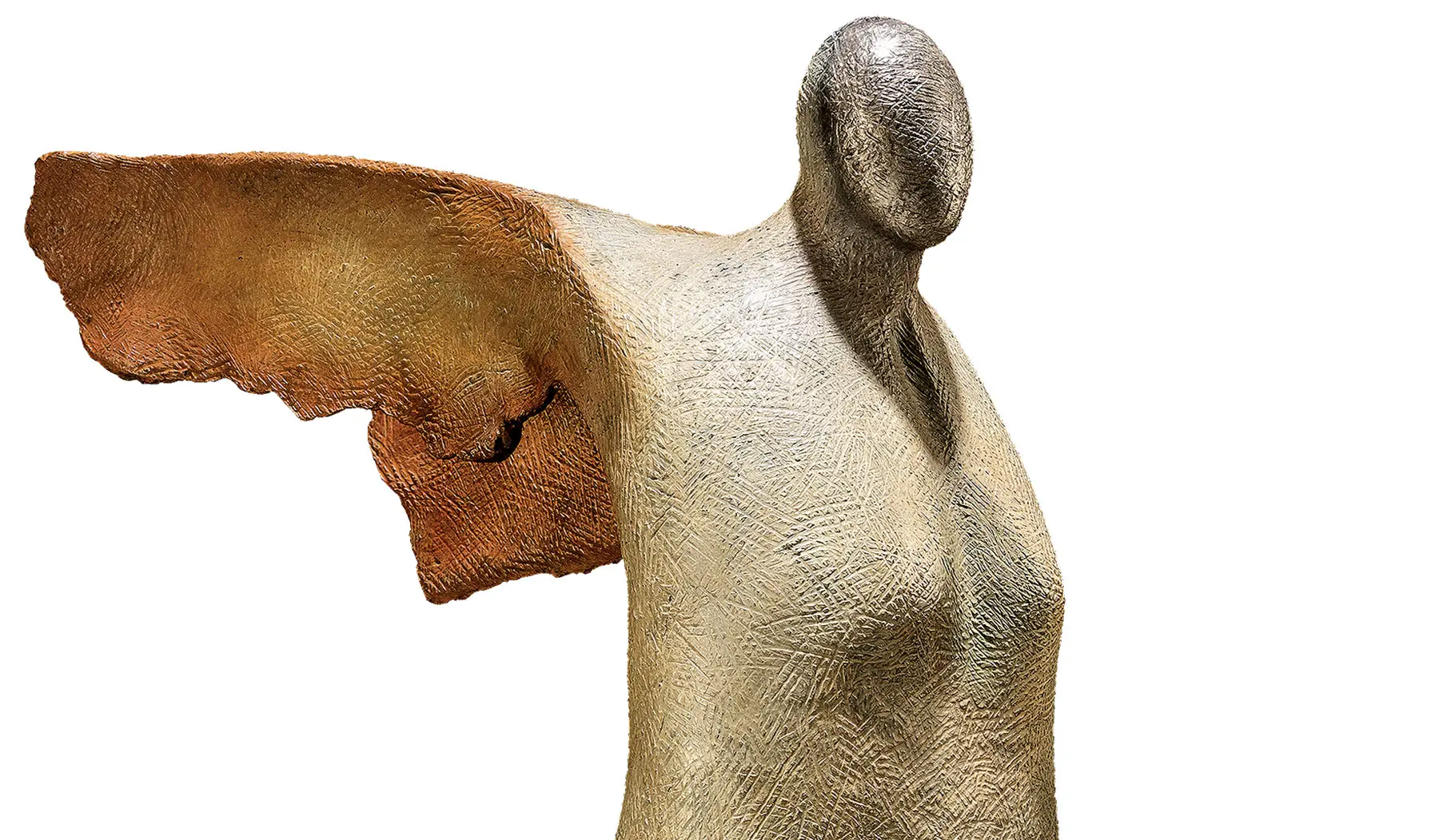
“Etceteras”, says Eugenio Viola, the curator of this retrospective exhibition of Jim Amaral’s work, means “and all the rest”; it implies an enumeration in addition to what was just said, because there is more to be said. It is a good title for bringing Jim Amaral’s oeuvre into the present, accessing it not by way of grand narratives, but through whimsical objects that nevertheless reveal the imagination’s ability to penetrate where logic has exhausted itself and to shift the real world, mixing up times and spaces and positing a kind of open thinking that makes it possible for viewers to reason in a different way. These medium and small-format sculptures are particularly important, perhaps, because denizens of Bogotá are accustomed to seeing Amaral’s works in public spaces, their large size forcing pedestrians to establish a relationship with much bigger bodies; in that context, mass is the protagonist, and one can’t perceive all the details of the work that this exhibition does bring into view. Here, the works on display are of a more intimate character.
Incidentally, whimsy, caprice—as in Paganini’s Caprices—is a desire to retain and elaborate on what appears suddenly in one’s mind.
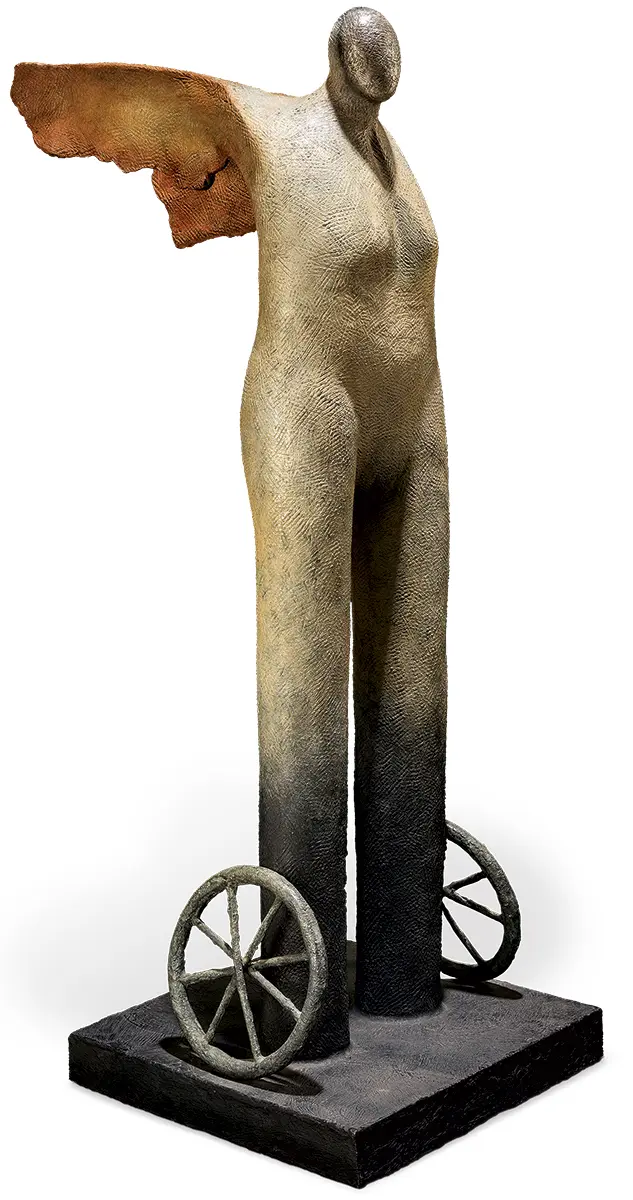
In Eduardo Serrano’s “The Three Dimensions of Amaral”, an essay included in Mundos conocidos (Known World), a book about the artist, Amaral’s work as a sculpture is gradually revealed in all its dimensions: the struggle with smelting; the demands that it places on bronze as it makes it into threads, seams, fittings, shells; its archeological character, as if the works emerged from a shipwreck or an excavation of thousands of years of accumulated soil; its thematic freedom and its scant interest in chasing the mandates of the fashionable and trendy. An illuminating essay, no doubt.
I would like to focus on a certain self-acceptance observable in these striped, never smooth or gleaming bronze bodies. They come to us with an inner world experienced here and now, a world they suffer in a process of evolution and escapes their control.
Sometimes, writers on art speak of psychoanalysis, but I believe the word is too generic for all that is happening there. Amaral’s works seem to result from the private space generated by the analyst’s couch, where the mandate to gaze and be gazed at is broken, and the possibility emerges of thinking everything on the basis of the body, even if it takes the analysand by surprise. The couch makes possible unspeakable, ambiguous, sexless sexualities and all kinds of references, as in a torrent of times and spaces; it renders an untamed mind visible, one more in touch with atavistic experiences and histories. I mention the analyst’s couch because contemporary modes of therapy, with more defined goals and with therapists and clients looking at each other in the eye, is a different matter. Amaral’s sculptural bodies are enmeshed in their own problems, don’t clamor for the viewer’s gaze, yet they nevertheless expand in space. And they do connect with a seemingly normalized viewer who remains, however, in struggle with his or her own ideas and desires.
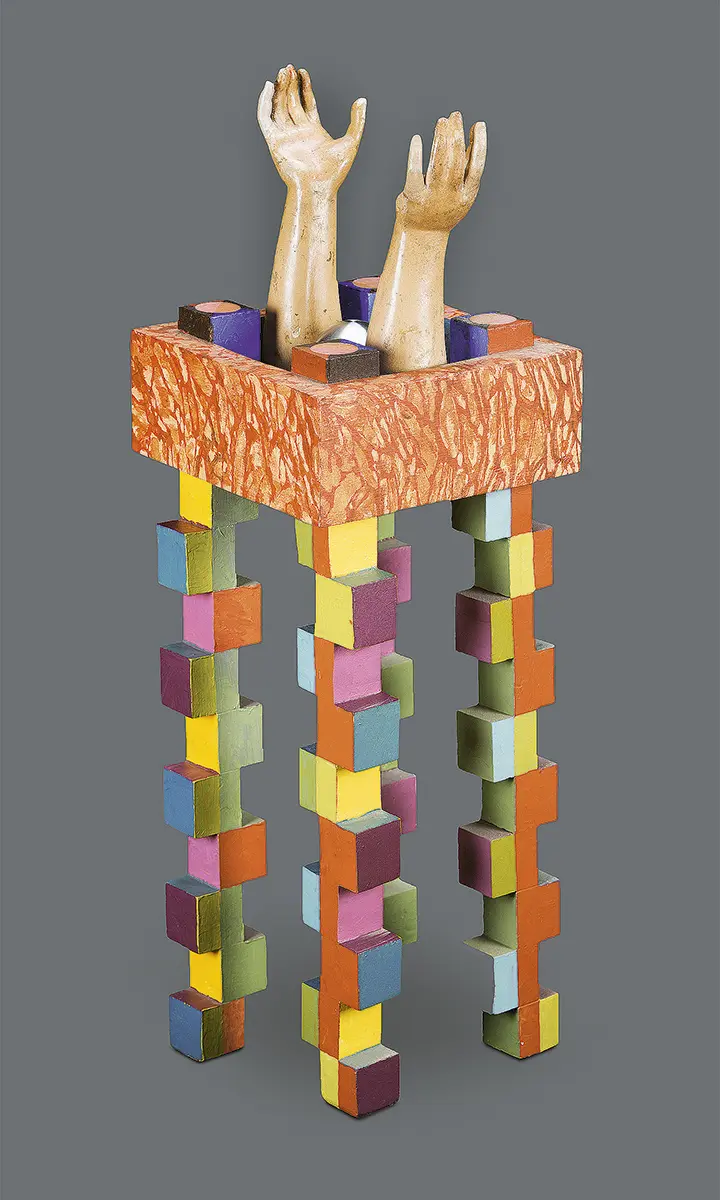
Amaral’s bodies end in prostheses, often connected by hinges; his is not a naïve naturalism. Generally, these prostheses—wings, for example, some with grills, feet with small wheels and immobilizing ligatures, or bands and fittings that traverse the body—seem to indicate that the body realizes the absurdity of its idealizations and laughs at itself a little. These are not suffering bodies, I think, at least not in the Catholic sense. These are bodies that can get no satisfaction, as Mick Jagger would put it; they are tied—for instance to a chair—but what binds them are their own psychological tangles and snarls, which must be brought into the outside and seen in order to be unknotted, or to forever remain in knots. In an era when subjectivity in the arts is of great importance—Louise Bourgeois—Amaral’s bodies are subjectivities in conflict, some of which alert us to psychological barriers, some of which are more entertaining or ironic in intent.
The space assigned for this retrospective was more than adequate. The 30th floor of a building in the center of Bogotá, with 360-degree views of the city and gray concrete flooring, turned the sculptures into an urban issue. These bodies and their prostheses could have been the inhabitants of a cement city on the verge of apocalypse. Perhaps even a Game of Thrones world, with the same weird mix of temporalities but with a much greater sense of the absurd, and also of the comfort to be found in an open display of contradictions. An exhibition presented in the context of MAMBO extramuros (MAMBO Out of Bounds), a museum initiative to take its exhibitions outside its permanent site. A well-rounded retrospective of the work of an artist born in Pleasanton, USA, who has lived in Colombia since 1957.
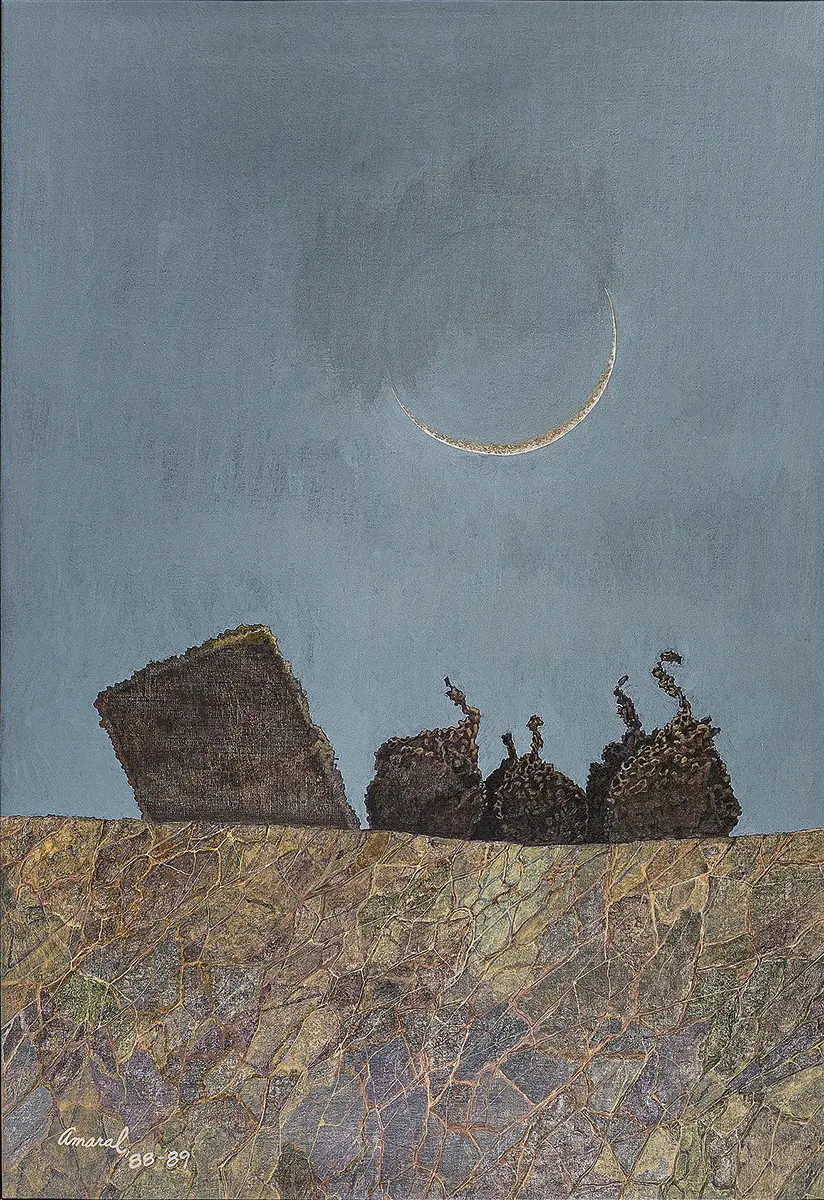
The exhibition included a selection of the blackened-horizon paintings so characteristic of Amaral’s work, a horizon of mummified or dead fruits. And his watercolors on paper deserve a chapter of their own: repetitive, multicolor decorative drawings that unfurl from the edge of the paper and end in encounters of bodies, conversations, and erotic relationships. Watercolors that bring to mind the obsessive decorations of non-Western art, for instance, India’s and its temples of decorative bands in stone with surfaces covered by eroticized bodies.
In the book mentioned above, Edward Sullivan cites Pessoa: “Direct experience is an evasion or a hideout for people devoid of imagination.” But it is not only that. Perhaps a suspended direct experience, stalled for a moment, in bronze, opens up other experiences that had remained folded away, and allows us to see them and understand that they are worth taking into account.
* © Photo: Diego Amaral. Courtesy of the artist
NATALIA GUTIÉRREZ