
Iván Herrera won the Colombian Ministry of Culture’s National Photography Prize, the country’s most important—and nearly sole—honor for this art form, in 2021. He won it for Sabana (Savannah), a series of landscapes focused on the rural environments of Bogotá.
One characteristic of this prize, undoubtedly the most anticipated one by photographers themselves, has been to recognize diverse careers in the genre: Fernando Cano (2017), Jesús Abad Colorado (2018), Viki Ospina (2019) and Sebastián Fonnegra (2020) received it in prior editions of the event, originally sponsored by the Swiss Embassy and formerly known as the Colombo-Swiss Photography prize, and held for eleven years between 2005 and 2016.
On this occasion, a decision was made to display the winning project at the Museo de Arte de Pereira, increasing the resonance of a prize heretofore only exhibited in Bogotá. Herrera had already been a finalist in 2019, and in earlier series he portrayed ghostly places and characters within the rain-soaked capital of Colombia. While Los sobrevivientes (The Survivors) focused on crafts and commercial activities at risk of extinction—cobblers, restaurants, watchmakers, locksmiths—the black and white photographs of El lasker covered the experiences of chess players—mostly senior-age men—who gathered (and still do) in the club that gave the project its title. The latter images were filmmaker Natalia Santa’s inspiration in the construction of the characters and script for La defensa del dragon (The Dragon Defense), which debuted at the Cannes Film Festival in 2017.
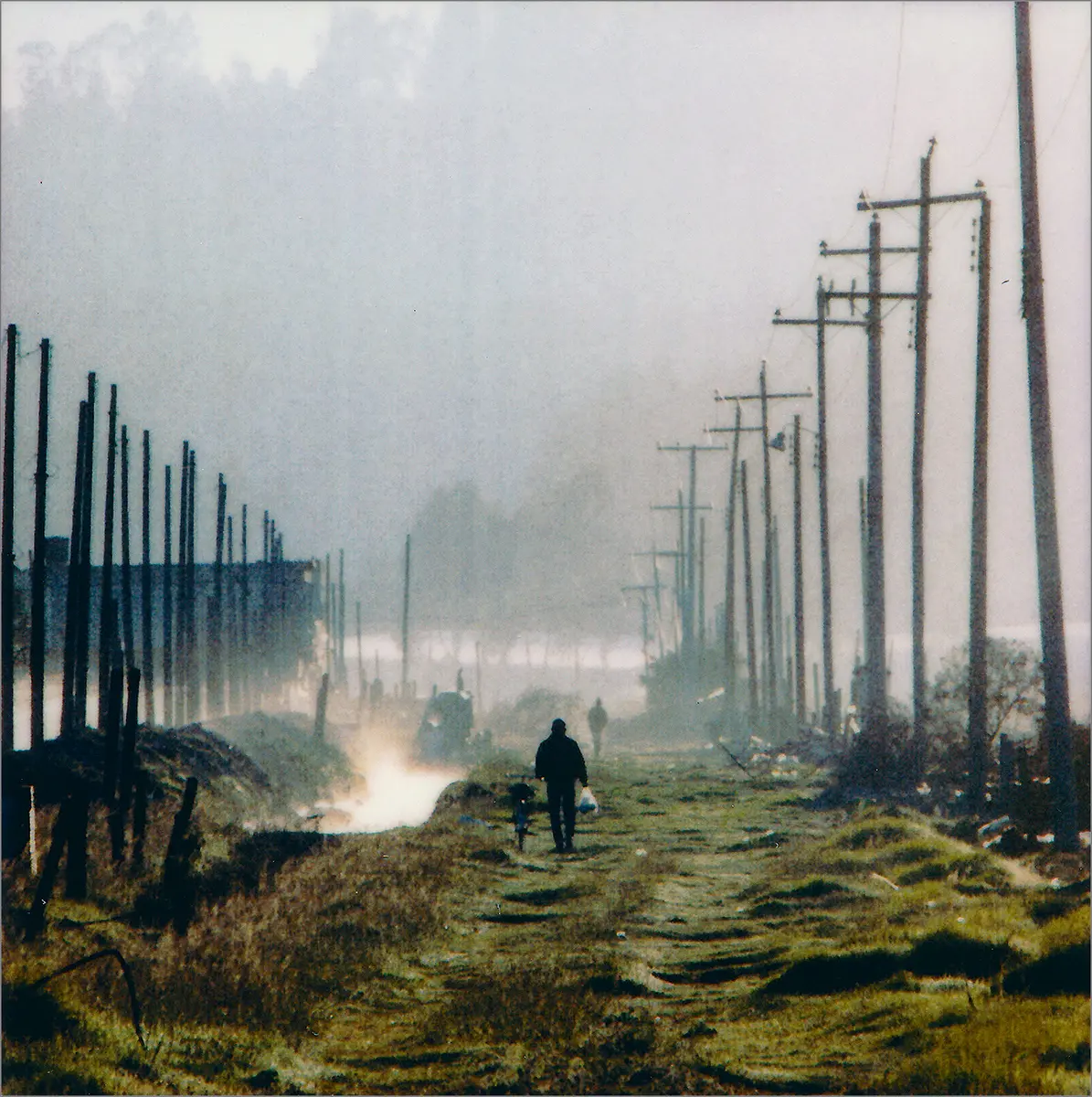
In Sabana, Herrera photographed Bogotá’s near environs, known as its goteras, during the uncertain, troubled days of the COVID-19 pandemic. Swimming against the current of what a more conventional photographer would choose when engaging the subject, Herrera set himself a special obstacle: he used an instant camera, a descendant of the legendary Polaroid, and accepted all the challenges that result from his choice, such as blanched and flattened colors, simplified shots, lost detail—in sum, an immediate ageing of the image as he captured hills, paddocks, wetlands, the ever-present lines of eucalyptus trees and forest spots, and the high plateau’s beautiful, inimitable light phenomena.
In this way, his landscapes resemble those by the group of painters known as the “Savannah School”, who in the first half of the twentieth century devoted their skills to recreating those same scenarios. Taking advantage of the limitations of his digital instant camera, Herrera shot a series of images to be edited later, behaving without intent as those Savannah landscape painters of the past, who sketched open-air impressions on their sketchbooks, in pencil and watercolor, to create approximations they would develop back in the studio. Herrera does the same, reworking the image not to “improve” it but to enhance as much as possible its expressive potential, without “betraying”, so to speak, the random quality of the original. For him, as for those painters, capturing a landscape is a creative exercise operating between that which is initially captured (the painter’s sketch, the photographer’s instant decision), that which is remembered (the subjective impression, which includes what one could deem the “extra-photographic” element—the cold of dawn, the smell of the fields, the song of the birds, the nascent light), and that which is desired (the final result, molded in the privacy of the studio).
The resulting work is simple and sublime, as was that of his Savannah School forerunners. Unlike them, however, Herrera presents Bogotá’s savannah in its contemporary state, under an accelerated process of occupation and industrialization. He is distressed by its decline, and his images communicate a sense of loss both through their evident signs and through more encrypted ones: the crosses of an abandoned cemetery, encountered again in the lines of lamp posts that function here as symbols of progress and a diminishing agricultural frontier; paths of unknown destination; derelict industrial structures; roads enveloped in haze; gloomy or coldly radiant fields.
As I noted before, these landscapes were created during the pandemic, and thus are diametrically opposite to the optimistic savannah paintings created by Herrera’s twentieth-century predecessors. These memories of light, these luminous miniatures of the incidental, devoted to the subtle atmosphere of the Andean plateau, present us with life as a riddle, a sum of inquiries that admit error and uncertainty, and which, in their melancholy beauty, tell us that Iván Herrera is, above or underneath it all, an “au plein air” photographer.