
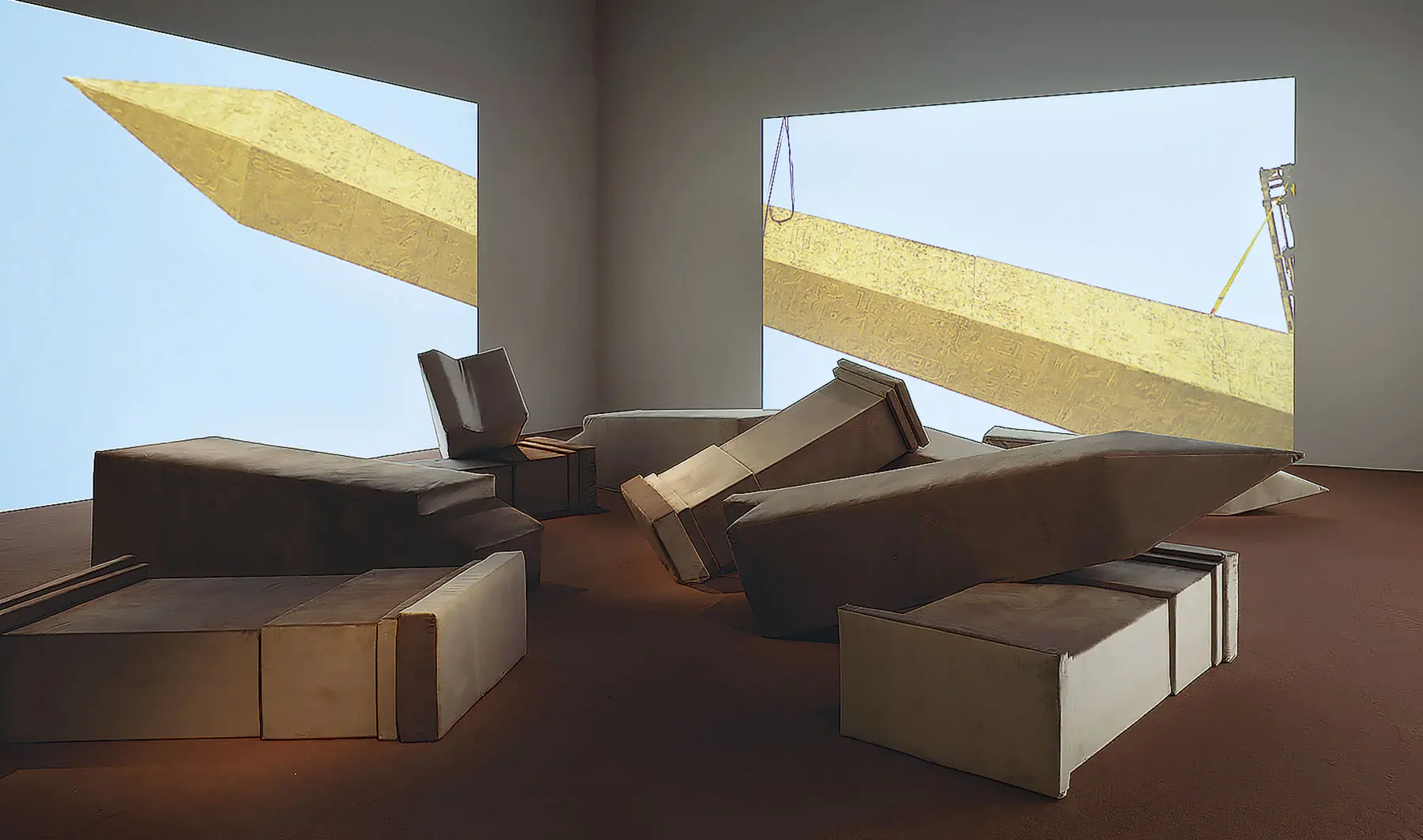
In the video that Colombia’s Iván Argote (Bogotá 1983) presented at Centre Pompidou as one of the nominees to the Marcel Duchamp Prize—alongside Italy’s Giulia Andreani (1985), Switzerland Philippe Decrauzat (1974) and France’s Mimosa Echard (1986), who ultimately won it—one phrase caught my attention with particular insistence: “Rêver est la clef” (“Dreaming is the key”). Indeed, this maxim-like statement serves as the basis, both conceptually and aesthetically, for the political reflection the artist presents us with in his forceful work. With humor and poeticism, without recourse to violent images, Argote’s three-part video (16 min. 10, 2022) examines our perception of public space and, more concretely, of the role played in three southern European cities by monuments memorializing a past of conquest and power, often associated with imperial or colonial enterprises. Argote emphasizes here “our memory of oblivion” and invites us to question our historical past as he, in the manner of a waking dream and a political fiction, executes three performances: the takedown of the Flaminio obelisk erected in Rome’s Piazza del Popolo, Cristopher Columbus’ statue in Madrid’s Plaza de Colón, and Marshall Galliéni’s statue in Paris’ Place Vauban.
With respect to his adoptive country France, but also to Europe as a whole, Argote confronted the issue from the standpoint of a solid political consciousness. His staunch critical perspective first developed in connection to the history of his native Colombia, as a young member of a highly political, militant family. The same critical approach is now directed towards contemporary social and political issues at a worldwide scale. “My works,” he says, “reflect on how we behave, how we understand our immediate environment, and how this environment connects to history traditions, art, politics, and power.” Making these contemporary quandaries his subject, Iván Argote goes straight for the sore points of an issue that shakes our memory to its core and gives rise intense agitation and agonistic debates in Western societies, not only in Europe, but across the world. This was the case in Mexico, to cite just one example, when after assuming office as the country’s President, Andrés Manuel López Obrador had Columbus’ statue in Paseo de la Reforma replaced by the effigy of an indigenous woman1. One can also remember other, earlier resonant cases, such as the dismantling of Stalin and Lenin monuments in the countries of the former Soviet bloc. When it comes to such erasure of the material symbols of a loathed political power, would it be logical to also pose the question of their hypothetical replacement? Argote does not offer a definite answer.
In the exhibition at Centre Pompidou, Argote’s installation comprises a three-screen video projection, accompanied by a discreet musical soundtrack that punctuates the succession of images. The soundtrack is heard also in a space the artist dubbed “Air de jeux”, a play between the homophone French words air (air, and also melody) and aire (area); phrase can be translated as “Play Air” or “Play Area”. This space was conceived as a kind of “agora” where viewers can sit or recline on fragments of obelisk and pink velvet plinths placed on the floor. The video, in three parts, is accompanied by the artist’s narration, consisting of brief maxims in English and French that, written across the entire, symbolically red screen, reinforce the flow of images and give it a regular rhythm. The substance of the text, reflecting Argote’s concerns, convictions, and even doubts, brings into relief the concept that undergirds the work as a whole and enriches its visual symbolism. Levitate, 2022, Part I of what Argote calls his “three anticipatory films”, concerns Rome, the city with the largest number of obelisks in the world. The artist imagines the levitation of the Flaminio obelisk, playing with the displacement/swinging of the historical object in space, desacralizing it, stripping it of its temporal character, freeing it from history, rendering it anonymous. Part II, Paseo, 2022, concerns Madrid and Cristopher Columbus’ statue. Argote chose October 12, known in Mexico and across Latin America as “Race Day” (Día de la raza), but also, unbeknownst to him, a Spanish national holiday called “Hispanic Day” (Día de la Hispanidad), as the date to have the downed statue march through the streets, tied down with ropes and in a state of defeat atop a truck platform, to the surprise and disbelief of passers-by. Part III, Au Revoir Joseph Gallieni, 2021, has to do with Paris and the statue of a French military officer situated across Les Invalides. The officer is Marshall Joseph Galliéni, former Minister of War, whose history intertwines with the consolidation of France’s colonial empire in Asia and Africa. This monument has been vandalized repeatedly, covered with a black bedsheet or inscribed with graffiti. Iván Argote’s performance, backed up by the work of French political scientist and militant decolonial feminist Françoise Vergès, consisted in the (fictional) takedown of the sculpture, highly symbolic act of iconoclasm around so emblematic a memorial as the Musée de l’Armée, with fake laborers dislodging a fake statue from its pedestal.
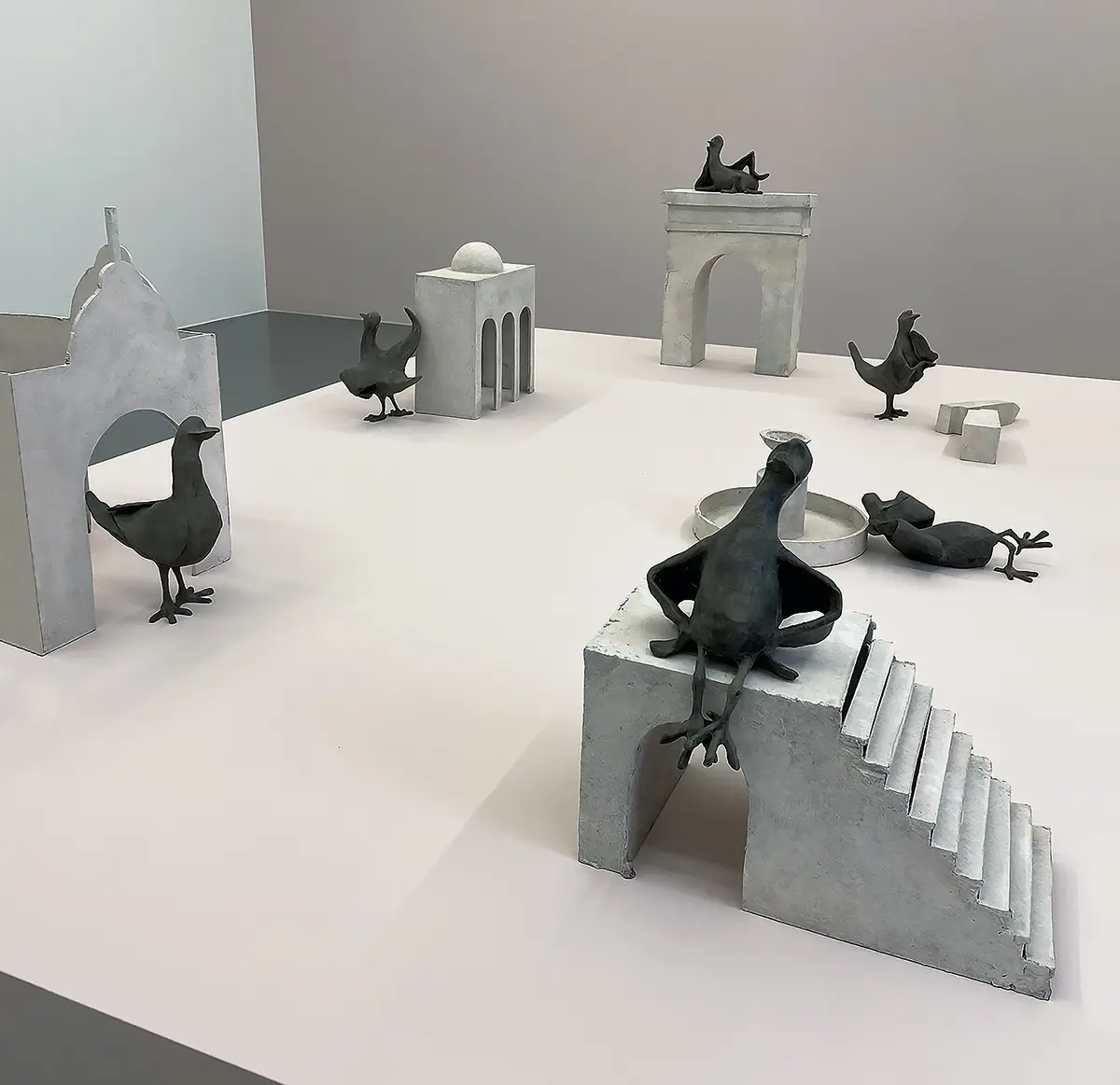
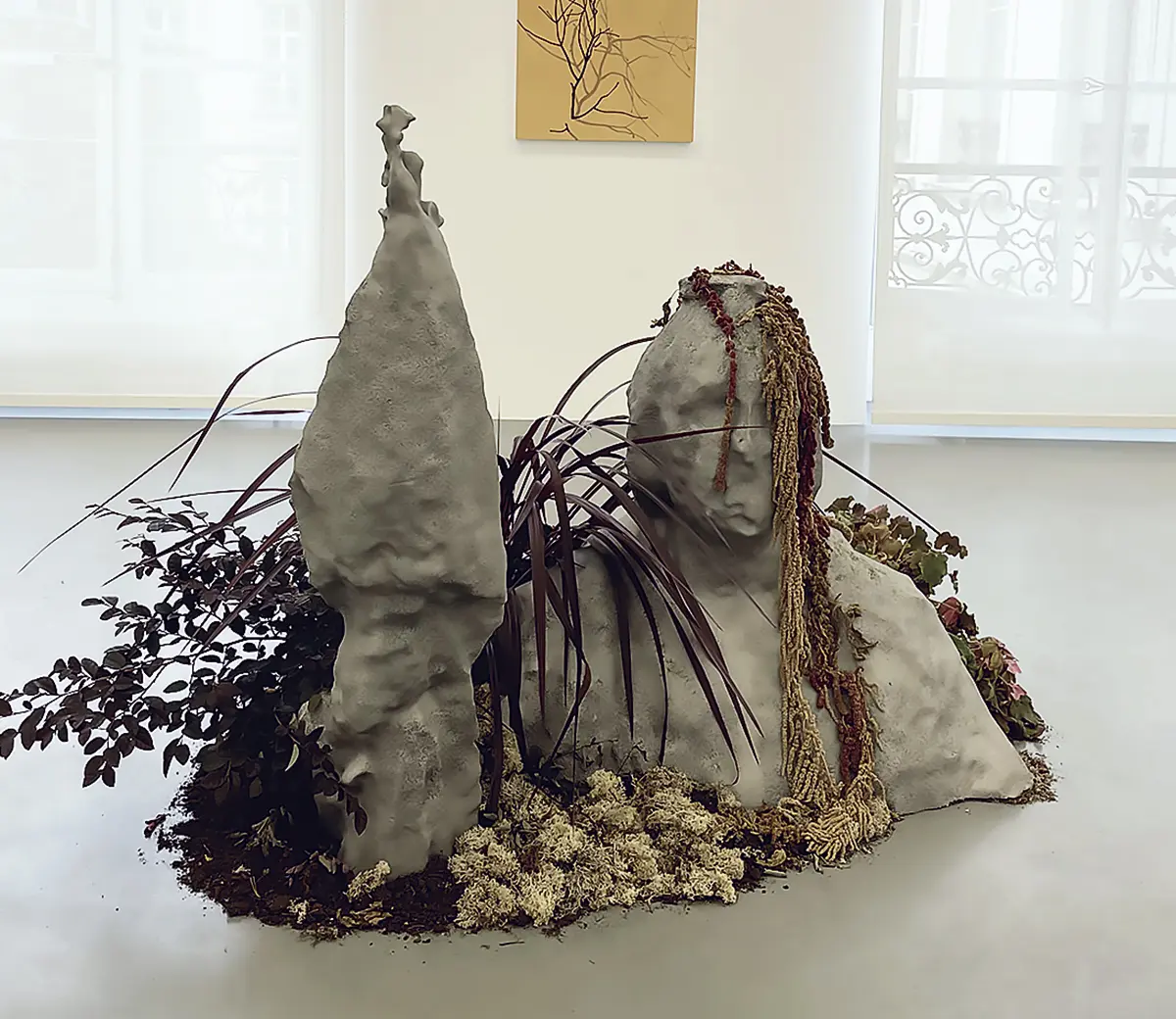
The exhibition at Perrotin gallery, titled “Prémonitions” (Premonitions), expands on the subject of the video seen at Centre Pompidou. This exhibition includes Post Human, a 2022 video work created during Argote’s recent stay in Rome’s Villa Médici (property of the French government). Ironically and humorously, Post Human foregrounds the pigeons that invade the oldest architectural works in every city, unwitting witnesses to the ruination of their most emblematic monuments (the Arc de Triomphe, the Obelisque, sculptures); these are the same pigeons who, tour guides and tourist all at once, will afterward take possession of the space thus “liberated”. The pastel and translucent hues that dominate the video (blotting-paper pink, soft blue and light gray) are the same we find in the paintings on exhibit in the gallery. Alongside the small- and medium-format canvases, representing fragments of monuments, two sculptures, one of a dilapidated pedestal, covered by scrub and brush, and one of a human figure of which nothing but the legs are left, it having been also devoured by wild vegetation, evoke, not without irony, the erasure or mutilation of such monuments in public spaces. There is also an installation that revisits, in its form and theme, the Post Human video. It features a nearly empty space in which a few emblematic monuments survive, with pigeons for their sole visitors. The full meaning of this exhibition comes into view when we are able to connect it with the Beaubourg video and once again encounter the great subtlety, subtext, and refinement of its images and its soundtrack. Those qualities characterize Iván Argote’s aesthetic and conceptual work.
Such a questioning view of the past is not only legitimate, but necessary. Nevertheless, one must be careful to base it on an objective knowledge of history, which is to say, one must put the facts the stakes in perspective in order to prompt constructive critical reflections that don’t immediately derive in feelings of guilt and repentance. Argote’s work combines several dimensions. It is at once political, aesthetic, didactic, and playful. Interrogating public space and the meaning of official narratives through those monuments, he seeks above all to grab our attention, to prompt critique, to shake up and provoke. For the force of its conviction, “for the unique, radically tender character of its activism”, this work of political fiction would have deserved the Marcel Duchamp Prize and more, in my opinion.
NOTE
1. Columbus’ statue was taken down on October 10, 2020, from the plaza located at the intersection of Paseo de la Reforma and Morelos avenues, with the intention of “restoring it and preserving our cultural heritage.”
* Courtesy of the artist and Perrotin.
CHRISTINE FRÉROT