Casa de América Latina in Paris hosted the exhibition “Structures sensibles” (Sensitive Structures) by Inés Blumencweig (Buenos Aires, 1930), from October 13, 2022 to January 20, 2023. It featured eleven structures made between 1961 and 1978, which are representative of a career spanning more than sixty years.
Particularly notable is how this solo show highlighted the way in which the artist explores three-dimensionality and incorporates industrial materials such as metal. Inés Blumencweig forces the spectator to pay attention to history. The reflections of the “Buenos Aires collectives” of the 1940s relate to a particular conception of the subject and to the exploration of two fundamental moments: Surrealism and abstraction.
Since the 1950s, Blumencweig exhibited the results of her studio work with Batlle Planas and Nélida Demichelis. Informalism was at that time a reaction to the rigidity of established rules. She was enriched by her trips to diverse cultural environments: visits to Washington and New York, and her residence in Italy with Mario Pucciarelli (Rome, 1928–2014), her husband and an artist who also followed the informalist trend. American action painting was to be the next stage in her explorations.
Inés Blumencweig’s work hints towards Torres García’s universalist forms. Hers are fundamentally personal ones. She places the accent on the reality of space. The logic of the constructive form unfolds from her interest in formal games, the paradoxes between volumes and planes, and a multiplicity of surfaces and new materials. Her art emerges from within, from the soul, and is expressed in sensory sequences.
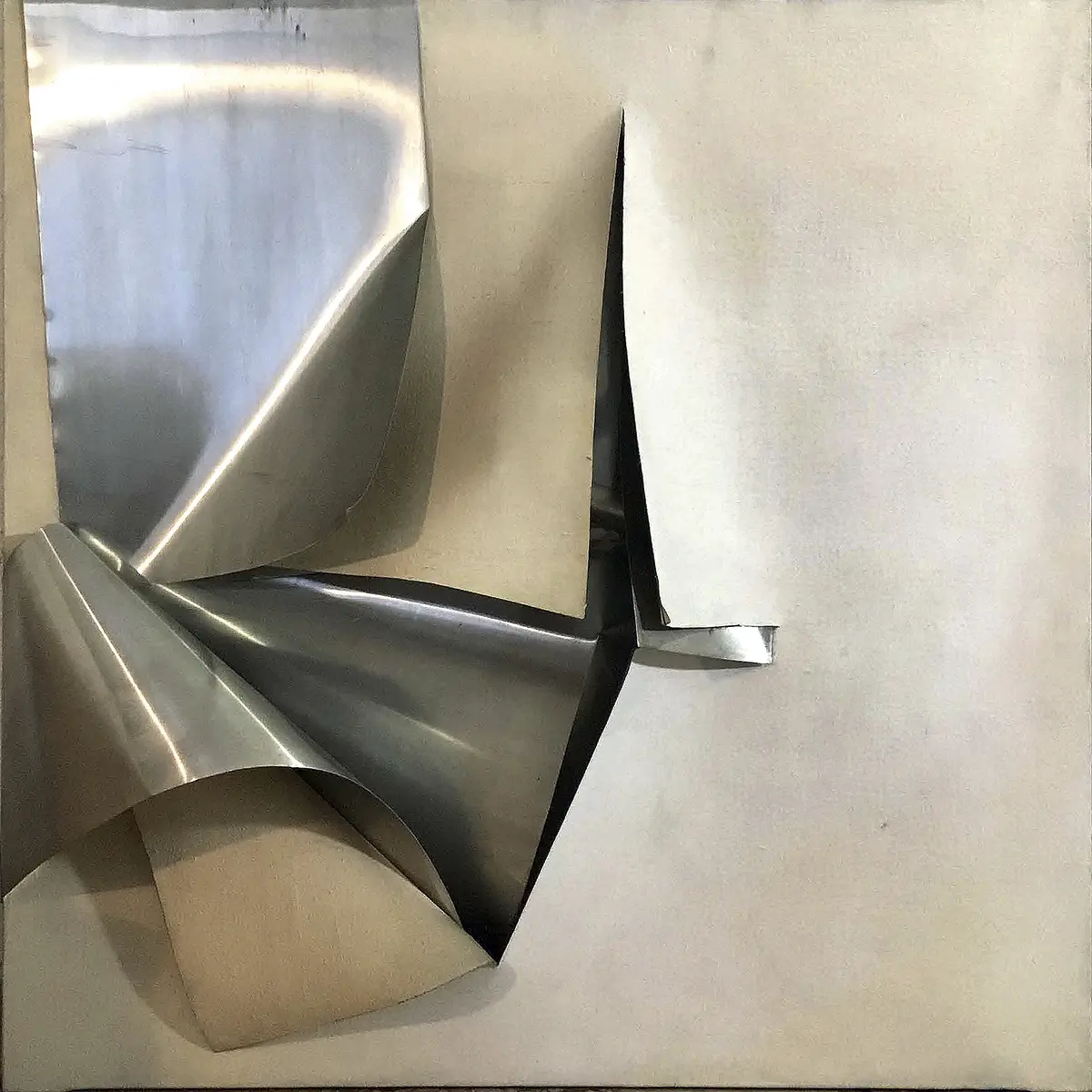
Several techniques used by the artist manifest the task of anticipation—especially in the use of cut-and-modeled metal—between the second and the third dimensions. She was influenced by Lucio Fontana’s Spatialism and other currents in the Italian peninsula, which tended towards abstraction.
The first works in this period date back to the early 1960s, such as Struttura Nero-Rame (1963), made of cloth and metal. As a whole, Inés Blumencweig expresses herself with freedom and a distinct personality. Space is contained; as if folded, cut, and enveloped. Various practical solutions point to her originality: intertwining nylon ribbons and quasi-Moebius paradoxes sustained by questioning the rectangle.
We are in a different space, which no longer follows classical principles, but rather the transforming action of matter. There are no transparencies. The effects of light and shadow negotiate with the volumes, complementing them with sculptural logic.
These structures also have an Oriental undertone. Her work shares the folding, interlacing, and a subtle discreetness with the art of origami. Her colors are sober but eloquent. There is also an unconscious reading of space that is projected and assimilated by the viewer.
From the start, Blumencweig’s work has fused Latin American and European artistic currents, but without any ties and in intimate progression. Throughout the different stages of her career, she has succeeded in making her art worthy of respect.
SUSANA SULIC