Music is one of the most clearly discernible thematic lines in the artistic career of Glenda León (Havana, 1976). The ambivalence of the “musical sculptures” or “visual instruments” featured in her recent solo show lies in the fact that they function both as wall works and sound pieces that operate much like string instruments. At the visual level, the principle is simple: wooden planks, pegs, and ropes are stretched to delineate minimal and suggestive shapes: the sun’s rays, rain or celestial constellations. On the conceptual and experiential levels, this series is a powerful generator blurring the boundaries between sound art, sculpture, drawing, and performance. Interaction with the viewer is key to accessing these works’ acoustic dimension, although they possess no device to program the qualities of sound, such as timbre or intensity, like most musical instruments do. Luthiers and players establish aesthetic and epistemic relations with guitars, cellos or violas according to certain rules and methods associated to the length and gauge of the strings, the distance and placement of the bridge, and other physical details. León’s pieces are governed by altogether different premises: her only strategy is to make them produce sound; their forms are determined by sight and not by hearing.
Out of experimentation, fun, necessity, or iconoclastic actions, many musicians throughout history have designed and assembled their own instruments. Interestingly, a similar operation now emerges from the visual arts, where sound is typically represented or evoked without being actively present. The unique nature of this series is that sound exists both actually and potentially. In fact, the band Neopercusión, comprised of soloists from the National Orchestra of Spain, activated all the pieces in a concert-performance during the show’s opening. It is not the first time that this artist establishes collaborations of this nature. With different variants, the pentagram has been a recurrent element in her work and her “visual scores”—in which she superimposes landscapes, petals, or raindrops on patterned sheets—have allowed her to establish creative links with musicians such as the pianist Aldo López Gavilán.
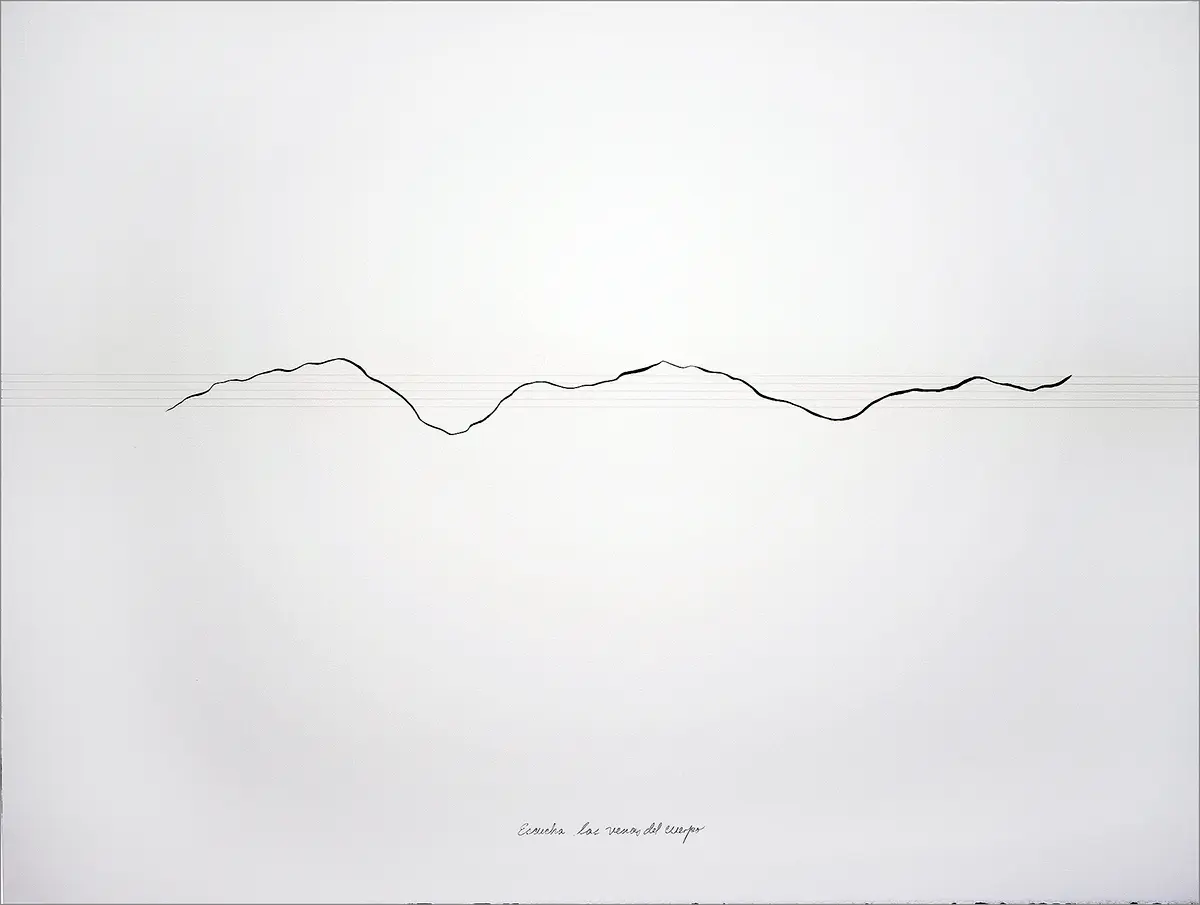
In this exhibition, the series “Cada sonido es una forma de tiempo” (Each Sound is a Form of Time) adheres to inertia from a renewed perspective: silhouettes of organic elements such as the flight of bees, the veins in the body, or Mount Fuji are painted on top of sheet music with a singular stroke made with ink and a Japanese brush. The sound here is pure invocation, since listening is the basic concept of the pieces and, in general, the spirit that prevails in the entire exhibition. This is not surprising if one considers that Glenda León trained as a dancer. Dance is an activity concomitant to music, and in it, listening, waiting, and silence are as important as movement and sound.
The cliché that constrains Cuban culture under the umbrella of music by virtue of the power that the country possesses in that field, has been rightly criticized. I find, however, that some seed of that deep cultural matrix must have germinated in a case like this: a visual artist with a minimalist aesthetic and not exactly a fan of the island’s vernacular rhythms deliberately directs her poetics towards a musical sensibility. Glenda León has declared her debt to “visual music,” a term coined not by chance to refer to the work of Wassily Kandinsky, who, together with another Russian, Igor Stravinsky, launched the explorations to make sound visible. Russia is another intensely musical nation. Although the artist also refers to John Cage and Fluxus as other notable influences, her art differs from the experimental spirit of the 1960s—which emphasized the process over the result—to the extent that her work, understood as an aesthetic object, has an enormous relevance: her processes translate into pieces where exquisiteness and delicacy prevail.
Irrespective of the above, León’s proposals are also a clear example of what is now called situated art practices, not only because they introduce a particular gender subjectivity within a tradition dominated by male artists, but because the themes that she has worked on for many years are organically finding an echo that is heightening their full potential, given the current situation. Within the codes and operations belonging to the realm of art, the works in this exhibition underline the aesthetic power of nature and invite the viewer to tune in with its rhythms in a context of increasing awareness of our environmental debacle. Appeals to listen and to pause are urgently needed in all spheres of our existence.