Never before did we have the opportunity to see such a comprehensive exhibition of the work of Fanny Sanín (Colombia, 1938) in Miami. “Thresholds for Contemplation,” which took place in 2022 at the Durban Segnini Gallery, can be considered a retrospective show since it covers the late 1960s right up to the 2020s. The earliest work in the show was made in 1965 and the latest in 2021, so we are talking about a span of more than five decades. A special circumstance marked the event: it was the last show organized by César Segnini (Venezuela, 1938 – USA, 2022), one of the most renowned Latin American gallery owners and also a great friend of Fanny Sanín.
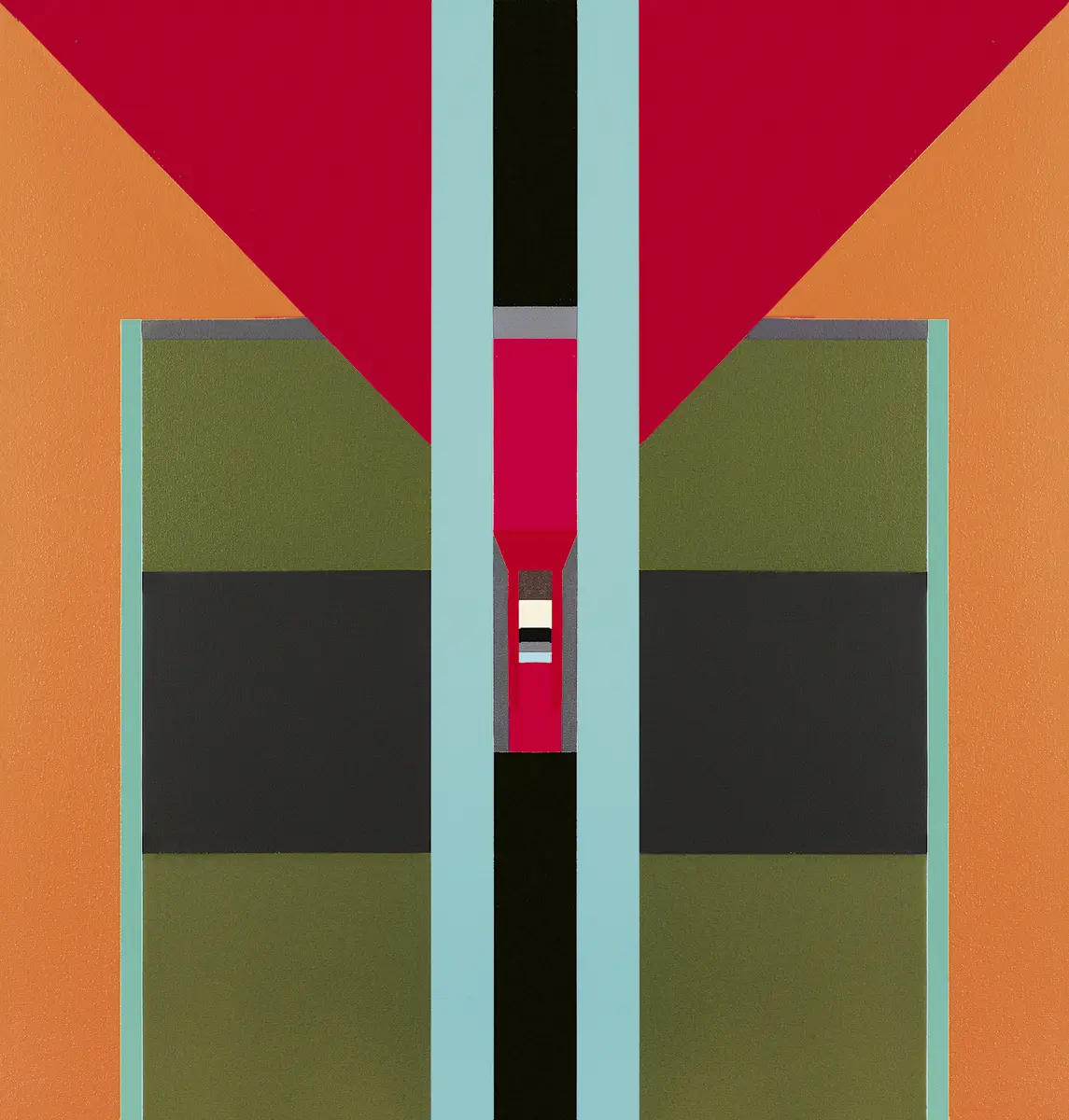
A curious counterpoint marked the exhibition’s display. Her first works from the mid-and- late 1960s hung parallel to her most recent works, from 2021. Between both extremes were paintings belonging to the different stages in Fanny Sanín’s abstract-language career. Works like Watercolor (1966) and Watercolor I (1968) are small-format abstractions in an expressionist key. In both, expression blurs the limits needed to fix the forms. These watercolors are closer to Informalism than to the Geometric Abstraction of her later production. Her intention back then was to go beyond the shapes composing the pictorial plane through the use of pastel colors, not compact ones; colors that function as background and figure at the same time. Works that place the intersection of the different spatial planes at the very center of the painting, creating a convulsed space, a sensation of discontinuous and protruding movement.
The works produced between 1970 and 1990 explore abstract languages that lean more towards geometry than expressionism. In the series “Study for Painting” (1980) and “Acrylic,” (1990), for example, Informalism gives way to a geometric architecture, as evidenced in the lines that define her shapes, and in her use of color. Forms become more geometric and the pastel colors, with some dripping episodes, typical of the works of the 1960s, give way to flat colors and an industrial appearance. Also gone are the gestures and the fortuitously undefined spaces that were to be replaced by the imperative desire to rationalize space and composition in pursuit of a more organized and structured perception of the world. In the series “Study for Painting” there is a clear claim to a poetics of geometry, although neo-expressionist reminiscences can still be detected.
Observing these characteristics, it appears that Fanny Sanín’s works of the late 1960s communicate a state of the world in progress, a nonconformity, a disagreement with forms of organization, both in the subjective and the material orders, which the artist felt were obsolete. Structures whose gears do not respond to the speed of the sociocultural changes taking place under the impact of the capitalist market economy, spurred by an accelerated process of industrialization. These structural imbalances had disastrous consequences in Latin America, exacerbated by the numerous military coups that took place between the 1960s and 1980s, which weakened freedom: the pillar of democracy. This in turn caused a social unrest marked by uncertainty, chaos, and dissolution. If Sanín’s paintings from the 1960s give off a convulsion of forms and a sharp expressionism that blurs its own limits, her works of the 2000s, on the other hand, are submerged in a clearly abstract and geometric poetics. In these, there is a growing concern for delineating, structuring, and building architectures of accessible spaces. A will to tangibly organize the background and the figure, and to formulate a precise calligraphy based on a geometric abstraction of the world. There is a trace, a precise line that dissects both the separation of the colored planes and the boundaries of the geometric figures that are formed in the background, with the color black in the leading role. The order, projection, and exact calculation of the contours become increasingly sharper. At this stage, Sanín’s work is somewhat related to two great Colombian artists: Manolo Vellojín (1943–2013) and Omar Rayo (1928–2010).1 With Vellojín she shares the precise strokes and geometric lines that dissect both the separation of the colored planes and the boundaries of the geometric figures that are formed in the background, with the color black playing a leading role in Sanín’s case. The order, projection, and precise calculation of the contours in her paintings are more calligraphic. Like Rayo, she also offers a combination of vivid colors inspired in the clothing and attire of indigenous populations on the banks of the Atlantic (Caribbean Sea) and the Colombian Pacific. In brief, “Umbrales para la contemplación” (Thresholds for Contemplation) presented one of the most consistent artistic bodies of work within the field of geometric abstraction in Latin America at the end of the 20th century and beginning of the 21st.
NOTE
1. Matos, Dennys. “Umbrales para la contemplación de Fanny Sanín” in El Nuevo Herald, Miami, Sunday, January 1, 2023, pp. 1D y 2D.