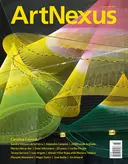
Theory. Goliath’s Head, an installation by Eduardo Basualdo, is featured on the cover of the latest and illuminating essay by Elena Oliveras, La metáfora en el arte (Paidós, Buenos Aires, 2021). 1 A huge and enigmatic black stone is about to fall from above. Does the work refer to Ezequiel Martínez Estrada’s text that carries the same title? Or to the painting by Caravaggio? Is it a metaphor for the fragility of the human condition? Precisely, Oliveras’s book explores the “constitutive element of the work of art” that allows us to “see one thing in another,” delving into that space of uncertainty which constitutes current art, so, interestingly, her reflections can help us to better appreciate the exhibition by Eduardo Basualdo (Buenos Aires, 1977), member of the experimental and multidisciplinary artist collective Provisional-Permanent, with whom he began to be known in 2004.
The magnificent solo show titled “Pupila” (Pupil) stands out among the eleven exhibitions that make up “Un día en la Tierra” (A Day on Earth), the insightful annual program organized by the Museo Moderno of Buenos Aires, which highlights works by emerging and established artists who reflect on experiences, identities, violence, struggles, shame, and transculturation, and is accompanied by an array of educational and social activities.
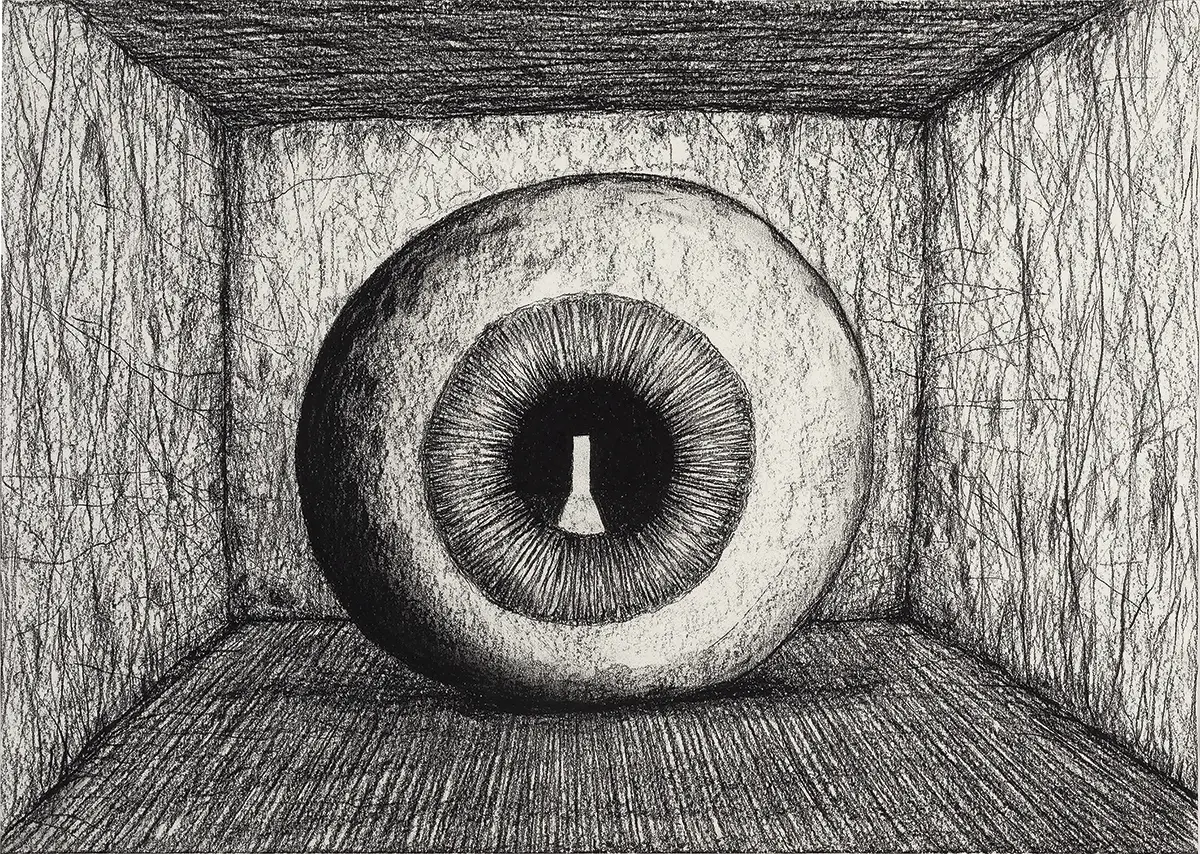
Physical and mental space is important for the development of Basualdo’s work. This centrality is verified both in the initial expression—the eye that turns its gaze inwards—and in the installation of “Pupila” (Pupil) which encourages visitors to make a prodigious journey through the abysses of the human mind and the dark corners of our hearts and dreams. “In this show, the most important gesture, poetically speaking, is the idea of closing one’s eyes to keep looking—inwards,” says Basualdo. And also outwards, as Victoria Noorthoorn, the museum’s director and this show’s curator (in collaboration with Alejandra Aguado and Clarisa Appendino) explains: “the artist’s eye is turned outwards to contemplate the same figures that until then had nestled only in his nightmares and the recesses of his imagination, as if the cerebral caverns could no longer contain that malignant combustion. And he understood, at that moment, that those images do not belong entirely to him.”
Basualdo’s narrative took shape in 2020, during the most critical period of the pandemic, when catastrophe threatened the world and the artist was reflecting on the book he is currently writing. The architectural design of the exhibition slowly guides the visitor, who will first see a succession of fifty drawings of various sizes, with elements that refer to previous works (the brain, the black stone). Spaces with white or red walls are altered to become narrower until they turn into passageways, and also open to reveal two rooms with somber installations that revive ancient and actual terrors, like the monolith with which the exhibition ends. The title of this last work, from which a disturbing sound is emanating, is 1977 drawn backwards. The same year the artist was born was also one of the bloodiest in Argentina, then ruled by a military dictatorship (1976-1983).
The exhibition, like so many others of his, begins with a threatening dark stone, but this time it appears drawn and housed inside a head: a black rock about to tear apart a house of similar size. Drawn with chalk pastels on white paper, the small drawings feature a pupil as the protagonist, which is sometimes shown in eyes without faces. Basualdo seems to want to exorcise anguishing thoughts, but also to condense notions about the beginning and the end; perhaps the intrauterine life inside the belly of his late mother, as well as a tragic collective denouement shown as a series of recumbent figures in the penultimate piece presented here; and much more. Through the eye’s pupil—“the hole and the membrane through which we know the world and our own body”—the blackest black possesses, multiplies, shrinks, and inhabits the brain populated by specters and, at times, by other eyes.
After observing the small-sized images in a large room connected to the sound of 1977, the visitor encounters an imposing black installation made up of the shapes of recumbent bodies and vestiges of other things that reveal havoc. Built with sheets of aluminum, the gigantic matte-black sculpture is dominated by what first appears to be a wave, but turns out to be “a giant pulsating figure;” a being that watches over other beings, covered with what seems to be a kind of mud that caused their destruction.
Along with this exhibition, the artist has just inaugurated “Precuela” (Prequel), curated by Martín Craciun at the galería (gallery) Walden Naturae in Pueblo Garzón (Uruguay). Drawings from various series and installations seek to “to go back to the mythological origins of my work.... There is an interplay of times beyond chronological time... It is a budding or transitional exhibition, a forerunner of something that has not been defined,” the artist explains. No: the project is not the prequel to “Pupila” (Pupil) and neither its sequel. Metaphor for what? Forerunner of what? Basualdo’s talent moves the observer to reflect with intensity and joy.
NOTE
1. The title of this book translates as The Metaphor in Art