The title of the exhibition by Edouard Duval-Carrié (Haiti, 1954), “The World as I Know It; Recent Works by Edouard Duval Carrie,” reveals the clarity of his self-reflective gaze. In other words, his creations derive from a process of intersubjectivity that is opposed to the idea of representing the known world with an alleged objectivity that usually engenders forms of oppression.
This Miami-based Haitian artist and curator has built a body of work that affectively interprets and reactivates the multicultural meanings of the Afro-Caribbean world into which he was born, staging again and again the vast stream of interactions in the complex historical fabric of his island, with an aesthetic language also shaped by his various geographical and cultural life experiences, and studying in cities like Paris and Vancouver. A universe loaded with spiritual symbols is thus unfolded, dragging along the double and inseparable experience of the biographical and the historical: the conformation of the national identity of the continent’s first black republic, always harassed by colonialist ghosts, is inserted in the very development of his art, conceived as a changing scenario of creation and animated by the force of imaginary presences that transform his vision of the world.
The Afro-Haitian pantheon that he recovered at age 16, when he returned to Haiti in 1970, is inhabited not so much by the tutelary figures of voodoo but by a mode of imagination that has offered him faces, bodies, and a place in contemporary art. He inserts these figures in the epicenters of large cities, subverting the dominant narratives. Duval-Carrié has succeeded in making the living presences, suspended in time, of deities and tyrants, rebels and victims both dead and alive, coexist in his own artistic world, in a kind of magic chessboard that is always open and unfinished; in a continuous procession that exalts the popular and ritualizes the conceptual; staging, reviving, and rethinking the enigma of his own history in engravings, paintings, installations, and sculptures used to deploy a kind of magnetic field that summons his characters—and us.
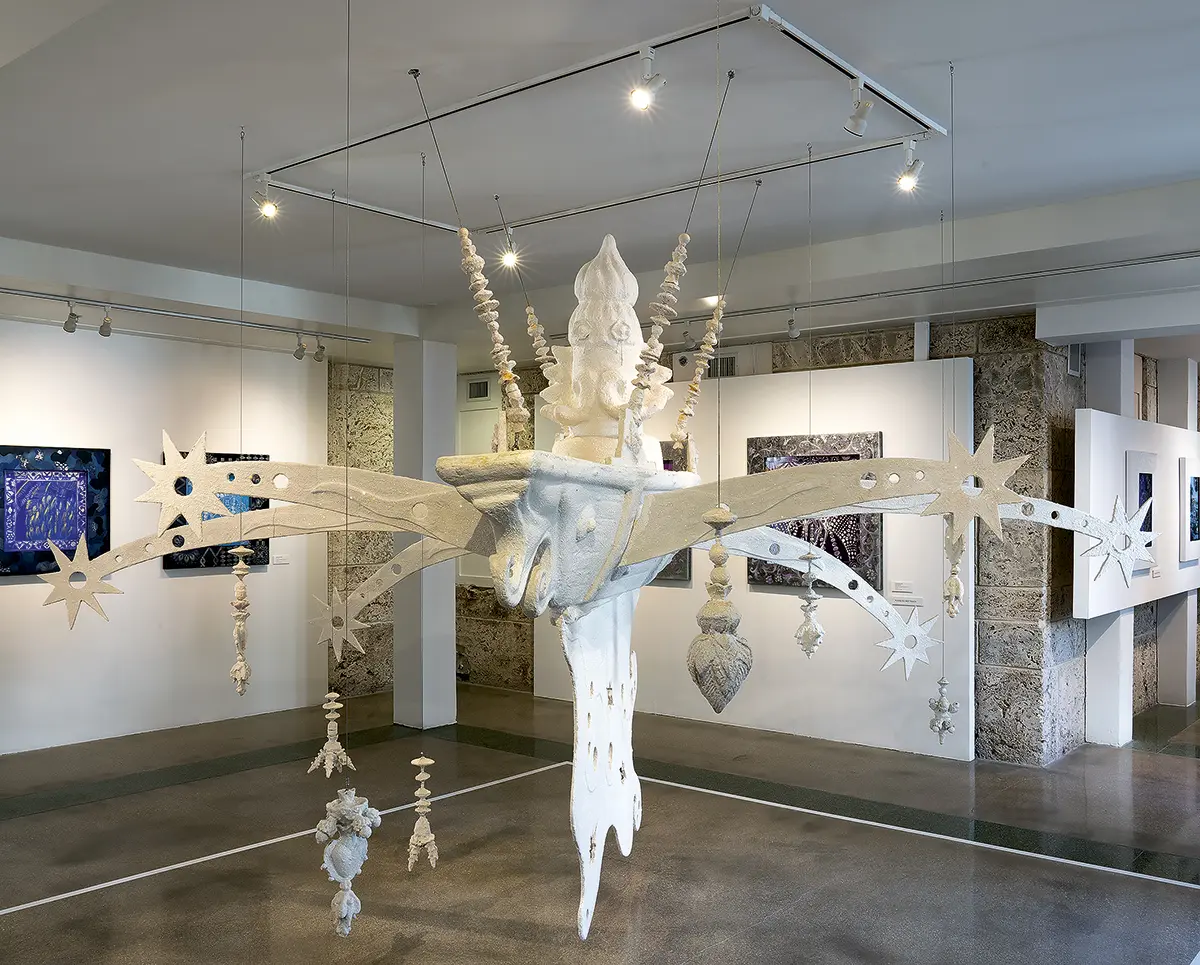
He would have wanted to build his sculpture Sugar Boat (2017) with real sugar, but the Caribbean ants made him give up that idea. In any case, his enormous floating ship in shining white, built with fiberglass and not anchored but suspended from the ceiling in the central space of one of the museum’s rooms, carries as cargo the delirious history of the sugar emporiums built on the piled-up skeletons of slaves, which produced a colossal wealth in the last three years of French rule, and then fell apart. His installation tells a story of which there are no records or documentation, but which evokes blurred yet collectively shared memories that Duval-Carrié ends up giving form to. Anemones hang from its sculpted star-shaped corners, such as those often attached to sunken ships, hence revealing the enigma of his installation. This piece, which emulates the ornamental, far from speaking of the luxury that surrounded the sugar trade, is a metaphor for the collapse of colonialist exploitation projects, and floats in space with its deceptively playful form in order to display its admonition.
The phantasmagorical presence of this sunken ship is surrounded by a series of characters outlined in white, drawn with the drypoint technique on intense blue or purple glass surfaces, and who survive confusing times and layers of reality. These monochrome works have antecedents in Maison brulant (Burning House, 2006), works on paper that, as Edward J. Sullivan has observed, include dots and circles similar to the scenarios drawn on the floor of voodoo temples for the arrival of spirits. His imaginary portraits of voodoo deities such as Aizan, a protective figure of commerce, Ogoun the warrior, or the cuckolded Bossou, accompany portraits of figures—such as the hero Jean-Jacques Dessalines—who have as much to do with the part of Haiti’s history that inspired Alejo Carpentier to come up with the concept of magical realism, as with the libertarian spirit of the Jamaica Letter. Above all, they comprise an intimate iconography. All these works completely take over the frame in such a way that, rather than containing the represented presences, their frame protects and completes them; they end up configuring a practice that clearly exceeds the limits of representation in order to transform the surrounding space.
The artist is a master in building atmospheres of an alternate reality that ultimately takes over spaces and constitutes a counter-colonization movement. He has turned the Coral Gables Museum into a ghostly sea where his sugar ship sails above time and is replete with demons, deities, and heroes who were once slaves and who, defying historical narratives, open a connecting passage between enslaved Africa and contemporary America. Let’s not forget that glass and mirrors are surfaces that communicate between worlds, and for this reason it is not surprising that a three-dimensional and transparent key materialized on one of the portraits made by an artist who has been experimenting incessantly over the last two years. Edouard Duval-Carrié creates with the subjective awareness that his creatures cross the limits of representation, become connecting passageways, and invert the order of realities.
* This exhibition was possible thanks to the support of Roberto Borlenghi and Pan American Art Projects.