Anaïs Nin said that we don’t see things as they are, but rather, as we are. One could describe “Mi mundo como objeto” (My World as an Object), Diana Fonseca’s exhibition at Max Estrella gallery, in Madrid, precisely in that way. Fonseca (Havana, 1978) created ten new works specifically to be shown in this, her first solo show in this space. These works allude to the details of objects and our everyday routines with the idea of subverting and infusing it with a new, more poetic and surrealistic meaning. Fonseca is interested in stripping things of their first utility in order to show, by means of her artistic gaze, another meaning, one imbued with less practical and more lyrical codes that transfer new senses onto the object itself. The work is freed from any commitment and opens up to new narratives.
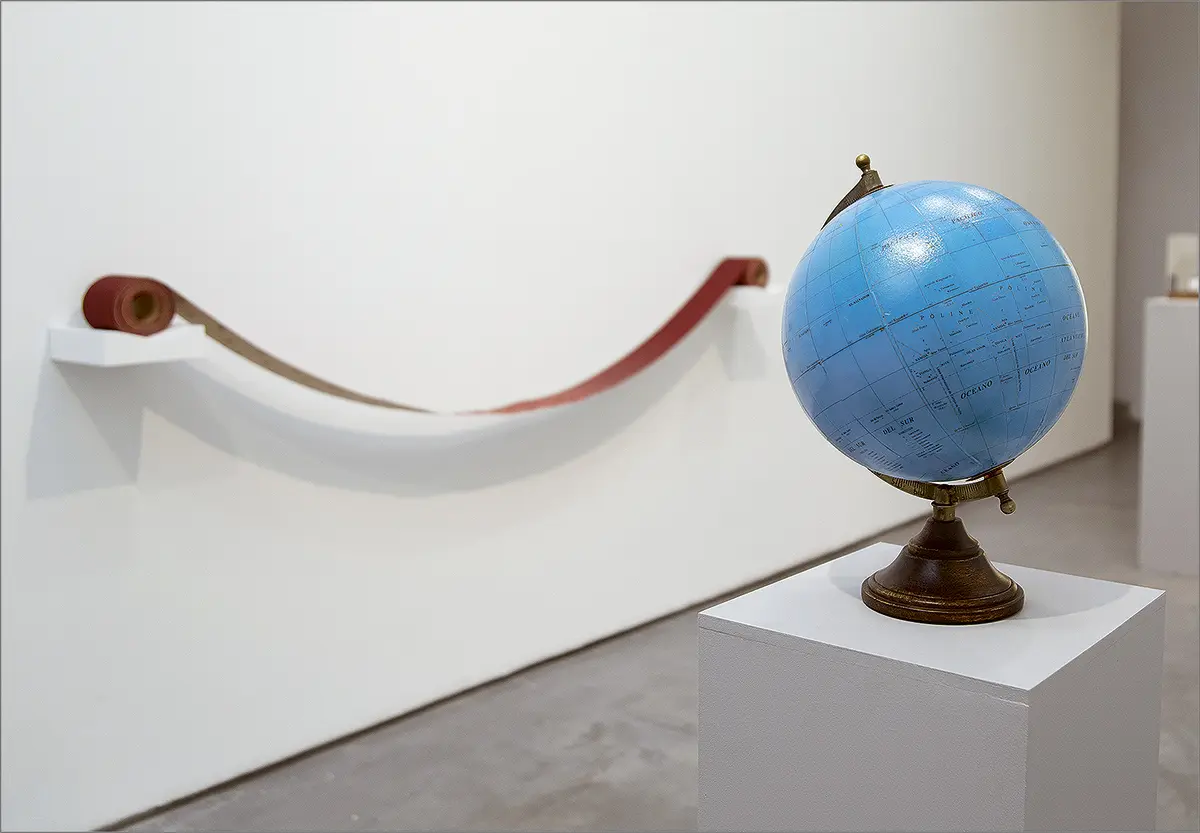
Opposites (hard and soft, light and heavy) face each other in the gallery, in works arranged across the different rooms. Mundo pacífico (Peaceful World) welcomes visitors into the exhibition, with a globe that loses its semantic meaning as the Earth as such disappears from it, in favor of a watery planet devoid of people, countries, and conflicts; Fonseca deletes the land and leaves with the sea at the center. Similarly, El libro de la Discordia (The Book of Discord) is a book with spines on both sides, impossible to open, as if no possibility of dialog or even of encountering a blank page existed. Such opposite dualities are also found in other works, such as Tregua (Truce), where two sheets of sand paper connect on one end, precisely at the point where their hardest part has been sanded out.
The contrast between lightness and weight, force and delicateness, appears in works like El peso de la inconsistencia, (The Weight of Inconsistency) where a feather balances on the edge of a heavy table, not falling yet not levitating, as if the visual element itself functioned as something contradictory. This is one of many readings Fonseca provokes in her painstaking exhibition, where each work is measured and thought through, suggesting deeper readings than what we can grasp at first glance.
In an exercise of vindication of the readymade, Fonseca uses everyday elements but with a different purpose, creating with them lyrical, surrealistic artworks that are also infused with a powerful critical intent, which strips them of their practicality in favor of greater poeticism. Thus, the clocks seen in different areas of the gallery are devoid of a utilitarian function; their hands have proliferated across every hour, or their numbers have fallen to the bottom and mix into a measured chaos that makes it impossible to read the time. Here, the speed of a present exacerbated by a precise control of all that occurs, of time itself, of space, of connections, is made contingent in works whose end is not the quantity of time, but its quality.
Fonseca reclaims the object beyond its practicality, advocating for the irrational as an aesthetic possibility closer to the heart and the mind. In consequence, her process tends more toward lyricism than to conceptual critique, even as the final result has similarities with the latter.
The eye, which also fascinates the surrealists, is the protagonist of the video projection Explosión-implosión (Explosion-Implosion), the oldest work on display (2019), one eye lets a tear flow and the other picks it up. Like Paul Klee’s angel of history, Fonseca peers into the past and the future with a bewildered gaze that stops the motion of time, falls and is raised again, in the same state of uncertainty that characterizes human existence as such.
Mi mundo como objeto (My World as an Object) Diana Fonseca’s exhibition at Madrid’s Max Estrella gallery, could very well have been titled in reverse; here, what interests the artist are the objects that become her world, our world, and have us thinking beyond. Everyday forms and routines, freighted with functionality, are stripped of their utilitarian aspect; we are presented with aesthetically minimalistic, formally conceptual works of art loaded with surrealistic meaning. In this exhibition, we are abundantly incited to play with the possibilities of a reading that goes beyond the boundaries, letting ourselves be carried away by our curiosity. Fonseca’s scissors, clocks, spheres, books, or papers are something else than useful items; they are metaphors of a way of looking at the world and communicating that which can emerge from our imagination. The works in Mi mundo como objeto (My World as an Object) make it possible for us, as Anaïs Nin had it, to see things as we are, overwhelming the boundaries of what they are. Visual riddles and games to see things otherwise.