“Solar Storm” is the title of Cuban artist Dagoberto Rodríguez’s first monographic exhibition in France, held recently at Galerie Peter Kilchmann, in Paris. Running from February 18 through April 15, it was only the Swiss gallery’s second solo show in its Parisian location, inaugurated last fall. A strong signal of support for the co-founder of the Los Carpinteros collective (Cuba-Madrid, 1994-2018): after the group’s dissolution, Peter Kilchmann decided to promote Rodríguez’s work, first with a monographic exhibition in Switzerland in 2019. In terms Rodríguez’s first solo outing in France, these three months are strategic for a presentation in such not-to-be-missed moments as the Art Paris fair.
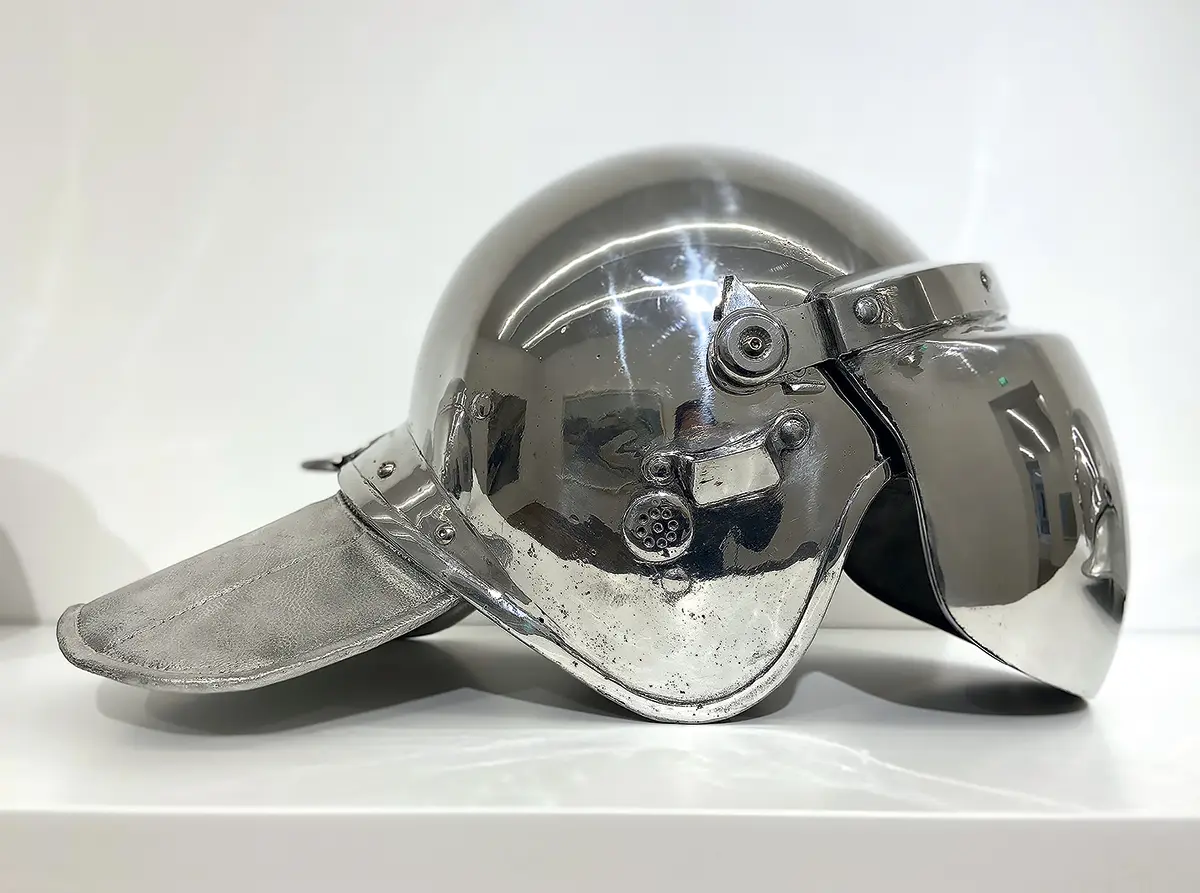
The exhibition is organized in four chapters, all interconnected. The opening is an installation of aluminum helmets placed equidistantly, in a military-like formation, on a white shelf. The wall text explains that these are detailed reproductions of uniforms used by anti-riot units of Spain’s National Police. An interesting choice for a French exhibition: as police violence escalates, the country decades ago dubbed “the birthplace of Human rights” has become the object of vociferous complaints for the repeated violation of precisely such rights. Police uniforms, ever more militaristic and aggressive, are the external symbols of a social tension that has at times begun to resemble a civil war. NIDEC CSC10: when we type this work’s obscure title into a search engine, it quickly takes us to a commercial web page, that of NIDEC Defense Group, “makers and purveyors of private and public and security equipment and military gear”. The CSC10 helmet is included in its anti-riot catalog, and can be purchased for a comfortable 129,99 €. It comes in the four primary colors, in white, and, more classically, in black. This is Rodríguez’s provocation: in a consumer society, any citizen can transform him or herself into a war machine at a reasonable price. Our distorted reflection on the helmets surfaces address us directly: Who are you in this situation? This powerful sculptural installation is presented across from two pictorial works, an oil and a watercolor, both depicting military tanks: Tanque ruso (Russian Tank) and Tanque ruso IV (Russian Tank IV). Rodríguez’s impeccable technique is deployed here in service of reproducing journalistic photographs from the war in Ukraine. The two tanks look unusable, one overturned, the other gutted. These works highlight the relative nature of military power, as well as the panic that hides behind such technological apparatuses, which in the end are more vulnerable than they seem.
The next room features four watercolors depicting city models built using Lego® pieces. Buildings, streets, all very well organized, with the monotony of their serially manufactured pieces: same shape, same color, one after the other ad infinitum. Three of the watercolors depict refugee camps: one in Jordan, one in Greece, a larger one in Bangladesh. The fourth depicts old Havana, the sole reference here to Rodríguez’s native country. Variable in size—I am told that each is directly proportional to the actual size of the refugee camp it depicts—these works bear prosaic titles: Moria Refugee Camp, Rohinyia Refugee Camp, Zaatari Refugee Camp. The Havana one follows the same pattern: Havana Refugee Camp I. And indeed, is the Havana Malecón not like a camp of perpetual standbys? In the midst of Cuba’s economic, social, and political crisis, the country’s capital has become a city for people in transit (at times, forever), filled with citizens hoping to find refuge in a different reality, that of their fantasies and dreams, beyond the sea.
Starting in the third room, Rodríguez indeed takes us to a different reality. The refugee camps’ holding pattern does not lead to some “free world” or “American dream”; we have seen how the West, corroded by war and violence, is in fact the cause behind the existence of those very camps—a snake relentlessly biting its tail. No, there is no alternative in this world, Rodríguez exclaims. If refuge is to be found, he posits, not without irony, it will be on Mars. Two oil paintings and one watercolor, all large-formats, depict robots exploring the red planet, the only one potentially habitable in our solar system outside of Earth. Made in 2023, these works comprise the artist’s most recent series. Jezero Crater, Bagnold Dune, Perseverance: symbols perhaps of an all too human tendency to always seek sources of life, of hope, beyond our own reality. Instead of laboring to change our world, we are inevitably mesmerized by the hopeless illusion of beginning anew on a different planet, where life may have existed long ago. However, may this not be also a wink in the direction of the name we have given to the very planet that exerts such allure? Mars, God of war, continues to play with our egos, and to represent his games, Rodriguez depicts him in Legos.
The exhibition’s final work is explosive: the 3D animation video from which the show takes its overall title, depicting a solar storm. While from a human point of view the Sun is a major symbol of stability and predictability, Rodríguez decided to show us its tumultuous life. Starting with a global view of the Sun, the video gradually brings us closer and closer to its surface, then inside it, into its fierce fiery turbulence and its kilometer-tall flares and ejections. Solar storms occur when the Sun suddenly liberates the energy accumulated in its atmosphere. Rather than a threat to us, may this not be seen as a reflection of what the societies we have invented here on Earth continually endure?
CHRISTINA CHIROUZE