Titled Habitar el colapso (Inhabiting the Collapse), Cynthia Gutiérrez’s exhibition at MACG is an intelligent, raw confrontation with reality. It poses questions about the evident irrelevance of the “monument”, in the broadest sense of the term, as an “official” conjuration. Its dubious and obsolete allocation of power, its revered presence and its historical incorruptibility emanates from each work with a singular resonance all of its own, at times subtle, like the tentative sounds of an orchestra tuning its instruments, and at other times as potent as the foundational chord that launches the second movement of Beethoven’s Seventh Symphony, bringing deafeningly forth a power capable of shaking the earth and toppling upon it all that we had wanted to believe unmovable.
Orchestrated by Víctor Palacios (curator at Museo Cabañas), the show brings together thirteen artworks in various techniques, materials and constructions, all focused on the interests that have guided this recognized Mexican artist throughout her career. How are memory, history, personal and collective identity forged? And, more importantly, how can they be reconfigured?
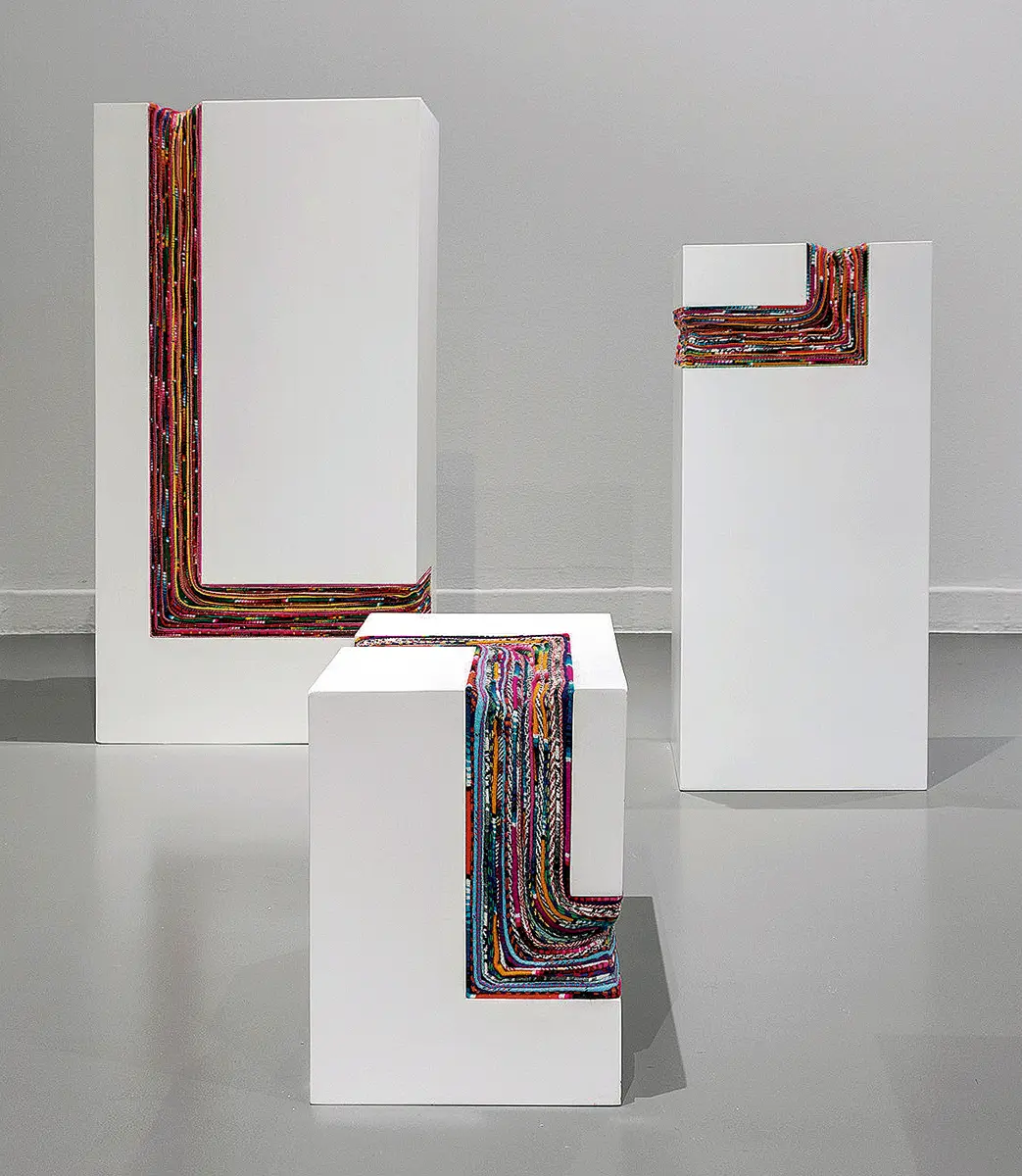
Gutiérrez revisited the last seven years of her production and created new works—for the most part, object groups—that constitute a forceful affirmation of her processes and broad interests, which in turn, by positing latent questions, open themselves up as invitations to future works. Sepulcros modernos I-XV (Modern Graves 1-15, 2019-2021) is a solid example, in terms of its conceptual gambit and its execution. Having made metaphors of the museum convention in an impeccable whiteness, Gutiérrez segments them in transversal angular cuts, takes away a part of each block, and inserts in their place amalgams of textiles clipped from traditional indigenous costumes, both handmade—backstrap and treadle looms—and industrial, resulting in interventions with formal and spatial depths that resemble mineral veins in multicolor textures, coherent with the size and shape of each base. The nondescript utilitarianism of those bases, usually used as sculpture supports, is transfigured into an incontestable presence by compacting the arbitrary art/craft distinction, to the point of unraveling it, into uncountable layers that proclaim the hands of their creators, grafts of those other “minor” histories, reasserting the urgency of their visibility.
Aliento suspendido (Suspended Breath, 2016) unfurls a lucid visual and intellectual horizon. From a distance, on one of the exhibition space’s longest walls, we observe a succession of small irregular bodies, like notes suspended in an imaginary music sheet. Upon closer inspections, these 130 bronze pieces that reveal themselves to be fragments of representations of wings. Broken eagle wings, the remnants of a grandiloquent symbolic continuum. It is a well-known fact that the eagle has been featured on emblems and insignias across the world and across history, including on Mexico’s flag. However, these bronze wing fragments indicate a horizon of uncertainty, and with it, interrogate the meaning of the figure and its permanence. Slowly moving forward and in parallel on the invisible music sheet’s single line, each broken body seems to sustain the same insistent tone, questioning the current validity of the historicist ideals/ideologies of the nation, empire, power, imposition.
Even though all the works featured in this exhibition demand attentive and prolonged consideration, Nebulosa V (Nebula V, 2016), a graphite on cotton paper drawing, is in my opinion the one that with the most enthralling eloquence expresses the issues with which Gutierrez’s work confronts us, as if seeking to wake us up from a vexing past to a present, active consciousness. The exhibition’s most “silent” work in its simple complexity, the drawing delineates in thin graphite tracings the borders of imprecise forms. Resting on it are the superimposed records of the contours of the 130 wing fragments. Layer by layer, these add temporality until they disappear as unitary entities, becoming a single body where the beginning and the end of each contour are rendered indistinguishable. Accumulating into the blurry unfolding of a single figure (or figuration), the delicate texture of this visual heaven suggests and foreshadows—ad infinitum—a possible, yes, habitation of the collapse.