On April 18, 2004, some fifty paramilitaries arrived in Portete Bay, a territory located in Upper Guajira. With a list in hand, they tortured and killed six women belonging to various Wayúu families and kidnapped two girls who are still missing. The motive for the attack was to seize the navigation routes of a port run by families whose women, prominent figures in the community, were then murdered, leading to the displacement of four hundred people. The massacre was planned by Rodrigo Tovar, alias Jorge 40, who in turn was led there by Chema Bala, a Wayúu who betrayed his people.
The title of the exhibition responds to the Latin verb deserere, which means to forget or to abandon, and points to the desert in the Colombian coast. Once again, Echeverri bases her investigation on events that have been largely forgotten due to the lack of media coverage. She retells these hidden facts through her art. In this case, she visited the scene of the 2004 massacre, became acquainted with the ruins—physical traces that testify to what happened—and spoke with survivors. She witnessed how, despite the passage of time, the wounds have not healed. The past remains fixed in the collective memory and is still a source not only of commemoration but also of fear that these events will recur.
Research for her video installation took several years of interactions with the community. “Contact with the inhabitants of the Wayúu allowed me to recognize them as a strong and powerful people, protectors of their territory, clear-minded in their knowledge and value of their traditions. They live among myths and symbols embedded in their natural geography and daily activities. The Wayúu woman sustains the rhythm of a matrilineal society, resolves conflicts, and leads the community’s existence with an authenticity that stands out in contrast with the patriarchal structure of Colombian society.”1
Women indeed have an important role within the various existing clans; they are leaders, organizers, and authorities who represent their people in different ways. Echeverri’s research brought her face to face with people and families that have been shattered by the brutal massacre: an atrocious and incomprehensible act for the Wayúu. The strong unrest that provoked the murders undid their social makeup, and residents felt compelled to abandon their homes. It is important to note that their mourning rituals have a complex structure. In their culture, two wakes are held. The first one is not a final farewell. Years later, the second and definitive wake takes place when the souls of the dead arrive at the gates of Jepira (Land of the Dead). Its indefinite interruption, as in the case of the murdered women due to the “absence of the desecrated bodies, as well as the premeditated aggression against women as spiritual leaders and mediators, suspends the possibility of restoring a balance. The torture, humiliation, and disappearance of the bodies of the Wayúu women during the Portete Bay massacre entailed the radical tearing of the community’s fabric, and thus altering the profound order of this world.”2
The show begins even before entering the gallery. A frame-by-frame animation in drawing is projected on four monitors onto the exterior facade. The images foreshadow the tragedy, with characters walking along the silhouette of La Guajira Peninsula until they reach Portete Bay. Stealthy, intimidating figures that kill with their weapons; the faces of some of those responsible for the massacre appear as invasive presences that watch us, and the territory is covered in a deep darkness that heralds destruction.
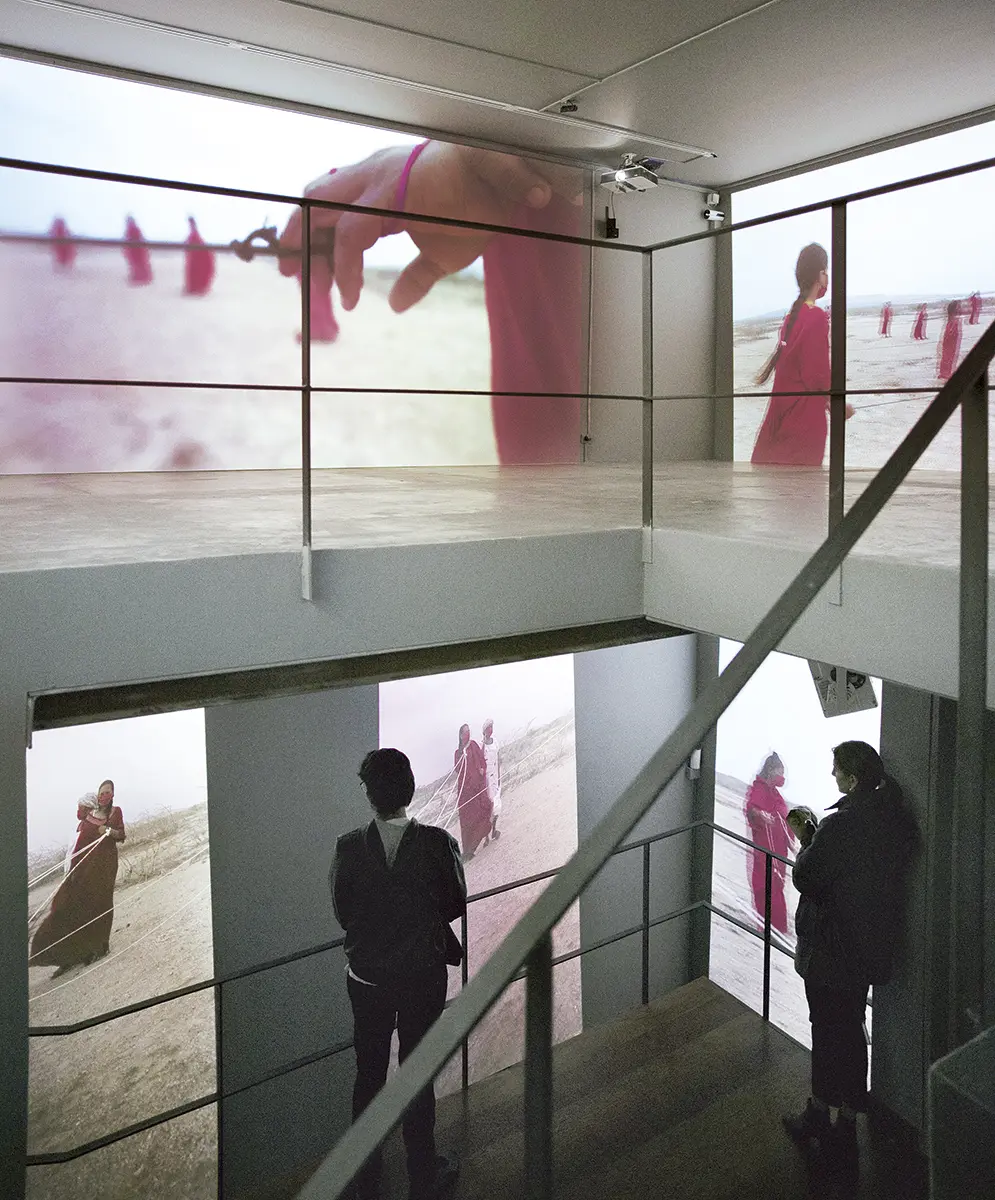
When entering the space, the viewer encounters a video installation with thirteen projections that occupy the gallery’s three floors. Situations and characters follow one another relentlessly. The work bears witness to a decanted reality where landscape, inhabitants, and sounds are in dialogue. The scenes help to reconstruct a displaced memory and cast no doubt that a violent act has occurred here. The images show that the events and the pain are still present; they cannot be deleted.
This work demonstrates how we can approach a memory related to the desert and the wind that runs through it. The ever-present wind—that, according to the Wayúu, brings and takes directions—becomes here a leading sound that accompanies the dances, drums, words, and voices of the surviving women in their red attires, but there is also the deafening noise of the engines of paramilitary trucks that cross the desert heralding death; a boy and his donkey bear witness to their arrival. Clemencia Echeverri’s editing acutely places image and sound into active exchange, giving the wind the prominence of a mythological force that intervenes both in the desert and in the daily lives of this territory’s inhabitants. She was able to go beyond the typical portrayal of the Wayúu as the victims of violence. The handling of image and sound brings us closer to key cultural elements of their everyday lives, such as the meaning of dreams, the presence of midwives who preserve and transmit ancestral stories, and the intention to rescue memories by approaching, with great respect, places where, despite all the violence, a community preserves its traditions and keeps resisting.
NOTES
1. Clemencia Echeverri, Deserere, exhibition catalogue, Bogotá, 2022.
2. Juan Diego Pérez and María del Rosario Acosta, “The Memory of Jepirachi,” in Deserere, Bogotá, 2022.