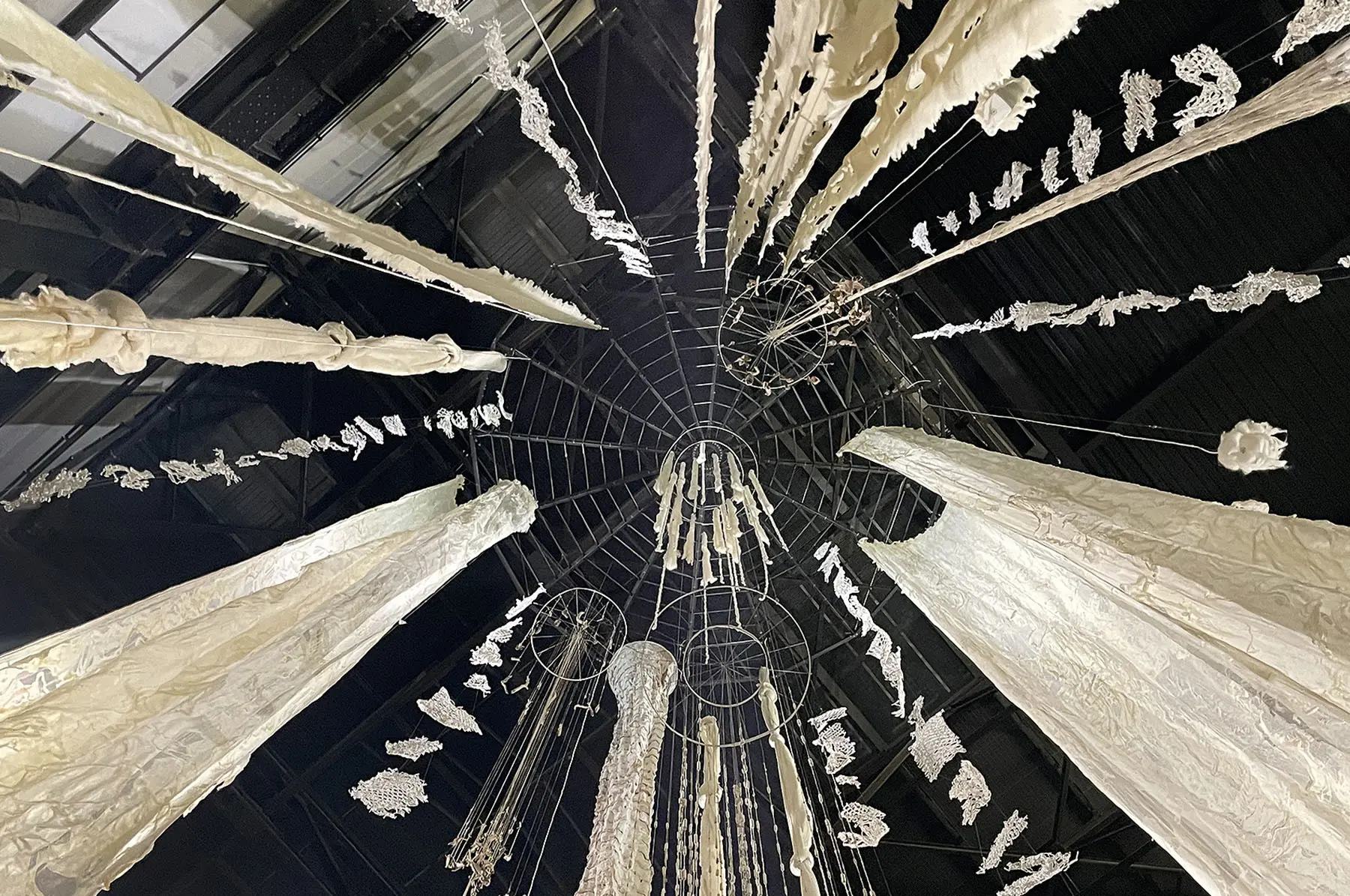
The work of the Chilean poet and visual artist Cecilia Vicuña is characterized by an interest in the fleetingness of existence, the extinction of all matter, and exile. It also deals with issues of memory, language, the living conditions of marginalized indigenous groups, and the natural world. A recent winner of the Venice Biennale’s Golden Lion, Vicuña not only employs ephemeral, recycled and discarded materials in her creative process, but has also placed rituals, ancestral beliefs, eco-feminism, and political activism at the base of her work. With this exhaustive trajectory as its starting point, her most recent project is Brain Forest Quipu, created for the Tate Modern’s Hyundai Commissions, in London. In this multimedia, multifaceted project, Vicuña’s investigation focuses on the symbolism, materiality, and energy of the quipu, the ancestral Andean knotted cord. With the quipu as the core element, she weaves a constellation of visual and political poems about the manifold interconnectedness of existence. Vicuña formulates a series of material metaphors about the codependency of the embodied microcosm and the infinite macrocosm, the oneness of humanity and nature, and the coexistence of the past and of all that died with all that breathes and has life.
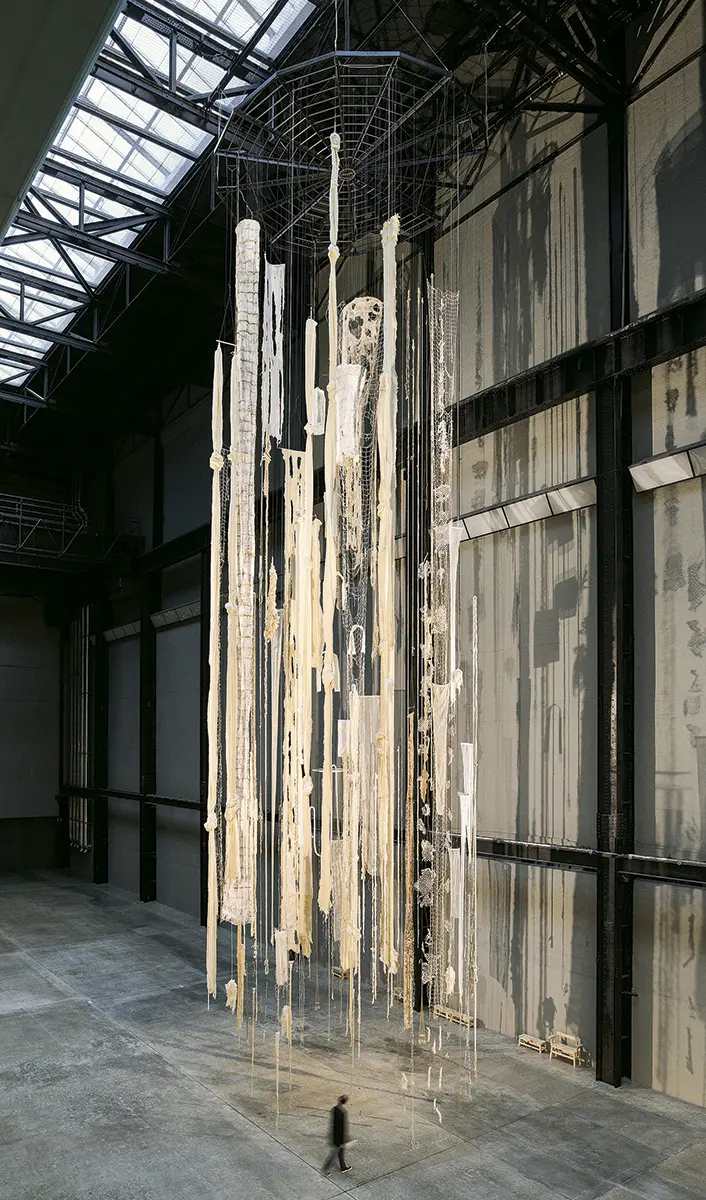
The quipu is an organizational, computation, and communication system rooted in ancient Andean civilization. It is based on arrays of knotted cords, and contemporary archeologists believe it was used to archive calendar information, collect data, and keep records. It is also thought that it may have been used to monitor tax collection, regulate regional governance, and control land use. In other words, the quipu was a device of domination, control, and power. Its precise function and meaning, however, is not entirely known. Against this, Vicuña’s romanticized poetic and artistic interpretation emphasizes the power that these arrangements of knots contain and produce. For her, the quipu is a poem in space, a tactile and spatial metaphor that unites us all and harbors personal and collective imaginaries. Brain Forest Quipu interweaves a series of spatial and temporal quipus in order to formulate a political argument about social injustice, the suffering of indigenous peoples, ecological violence, and the climate emergency.
The first quipu in this discourse constellation is a monumental installation of threads and weavings situated inside Turbine Hall’s overwhelming industrial space. Hanging from the ceiling at either end of the ample gallery, two large, similar-looking circular structures welcome visitors into the exhibition. The cords in these works, which resemble dreamcatchers, are made of the bleached bark of dead trees, and a number of organic items and objects found along the banks of the Thames are tied to them. The possess a spectral character. Additionally, a series of sound quipus are woven into Vicuña’s dramatic installation, with fragments of traditional ceremonial indigenous music and field recordings of nature. The soundscape makes one shudder; it comes across as part of a pagan ceremony filled with whispered incantations and shamanic chants. The third quipu in this web of matter and ideas is the Digital Quipu, comprised of video recordings of indigenous activists who use digital platforms to communicate their message. The final component is the Quipu of Encounters, or “action knots”, which weaves rituals, performances, and global events with activists who struggle to defend the planet’s vital ecosystems and its indigenous communities.
Latin American art has often used indigenous elements of a pre-Hispanic origin as a validation resource and a passport to the West. Her deployment of identity elements from the Andean region and her “return to roots” suggest that Vicuña is continuing with a Latin American quest for an identity rooted in non-Western traditions. On the other hand, there is a clear tendency in international contemporary art towards subjects like esotericism, occult and pagan practices, rituals and spirituality, and Vicuña’s work also connects with a postmodern aesthetics intent on making art ephemeral. Transported from the pre-Hispanic era and the context of the indigenous cultures of the Andes, here the quipu is presented to contemporary publics in one of the West’s most relevant centers of power. The results of its resignification in this context must be problematized.
From a more positive standpoint, nevertheless, the quipu becomes a powerful poetic, artistic, and political instrument. Through objects, sounds and words, images and rituals, the quipu joins viewers with their ancestors and forebears. It reminds one of the inescapable fact of a planet inhabited by a multiplicity of subjects, and that all actions have consequences. In this web of metaphors sculpted in time and space, the quipu connects the mind with nature and the body with the land, while the spirit communes with the cosmos. Ultimately, the weaving that results from this series of quipus is a kind of ceremonial revelation; it raises awareness about the climate crisis, the damage to the ecosystem, and the violence exerted on indigenous peoples. The final message is that the Earth is a thinking, feeling, imagining, desiring forest. The Earth, which lives in synchrony with the breathing of our bodies, is comprised of quipus that produce energetic and emotional crossroads, and interconnect existence.
PAULA ZAMBRANO PH.D.