The Rothko Chapel, which opened in Houston, Texas, in 1971, was built for the contemplation of a series of murals by the American artist Mark Rothko. Visitors entering the chapel encounter a nondescript space containing large murals in dark, deep colors. They are immersed into large layers of color and light, and contemplation, quiet, and stillness give rise to an emotional and spiritual experience. Visitors to Bruma (Haze) Beatriz Gonzalez’s exhibition at Fragmentos will have a similar immersive and contemplative experience, one that, by connecting with the physical space of the gallery, goes well beyond the visual aspect.
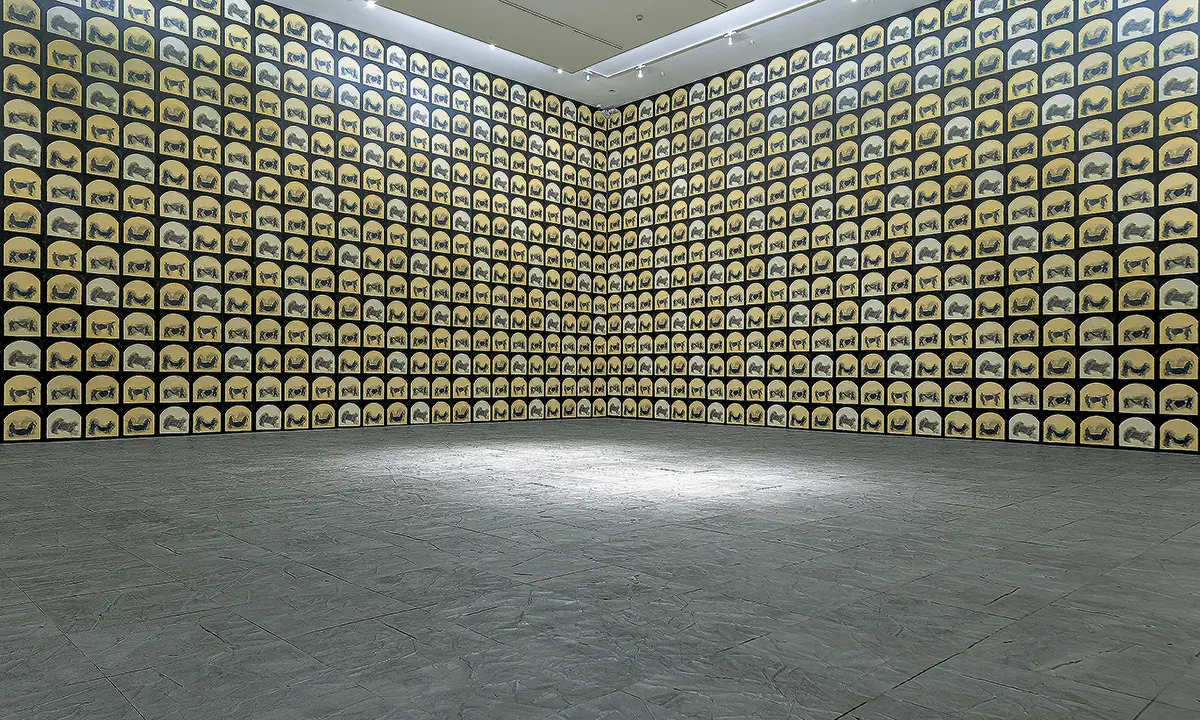
Bruma’s run at Bogotá’s Fragmentos, Espacio de Arte y Memoria, extends from September 15, 2022 through July 16, 2023. Curated by María Belén Sáez de Ibarra and presenting the Colombian artist’s most recent proposal, the show is comprised of two key sections: first, more than twenty paintings and six sketch books on display in an exhibition room and a hallway, welcoming visitors as they enter; then, A posteriori (2022), a large-format installation where the artist transposes her well-known images of cemetery workers from the stone of the columbaria of her Auras anónimas (Anonymous Auras, 2007-2009) onto wall hangings covering an imposing interior space in its entirety.
Here more than ever we see González’s fixation with repetitiveness. In A posteriori (2022), viewers find themselves submerged, as though inside fishbowl, in a room covered by yellow wallpaper, with small repetitions of an image we are well acquainted with since those columbarium workers. The small black niches framing the silhouettes of those corpse-transporting men form a visual sequence. The figures appear in different poses, lightly blurred. Some seem to be moving forward with the heavy load of the bodies they carry; others look defeated by it. The scale is small, forcing viewers to get close in order to make out the meaning of the haze of images.
The silhouettes are recognizable for viewers familiar with González’s work, but—as is also the case in the Rothko Chapel—their arrangement in this space prompts us to pause, contemplate and reflect. The paper overwhelms our visual field and, more than an extending invitation, forces us to connect with the image of violence and suffering by which we find ourselves surrounded. As curator María Inés Rodríguez points out, “repetition in González’s work is an act of deceleration, of resistance to immediacy and consumption, an openness to the contemplative.”
The Funebria series (2019-2021), which visitors encounter in the first section of the show, serves as a preparatory stage for A posteriori (2022). The series derives from news reports describing the 2019 discovery of mass graves with the remains of “false positives” in the Las Mercedes cemetery, in Dabeiba, Antioquia. These medium-format paintings depict diggers (Enterrador de Barranca [Barranca Gravedigger], 2019) and farm workers who excavate the land not to cultivate it, but to find the remains of young people killed by the Colombian army. Here, González repeating silhouettes demarcate an action, excavating, but, viewers will find that unlike those in Auras anónimas (2007-2009), these become blurry and indistinct against blue and green grounds, for example in Panorámica agreste (Rough Panoramic, oil on canvas, 2021). This technique creates a sensation of movement, transience and fugacity. It also gives viewers feelings of mystery and bewilderment, as the figures appear to be in the process of vanishing, consumed by landscape an oblivion.
Lastly, on the side of the hallway that leads to the A posteriori (2022) installation, viewers find a series of reproductions. A cabinet displays notebooks and loose pages with the various approaches and variations tried by the artist in order to arrive to the figures of the cemetery workers and the field diggers. González insists on the idea of repetition and on her attempt, through it, to shake and disrupt the viewer. In her work, the act of repetition becomes an instrument to explore collective memory and a kind of resistance to oblivion.