The exhibition “Schhhiii…” brought together more than fifty years of artistic production in Argentina’s first panoramic exhibition of the Brazilian artist Anna Maria Maiolino (Scalea, Italy, 1942). Just over two hundred works include paintings, drawings, woodcuts, sculptures, photographs, films, videos, sound pieces, and installations made from the late 1970s to the present. This show is an adaptation for the MALBA of the one presented between May and July 2022 in São Paulo with the title “PSSSIIIUUU…”. Here a double reading is evident: the signal for silence and a call to seduce; an ambivalence highlighted by curator Paulo Miyada, who stresses that it “is a constant feature in Maiolino’s production.” The temporary exhibition hall gathered the result of three years of curatorial research aiming to propose Maiolino as a milestone in Brazilian political art, an aspect of her work that is rarely discussed by critics. The show was curated under the concept of a spiral so as to eschew linear chronology and reveal “the experience of a wise narrator of existence, care, desire, sorrow, and pleasure; the “circular nomadism of an immigrant with many nationalities—or none,” as Miyada defines it.
It features three nuclei: Anna, where life, biography, desire, and multiplicity converge; No, no, no, with works that confront totalitarianism, censorship, repression, and inequality; and Acciones matéricas (Material Actions), where certain atavistic gestures involving daily shores that relate to the beginnings of human production—such as pressing, molding, cutting, grasping, draining, and rolling—are explored through the use of materials like clay, paint, glass, or concrete.
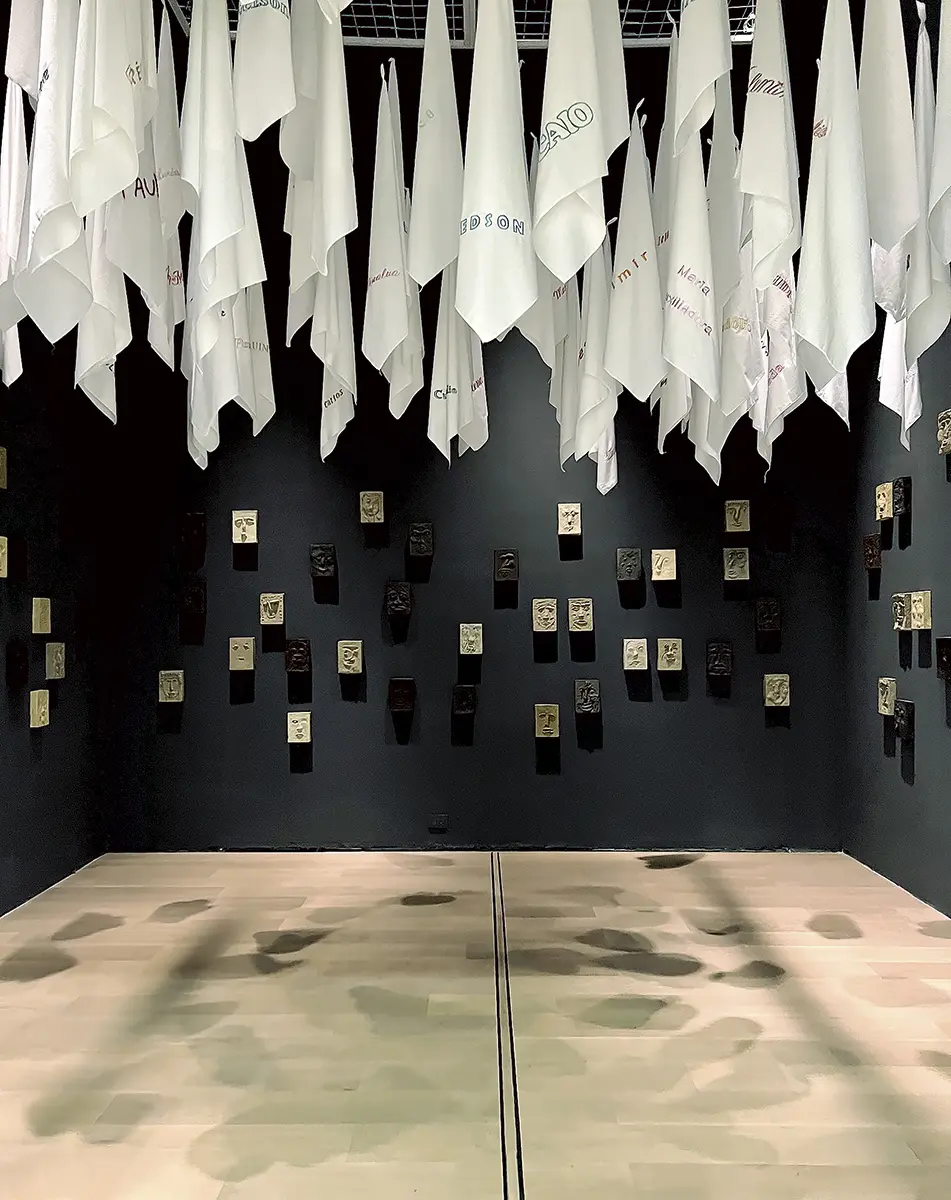
Recently, the artist gave an amicable talk at the museum and spoke of a dividing line between pieces produced before 1993 and those produced afterwards. The works made in the 1960s are based on the discovery of tactile interrelationships. They prove to be very artisanal studio pieces, especially the drawings and engravings that recount an almost domestic and personal experience. They differ considerably from the creations of the 1970s, when she incorporated new media, such as Super-8 films, videos, installations, performances, photography, poetry, and sound, and focused on the outside world. In the period between 1984 and 1989, after settling in Buenos Aires, she experienced first-hand the so-called “Democratic Spring,” including the Juicio a las Juntas (Trial of the Juntas) in 1985. Maiolino agrees with the curator, who detects a visceral approach to the political question during that period; proof of this is the great installation Las Locas (Madwomen: Making Love Revolutionary) in homage to the Madres de Plaza de Mayo (Mothers of Plaza de Mayo), where handkerchiefs—emblems of the search for truth and justice for those who disappeared during the dictatorship—dangle from the ceiling, while ceramic square molds of barely sketched faces hang on the walls, as if blurred by time and resembling the ground of the historic square where the mothers did and still do their rounds every Thursday.
Anna Maiolino described her series Esculturas Modeladas (Modeled Sculptures), begun in 1993, and Terra Modelada (Modeled Earth), begun in 1994, as well as the drawings Marca de la Gota (Mark of the Drop) and Codificaciones Matéricas (Material Codifications), from the same year, as the “preliminary process of a poetic language that accommodates opposites, such as light and shadows; order-disorder; composition-decomposition; the one and the many; the whole and the fragment; lines and dots; finite-infinite.” Molded by hand and aiming for repetition and a certain principle of uncertainty since they are not easy to understand, these pieces offer different layers of meaning. An unplanned path or a level of pre-expression frees the artistic process of too much control. Its rhizomatic growth entails a differentiated and polymorphous drift in each of these works. In a corner of the room, towards the end of the show, an installation stands out: Terra Modelada (Modeled Earth), comprised of a table placed diagonally, full of clay forms resembling edible things, and related to a wall where pieces of the same red clay, embedded in a weave of metallic fabric, seem to grow in various directions.
Titles are generally not symbolic and do not clarify the meaning of her works; some indicate or name the procedure with which they were made. At her talk, Maiolino explained that she also uses “mathematical terminology such as ‘more and less’; ‘plus these’, ‘more and more’, ‘there are two hundred,’ or adverbs such as ‘here and there’; ‘now’; ‘before or after.” In addition to the relationship between space and number, time is variously inserted in her works. An infinite time that, according to her, “remains as a desired destination,” although inaccessible, imperfect, disproportionate; for this reason, only finitude can be the architect of her pieces.