Lived experiences are remembered based on priority. Stating that emotions and consciousness give shape to the way in which we remember things, Wanda E. Ramos Baquero, in La (re)invención de la memoria (The (Re)invention of Memory, 1996), reveals memory as an attempt to render the object tangible. This is to say, memory is transformed into an individualized process, wherein an intra-personal method makes inter-personal relationships possible. A visit to the art exhibition “Swimming Where Time Was” puts one in mind of that text. This show manufactures a large-scale perspective—at times abstract, as in One Hundred Dreams from Now (2022), at times realistic, as in When Sunny Gets Blue (2022)—of artist Ángel Otero’s (re)invented memories. By means of vibrant colors, textures and (re)found objects, the exhibition takes viewers to emotions that Otero (San Juan, Puerto Rico, 1981) experienced in childhood, without falling into extravagant stories or fallacies of privilege.
Otero’s first large solo exhibition was open to the public between November 10 and December 23, 2022, in the fifth floor of New York’s Hauser & Wirth gallery. The artist’s technique involves first painting the foreground on Plexiglas and then transferring it onto canvas, often incorporating reliefs. This exhibition featured eight such untraditional paintings. The series was created in its entirety in 2022, taking as its starting point an older work from ten years ago.
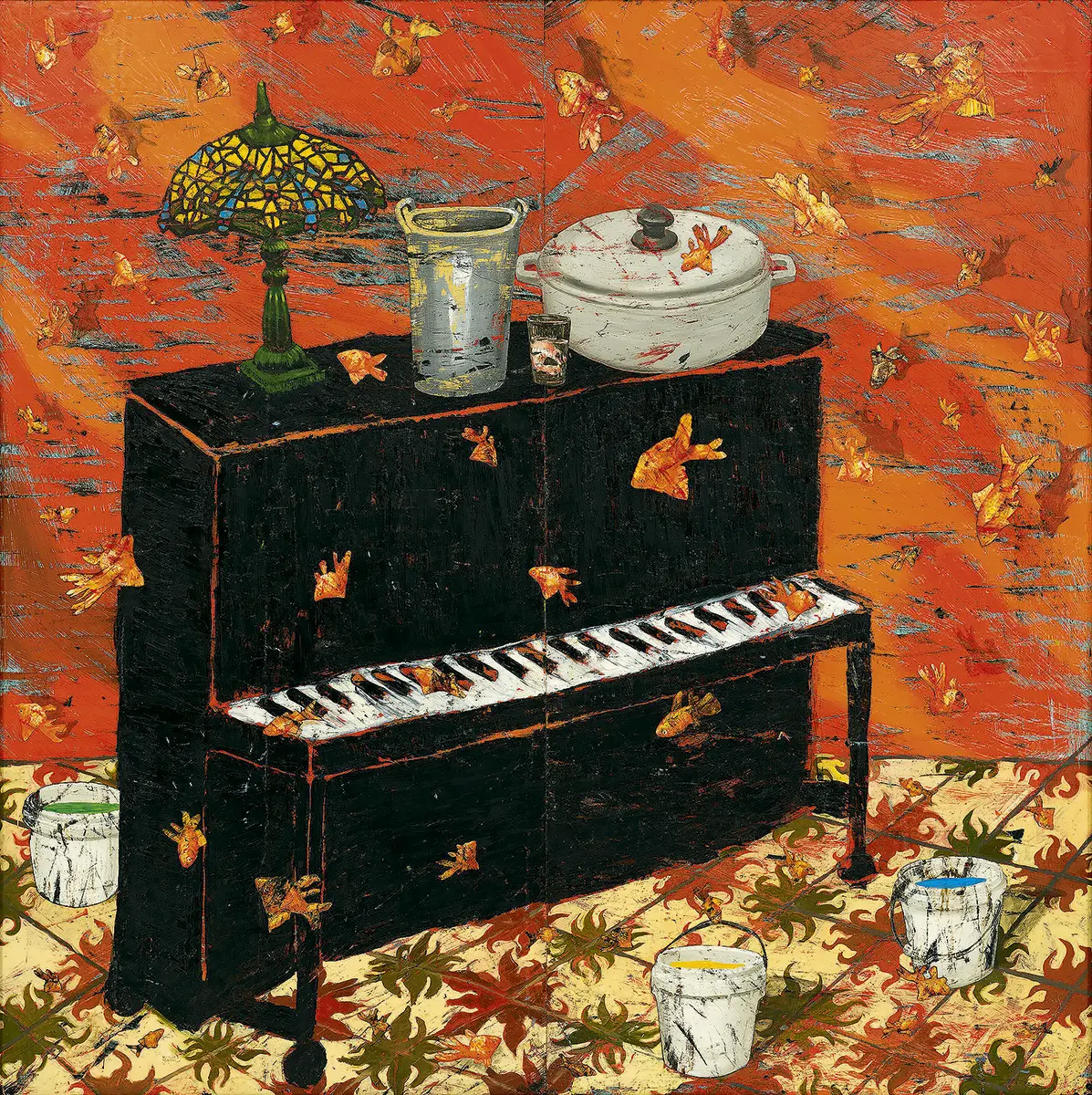
Otero gestures towards his family, especially his grandmother, and the values surrounding it in Concerto (2022). The private memories presented in his paintings retain a romantic tone and are used as a springboard instead of being reproduced photographically. Otero’s distorted images are full of poetic ambiguity. Starting with the floor tiles, so popular in Puerto Rican architecture, all the way to the large cooking pot where rice, a basic local staple, is commonly made, we are presented with an appreciation of and a tribute to vulture on the part of the artist. Space is traversed by unreal fish tornados, a recurrent motif in Otero’s work, inspired in remembrances of home.
This painting illustrates the contradictions of the social class it represents. The water buckets on the floor are a comment on the instability and fragility of the inhabited space. They describe the sequels of the Caribbean region’s frequent hurricanes and downpours. In their anachronism, such buckets can also be found in Otero’s actual studio. In the work, the room is built around its protagonist, the piano, also present in one of Otero’s studios. On the piano stand a couple of objects, among them a Tiffany lamp, a must-have in many Puerto Rican homes (even if they are often knock-offs.) This lamp also signals in the direction of La lámpara Tiffany (The Tiffany Lamp), from 1975, one of Puerto Rican artist Myrna Báez’s most celebrated works. We also see a glass holding Otero’s grandmother’s dentures, a characteristic curio from the artist’s childhood.
Behind Curtains (2022) is set inside a dark-green arch. The space is divided by a white curtain in lace, using a bobbin technique. In Puerto Rico, this handcraft skill is transmitted from generation to generation, with Moca, a town in the country’s western coast, christened “lace capital”. In the painting, in front of the curtain, we find a wooden tub containing a series of brown objects, including a chair with a white cube. The element of the chair may be a reference to Otero’s sculpture The Enlightenment (2010). The dimensions and location of the objects inserted in the painting contradict reality. Behind the curtain, the tile floor intersperses black and red hues. There is a table with a blue tablecloth and a red flower in a flowerpot. Towards the back, the wall flashes a bright yellow. Meanwhile, the ceiling features purple and wine-colored hues. Otero works with complementary colors, which contribute balance to his discourse. His horror vacui and his obsession with textures bring to mind Tomás Ybarra-Frausto’s theories of rasquachismo.
Our perspective on a given event will adjust our remembrance of it. The key debate is not between truth and falsehood. Narrative is essential, but imperfect; lived experience survives neither memory nor its expression. Autobiography becomes vital for memory to exist. Priorities can be (re)invented and (re)organized based on new events and new perspectives; in consequence, memories can be (re)created. Seemingly based on a dream world, Otero presents objects and their contexts artistically. The exhibition awakens its visitors with a profound, warm embrace. Otero narrates (re)invented memories.