Andrés Orjuela gained international renown in the last decade with his series Archivo muerto (Dead Archive), based on what remains of the photographic archives of El Espacio, the last of the nota roja newspapers—publications specializing in the sensationalistic coverage of crime and violence news—that circulated in Bogotá in the second half of the twentieth century. Discarded as garbage and picked up by street recyclers, those archives had been sold almost in their entirety as scrap paper. A few photographs were salvaged in the hands of a handful of collectors, and an even smaller number was given to Orjuela, who blew up the original and illuminated it manually, selecting images that are typical of the genre: crimes, beatings, apprehended criminals, and so forth—sadly, still a contemporary set of images, a colored version of the past that recreates the viciousness of the world today as much as then.
Among those of us familiar with Orjuela, there was intense expectation to see his next steps after the success of Archivo muerto (Dead Archive); he has taken them now forcefully and convincingly, with a double exhibition of the results of a period of feverish creativity he experienced in 2022. During the early portion of that year Orjuela produced more than eighty works, which he presented simultaneously in the renovated venues of Galería La Balsa in Bogotá and Medellín, and titled Under the Mask. In these works, Orjuela deepens his already extensive exploration of the conflict between good and evil, criminality, the representation of violence, the uncontrollable, the inevitable, and, in essence he complexities of the human psyche.
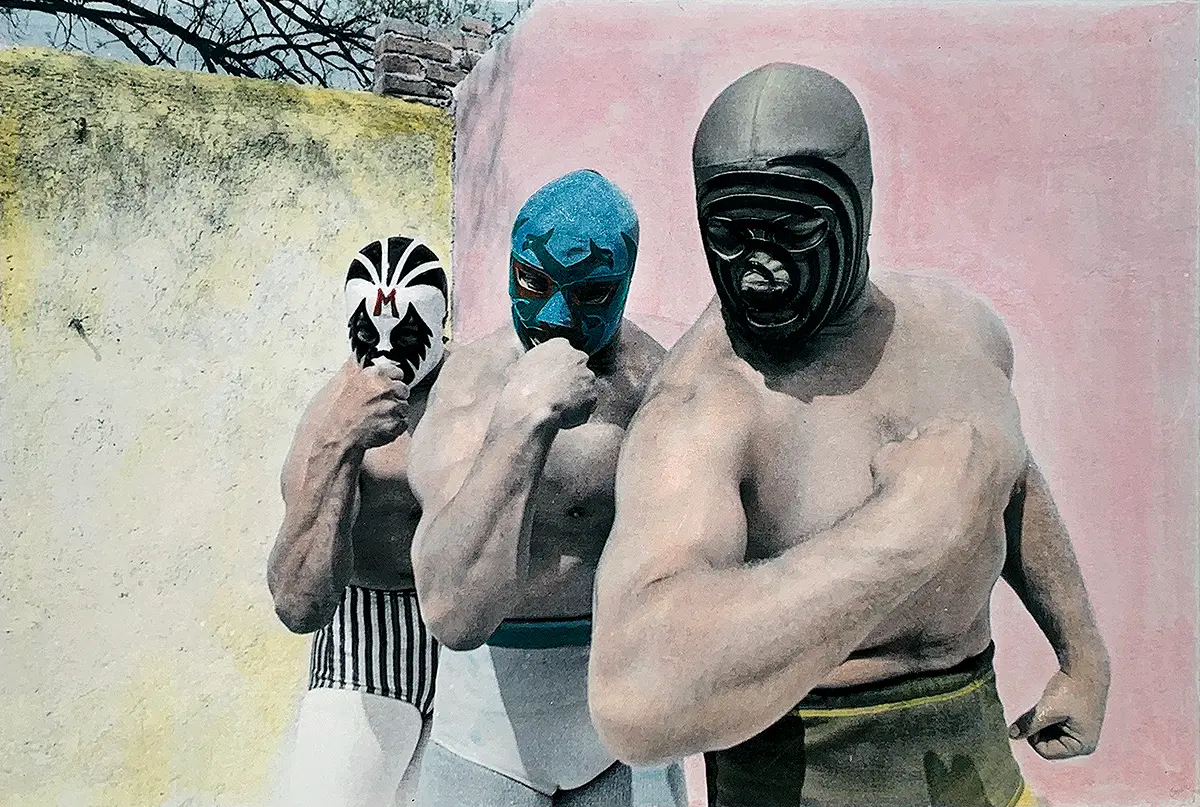
The trigger and starting point is once again the archive, or in fact, several archives, as Orjuela used more than one. He found the first of these, the one that gives the exhibition its general title, in an antiques market in Mexico City. It is the photo album of an initially unknown lucha libre performer whom the artist later was able to identify as “Mil Máscaras” (A Thousand Masks), the protagonist of several movies during the golden age of Mexico’s lucha libre cinema. As in Archivo muerto (Dead Archive), Orjuela blew up and illuminated the originals, in this case in order to emphasize the great symbolic power lent by the mask to a semi-nude athlete. The exaggerated, ambivalent poses struck by the wrestler and his companions in photographs where masks and costumes are not devoid of a certain sensuality, are shrewdly and even humorously captured by Orjuela; as Jorge Alberto Palomino says about this series, “we can’t really tell whether the photos are for a wrestling show or for a dating app.”
The second archive, directly related to the first one and the source of works like El cobarde–Adorable Rubí (The Coward–Adorable Ruby), El Nazi–León negro (The Nazi–Black Lion) and Marcus–El indio (Marcus–The Indian), is another personal photo album, in this case of a lucha libre fan. Acquired in a flea market, the volume comprises press clippings, advertisements, and autographs of wrestlers, likely obtained in wrestling arenas. On selected pages, Orjuela inserts, collage-like, images and texts from La historia general de México (The General History of Mexico) and Alarma magazine, the latter a veritable nota roja institution he had previously used in his series Muestrario (Sampler, 2012). By combining these sources, the artist establishes connections between heroic archetypes, machismo, popular culture, spectacle, crime, and tragedy. The images tell a story of Mexico’s past and present as a country cowed by the monstrous figures of drug trafficking capos, but also come across as a tribute to personal mythologies, to subjective and collective aspirations, to private aesthetics and childhood dreams that refuse to die.
To this investigation into libido and Thanatos, visual and eschatological fascination, desire and terror, but also into delight and admiration, archive fever, and personal albums, Orjuela adds another set of works, one that engages in a more general consideration of that which hides behind a mask. Based on a third archive, Antiguos posters de cine (Old Movie Posters), and also acquired in his explorations of Mexico City flea markets and intervened with oils and gold leaf, this set is devoted to classic horror films and its unforgettable icons such as Frankenstein’s monster, Count Dracula, the vampire woman, The Mummy, The Werewolf, Gorgo (a version of Godzilla), and also to Mexican cinema’s articular contributions to the genre with its lucha libre heroes: El Santo, Blue Demon, and Las Luchadoras, to name but a few.
The show closes with silkscreen prints and paintings that combine the iconographic sources mentioned above, masks of Mexico’s recent presidents, and phrases gleaned from philosophical works, like “A specter is haunting Europe,” the start of Marx and Engel’s Communist Manifesto, printed on walls in the characteristic typography of horror film advertisements. It is an extended tribute to Mexico’s popular culture, to its everyday dynamics; in sum, a personal diary by a Colombian artist who has lived in Mexico for over a decade, and who has examined the communicating vessels between the two countries.