Ana Tiscornia (Montevideo, 1951) presented her recent production in the new spaces of Galería Nora Fisch, under the title of Una y otra vez (Time and Again). With references to architecture and to the home, the selection of works included diverse materials: paper, cardboard, construction supplies, clay, wood, paint, photographs, and concrete, among many others.
Occupying rooms 1 and 2 of the gallery’s ground floor, the works on exhibit alluded “Time and Again” to one constant in Tiscornia’s oeuvre: displacement, oblivion, loss, and different construction cycles.
Tiscornia’s works are characterized by the way they bring together heterogeneous materials. They could be described as vestige art for their use of remainders, things found, things shed, residues, refuse.
That which remains carries with it the mark of the past. Indeed, Tiscornia has developed a unique way of thinking about the salvaging of a bygone past, centered around the construction-destruction sequence, followed in some instances by reconstruction. In the construction phase, she explicitly shows the relationship between art and architecture; in the interstices of the sequence as a whole, she unveils, subtly, a number of questions about the contemporary world.
The installations that visitors encountered first in each of the two exhibition rooms provoked the feeling of being inside a home, specifically in a living room: a green wall, a cactus on its pot, and a painting by a corner. These images contrasted with the works displayed around them, which, while resembling architectural blueprints, alluded to demolition, which created a tension based on the calm/chaos binary.
The clipped fragments of blueprints seen in works like White flag suggest new floor plans that connect and disconnect outside any discernible structural logic. We catch glimpses of staircases, walls, superimposed wallpapers, giving shape to an idea of ordered chaos. The abstract shapes formed by the clippings and cutouts are anything but random; Tiscornia’s aesthetic inquiry has long explored an affinity with the synthetic sketches of architectural draftsmanship.
The technique of collage allows Tiscornia to plot lines and planes, bringing drawing into relief as she outlines the geometric shapes of a potential construction schema. Two powerful, early motivators drove her journey: the construction of a house next to hers as a child, which she witnessed step by step, and the blueprints prepared by her architect uncle. Later on, still in Uruguay, these factors even motivated her to study architecture.
It bears noting that architecture is twice present here: as a theme in the works themselves and in the arrangement of the exhibition area, where Tiscornia proposes—in the manner of a site-specific installation—an inhabitable space, a site of belonging and a container of memories.
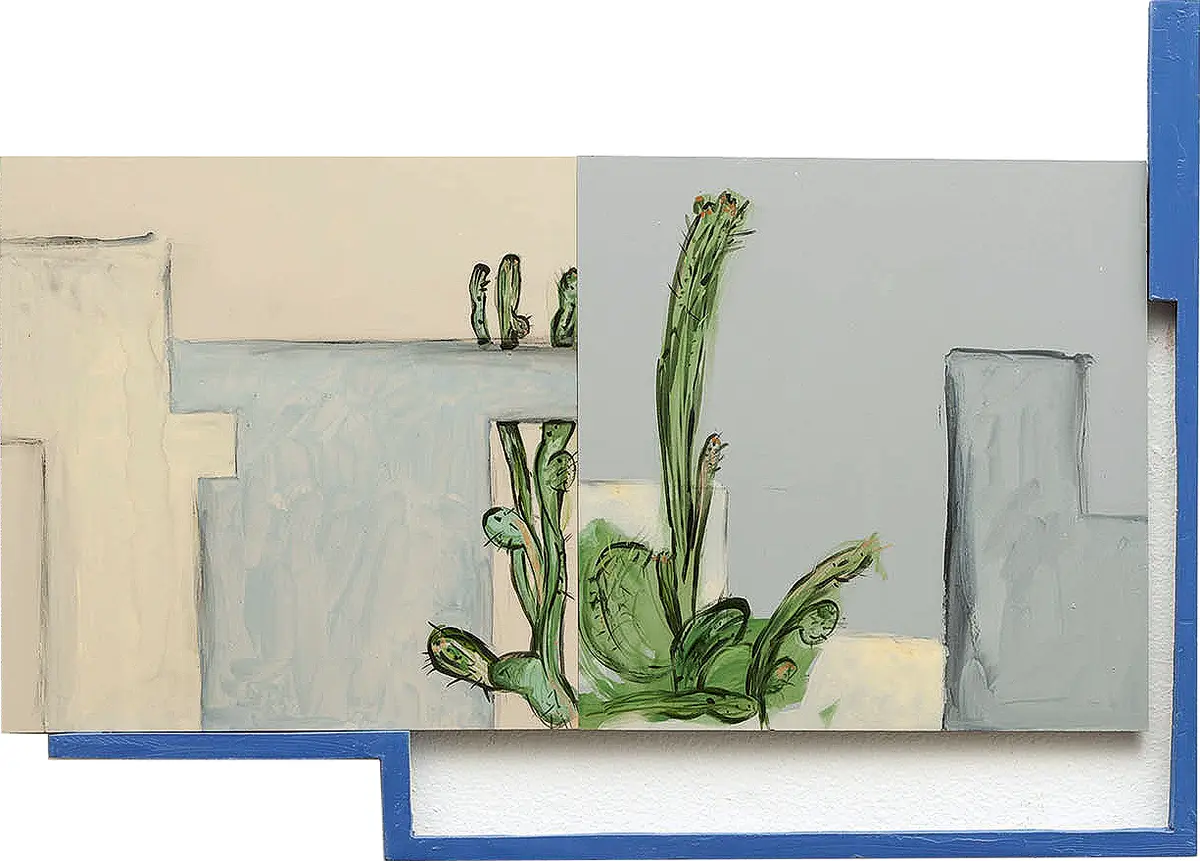
Another standout is a group of works with flat backgrounds and trimmed frames that create a collage on their own on the wall, in the shape of a cactus that dialogued with the installations at the entrance to the rooms that contained it.
The figure of the cactus can be interpreted as a symbol of survival in the least favorable conditions. In times of war, uncertainty and precariousness, it prompts us to question the extent to which human beings can continue to live off what remains.
This theme emerges in Tiles, a series of photographs intervened with concrete. They represented mosaic floors, bureaucratic constructions, urban landscapes, living spaces now abandoned or rendered uninhabitable. Although dominated by the idea of decay, they imply the notion of repair, thanks to the addition of a basic building material.
The recognition of Ana Tiscornia’s work—who received the Konex Mercosur Award in 2022 alongside Alfredo Jaar and Rosana Paulino—continues in De este a oeste y de norte a sur (From East to West and From North to South), an exhibition at Parque de la Memoria’s PAyS gallery, a space curated by Argentine Association of Art Critics’ president Florencia Battiti. This exhibition ran in parallel to the one at Nora Fisch, featured similar materials and followed a comparable conceptual and aesthetic orientation. It alluded to an uncertain world that oscillates between the construction-destruction and past-present poles, to which it also added the ambivalent relationship between art and architecture.
The show at Parque de la Memoria emphasized the idea of destruction by means of a wall forcefully broken through, with debris strewn around on the floor. At the same time, the idea of an inhabitable space emerged in the image of an interior living room. The utopia of survival floated between these two opposite situations, with a group of cactuses on terracotta pots and concrete blocks enlivened by mosaic tiles.
“Searching for some kind of poetic construction in the midst of a catastrophe is perhaps the only hopeful gesture available to me,” Tiscornia says.