Post-apocalyptic, end-of-the-world ideas have permeated the universe of cinema; if we were to enumerate the movies that exists on the subject, the examples would be myriad. In the visual arts, however, works dealing with such materials are encountered much less often. El fin de la imaginación (The End of Imagination), an exhibition by Adrián Villar Rojas and Mariana Tellería, is one such rare instance: it focuses on a post-apocalyptic world, with the remains of civilization scattered around other planets.
Villar Rojas (Rosario, Argentina, 1980) is known for this kind of large-scale installation, and to create these works, commissioned by The Bass Museum, he repurposed elements from previous exhibitions. Two works by Tellería (Rufino, Argentina, 1979) are also part of the show. These two Argentinean artists, members of the same generation, adopt similar positions about their shared concern.
Curated by Silvia Karman Cubiñá and Leilani Lynch, the exhibition is arranged in three rooms. The first, at the entrance, contains a single work. It consists on a refrigerator with its freezer door open and its light on, and a cake inside. A dead dinosaur, some trees, and two candles forming the number eleven decorate this cake. It resembles a mountain made of dirt and rocks, atop which those elements sit. In a way, the scene is a representation of a before and after for humanity, between the dead dinosaur and the barrenness of the eroded “landscape”.
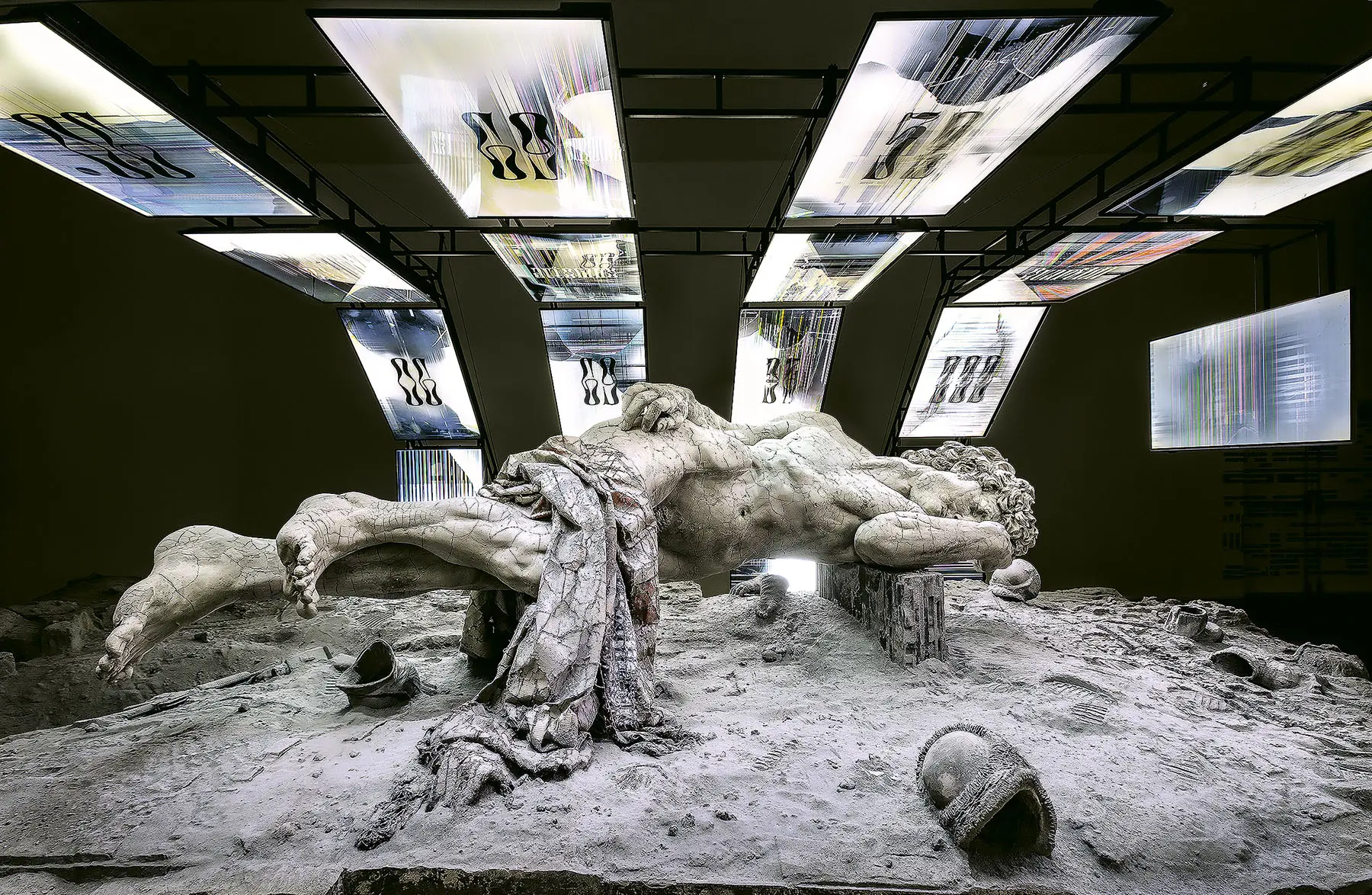
The second room features a large-scale installation representing a scene on the Moon. Here we encounter a David sculpture toppled onto the type of sandy ground we see in all lunar images. The footprints on the ground are, like the sculpture, of human origin, the imprint of boots and other traces of human passage on a now-abandoned site. Above the sculpture is a kind of fragmentary roof with screens projecting calendar symbols.
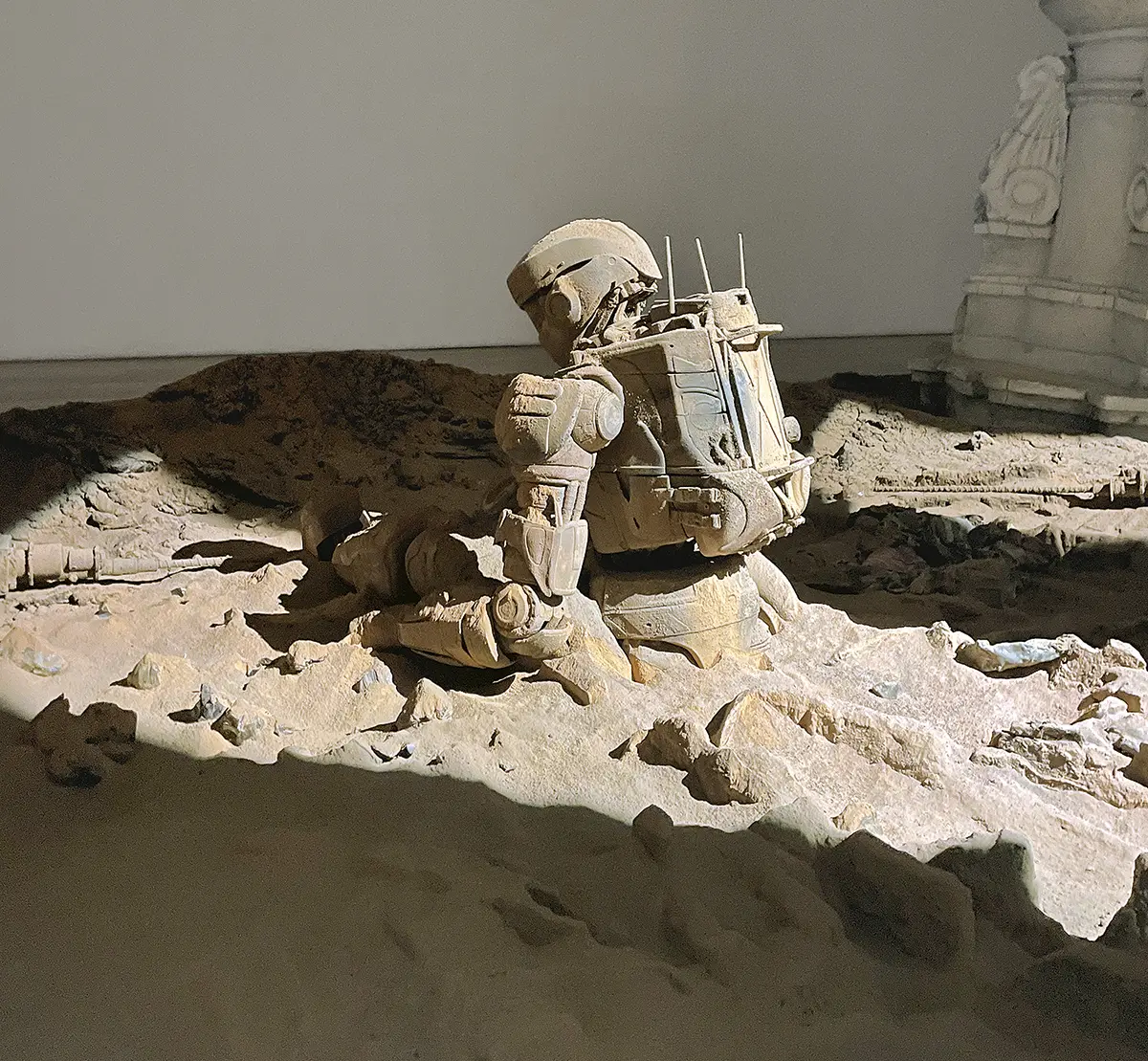
The final room represents an imaginary Martian landscape. This is the largest installation and features the work of both artists. Here, the ground is reddish in color, an allusion to the characteristic image of Mars’ surface and a resource widely used in film to identify the planet. At the entrance to the room are two works by Tellería: one is a replica of the eternal flame at the National Historic Monument to the Flag in Rosario, Argentina; the other is a bronze plaque, similar to those used for funerary purposes. Inside the room is an equestrian sculpture, and next to it, a robot. The rest of the scene is taken over by a variety of elements alluding to interplanetary travel and human intervention in other planets. Among these are a vehicle made from parts of rovers used in interplanetary exploration, a robot dressed in a characteristic outfit, and various traces left by vehicles and shoes. The room’s dim lighting contributes to create the feeling of being in one such imaginary place.
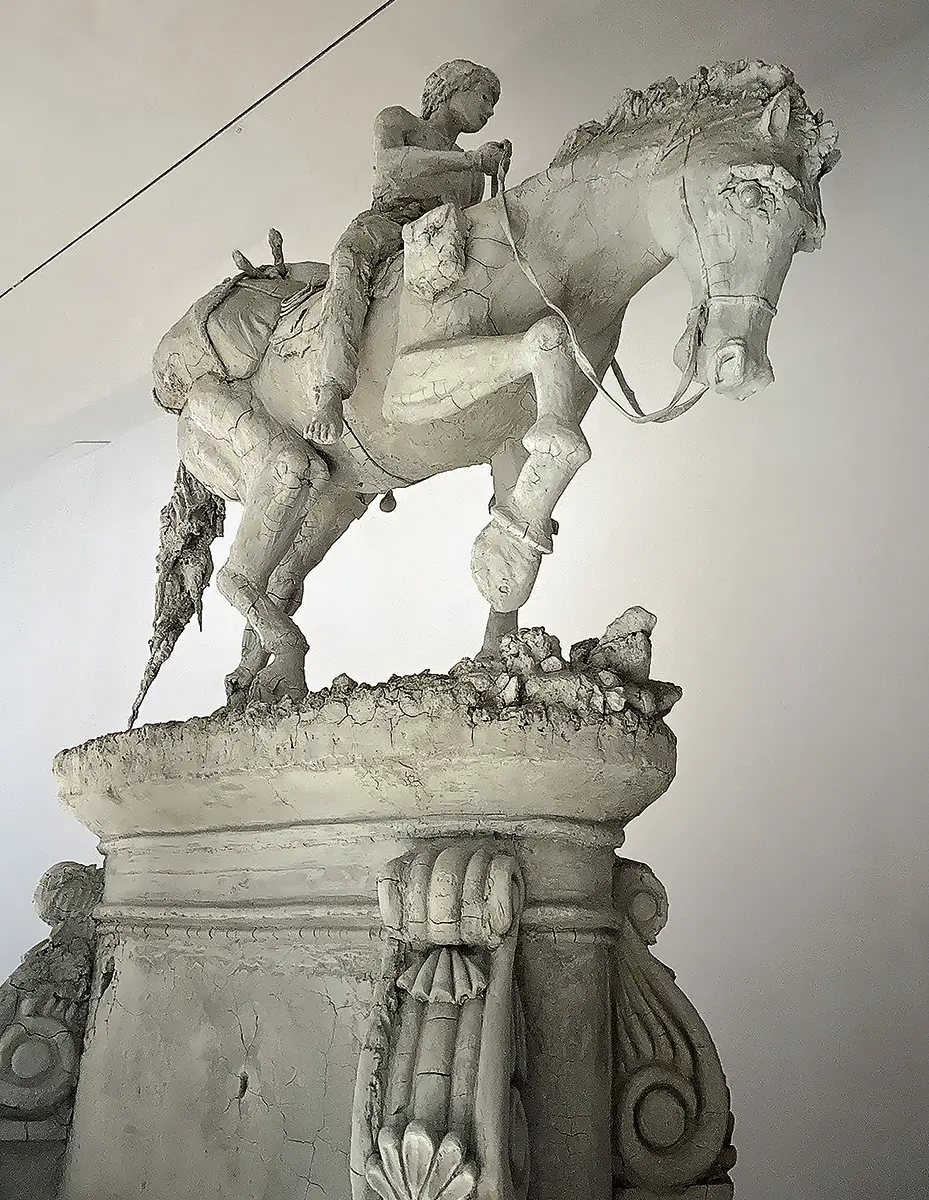
Both installations immediately put one in mind of the possible consequences of a human conquest of other planets in a post-apocalyptic time. We are presented with an imaginary future after intergalactic expansion, represented through a mix of historical, cultural, social, political, and technological references. The complex symbolism on display in the show is an amalgam of the past, the present, and the future, which the artists use as a medium to consider how Earth’s history may be perceived after the Moon and Mars are colonized. Their critical use of established symbols of power prompts us to reflect about their future equivalents, how they may be interpreted, and what capacity may they have to endure over time. Will they have the same memorializing form, erected as monuments to personalities of a given era? Will they meet the same fate as those on Earth after a revisionist process? Which ones will survive, and how? Will they be similarly toppled and condemned? Whole concerned with something seemingly far into the future, these questions bring to the fore historical and sociological issues in contemporary society that have the power to impact the course of human civilization.
There is a strong stage-like element here, undoubtedly based on widely accepted cinema images, as several of those pre-established notions are used to recreate the planets. One of the goals of this show is to provoke a critical reaction to historicism, to the selection and celebration of certain events through monuments, and their role in the creation and sustainment of memory for future generations.
IRINA LEYVA
Art Historian, Founder Newcastle Art Consultants